What you actually find in Kritsa’s back country
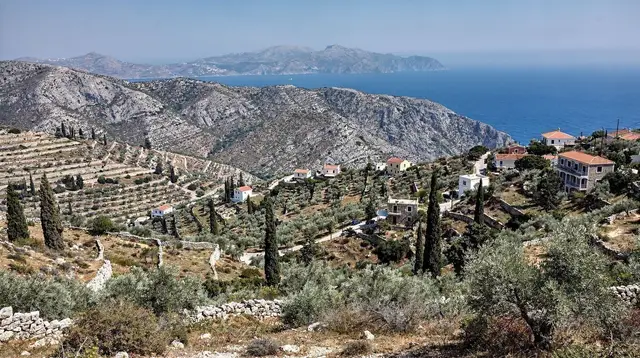
Most visitors to the Lasithi region never get past the coast road that links Agios Nikolaos to Elounda. That is a reasonable choice: the water, the boats to Spinalonga, and the restaurants along Lake Voulismeni cover most of a holiday on their own. But turn inland for twenty minutes and the landscape changes — olive terraces climb the hillside, the road narrows, and Kritsa appears stacked against the slope below the limestone ridge that separates the coast from the Lasithi plateau.
Kritsa is one of the largest traditional villages left on the island, and it has kept a working weaving trade that most coastal resorts lost decades ago. Looms still sit in doorways along the main lane, and the lace and woven bags sold here are, in a good number of shops, actually made on site rather than trucked in. A few kilometres further along the same road sits Neapoli, a market town that most tour buses skip entirely because it has no headline sight — which is exactly why it is worth a stop if you are passing through.
Neither place should be oversold. This is not a monument on the scale of Knossos or a landscape on the scale of the Lasithi plateau just up the mountain, and it is nothing like the fortress island of Spinalonga sitting in the bay below. Kritsa is a village you explore on foot for an hour or two — narrow lanes, a scattering of churches, a view back down over the gulf of Mirabello — not a site with an entrance gate and a ticket booth. Go in with that expectation and it earns its place on an itinerary; go in expecting a headline attraction and you will wonder why you drove up.
Getting there: why the KTEL is not the answer
The KTEL coach network covers the north coast highway between Chania, Rethymno, Heraklion and Agios Nikolaos with genuine reliability — see our guide to KTEL buses in Crete for how that trunk route works. Kritsa sits off that trunk, in the hills above Agios Nikolaos, and the connection is thin: a handful of runs a day at best, timetables that shift with the season, and a stop that leaves you to walk uphill into the village centre. It is not a route to plan a day around.
A rental car solves this in one move. The drive from Agios Nikolaos climbs steadily for about ten kilometres and takes twenty to twenty-five minutes on a paved, well-marked road — nothing like the dirt track out to Balos on the other end of the island. If you are not driving, a taxi from Agios Nikolaos or a half-day organised excursion are the realistic alternatives; several tours bundle Kritsa with the gorge above the village or with a beach stop on the way back down. Our guide to renting a car in Crete and the companion piece on driving in Crete cover what you need before picking up the keys.
| From | Distance | Drive time | KTEL practical? |
|---|---|---|---|
| Agios Nikolaos | ~10 km | 20-25 min | No — sparse, seasonal |
| Elounda | ~18 km | 30-35 min | No |
| Heraklion | ~70 km | ~1h10 | No — change at Agios Nikolaos, then no onward leg |
| Lasithi plateau (Tzermiado) | ~25 km | 30-40 min | No |
Kritsa village: what an hour or two on foot looks like
Park near the edge of the village — the centre is pedestrian in all but name, and the lanes are too narrow for casual driving — and walk in on foot. The main street climbs gently past a run of weaving and craft shops, several with a loom actually set up inside the doorway rather than tucked in a back room for show. Prices for a hand-woven runner or a set of woven bags sit well above what you would pay for a printed souvenir version elsewhere on the coast, and that gap is close to the honest cost of the work; haggling politely is normal, pretending the difference is a rip-off is not.
Beyond the shopping street, Kritsa unfolds into a genuine residential village: whitewashed houses, a scatter of small churches, cats on doorsteps, and views that open up over olive terraces down toward the gulf. There is no single must-see monument inside the village to anchor a visit — no palace, no fortress, nothing on the scale of Knossos or the walled fort at Spinalonga. What Kritsa offers instead is texture: the sense of a Cretan hill village that still functions as one, rather than one that has been reshaped entirely around tour buses.
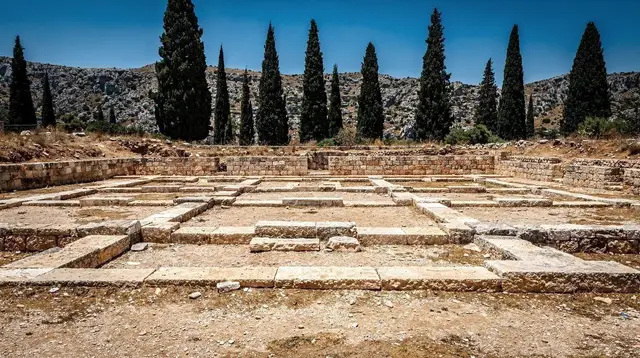
On the hillside above the village, unmarked from the main lane, are the scattered remains of ancient Lato, a Dorian-era hill settlement with a stone agora and foundations climbing the slope between two peaks. It gets a fraction of the visitors that Knossos or Phaistos draw, and there is little on-site interpretation — bring water and expect a short, steep approach rather than a paved path. It rewards travellers who like ruins without crowds more than those who want an organised museum experience.
For a longer stop, the Kritsa gorge above the village offers a walking route through a narrower ravine, and operators run guided half-day options that combine the walk with a stop at a beach on the way back to the coast.
a guided half-day walk through the Kritsa gorge covers that route with a driver and a local guide, useful if you would rather not navigate the trailhead and timing yourself.
Neapoli: the market town most itineraries skip
Continue past Kritsa along the same inland road and the landscape opens into a wider plain around Neapoli, a small town that served for a period as the administrative capital of the Lasithi region before Agios Nikolaos took that role. Neapoli has no beach, no headline sight, and almost no presence in the standard tour-bus circuit — which is precisely its appeal for travellers who want to see an ordinary working Cretan town rather than one shaped around visitors.
What Neapoli offers is a proper town square with cafes used by locals rather than passing tourists, a Saturday market that draws sellers from the surrounding villages, and a scattering of churches and neoclassical buildings from its period as a regional centre. It is a fifteen-minute stop more than a destination in itself, best treated as a stop on the drive between Kritsa and the Lasithi plateau rather than a reason to leave the coast on its own.
Combining Kritsa with the rest of Lasithi
Kritsa’s real value on an itinerary comes from what sits around it, not from Kritsa alone. The village works best as one stop on a loop that also takes in the Lasithi plateau and the Dikteon cave further up the mountain, or as a half-day break from a base in Agios Nikolaos or Elounda. Our three-day itinerary for Lasithi and the east sequences these stops so you are not backtracking across the same stretch of road twice in a day.
a day trip that pairs the Lasithi plateau with Knossos is one way to see the plateau above Kritsa without self-driving the mountain road, though it does not stop in the village itself — check the itinerary before booking if Kritsa is the priority.
For a shorter combination that stays closer to the coast, several operators run half-day trips linking Kritsa with a beach stop rather than the plateau.
a half-day trip pairing Kritsa with Myrtos beach on the south coast covers that combination with transport included, useful if you are without a car and want both the village and a swim in the same afternoon.
What does not work well is treating Kritsa as a full day on its own. There is enough here for two to three hours on foot, not eight, and the village has no beach within easy reach and essentially no evening life — restaurants close early and there is nowhere resembling the bar strip of Agios Nikolaos or the resorts further along the coast. Build Kritsa into a loop with the plateau, Agios Nikolaos, or the caves further inland rather than driving up for the village alone.
When to go, and the hour that trips people up
Kritsa sits at enough elevation to be noticeably cooler than the coast, which makes it a reasonable midday escape in high summer — but July and August still bring heat into the low thirties Celsius on the walk up through the village, and the shopping lane has little shade. Late April through June and September into October are the better windows: mild enough for the uphill walking, with the wildflowers on the terraces around the village at their best in spring.
One detail catches visitors out when they are timing a bus or a tour pickup: Crete runs on Eastern European Time, one hour ahead of Paris, Berlin and Rome. A pickup or departure quoted for 9:00 is 9:00 local time, not 8:00 as it would read on a clock set to central European time — worth checking twice given how thin the public transport options already are on this route. Our best time to visit Crete and Crete weather month by month guides break the seasons down in more detail if you are still choosing dates.
What Kritsa is not, and why that matters for planning
Set expectations before you drive up. Kritsa has no beach of its own and no beach within a short walk — the nearest coast is back down at Agios Nikolaos or further along toward Elounda, and no amount of route-planning turns this into a swim-and-village day without a car and a longer loop. It has no nightlife in any real sense: a handful of tavernas serve dinner to the village itself and to travellers staying nearby, and the shopping street empties out by early evening. And it has no single monument that competes with Spinalonga’s fortress walls or the open plain of the Lasithi plateau fifteen minutes further up the mountain — the ancient site at Lato is genuinely interesting but modest, unmarked, and easy to miss without asking locally.
None of that makes Kritsa a mistake. It makes it what it is: a good half-day addition to a stay based on the coast, best reached by car, best combined with the plateau or with Agios Nikolaos itself, and best visited without the expectation that it will anchor a full day on its own.
Kritsa and Neapoli: frequently asked questions
Can you visit Kritsa without a rental car?
Yes, but not easily by public bus. The KTEL network does not run a reliable service into the village, so most travellers without a car use a taxi from Agios Nikolaos, roughly 20-25 minutes away, or join an organised half-day excursion that includes transport.
How long do you need in Kritsa?
Two to three hours covers the village on foot at an easy pace, including time in the weaving shops. Add an hour if you plan to look for the ancient site of Lato on the hillside above, and treat it as a half-day stop within a longer loop rather than a full day.
Is there a beach near Kritsa?
No. Kritsa is an inland hill village with no coastline nearby. The nearest beaches are back down at Agios Nikolaos or along the coast toward Elounda, so pair the village with a coastal base rather than expecting a swim on site.
What is Neapoli, and is it worth stopping in?
Neapoli is a small inland market town on the same road past Kritsa, once the administrative centre of the Lasithi region. It has no headline sight but offers an ordinary town square and a Saturday market with far fewer visitors than Kritsa — worth a short stop on the drive rather than a destination on its own.
What is the best time of year to visit Kritsa?
Late April through June or September into October, when temperatures suit the uphill walk through the village. July and August bring heat into the low thirties with little shade on the shopping street, though the elevation makes Kritsa somewhat cooler than the coast below.
Does Kritsa have restaurants and nightlife?
There are tavernas serving lunch and early dinner to villagers and visitors, but nothing resembling the bar strip of Agios Nikolaos or the coastal resorts. Plan to eat in Agios Nikolaos or Elounda if you want an evening out.
Can Kritsa be combined with the Lasithi plateau in one day?
Yes, and this is the most efficient way to see both. Kritsa sits on the road up toward the plateau, so a loop that visits the village, continues to the plateau and the Dikteon cave, and returns to the coast makes good use of a single day with a rental car.
What should I know about the local time when planning a bus or tour pickup?
Crete runs on Eastern European Time, one hour ahead of Paris, Berlin and Rome. Confirm whether a quoted pickup time is local before relying on public transport near Kritsa, since the KTEL options into the village are already limited and a missed connection has no quick backup.