Sunset Cruises in Crete
Is a sunset cruise worth it in Crete?
Yes, but only if you pick the right coast and season. Crete has no volcanic caldera and no whale or dolphin grounds, so a sunset cruise here sails to an island — Balos, Gramvousa, Chrissi, Dia or Spinalonga — or along a roadless stretch of coast, never to open water to watch marine mammals. In July and August the meltemi wind regularly cancels departures to Balos, Gramvousa and Chrissi from the north and west, while boats from the Libyan Sea coast in the south keep running.
What a sunset cruise in Crete actually is
Ask what a sunset cruise looks like on a volcanic Greek island, and the picture is obvious: a boat circling a caldera as the sun drops behind a crater rim. Crete has none of that. The island is limestone and folded mountain, cut by gorges rather than shaped by an eruption — there is no caldera here, no fumarole, no thermal bathing pool, and nothing resembling the Santorini postcard. A sunset cruise in Crete is a different thing entirely, and worth booking on its own terms rather than someone else’s.
It is also not a wildlife trip. Crete does not sit on recognised whale or dolphin watching grounds, and no operator here genuinely sells that as the point of going out. What a boat trip from a Cretan port actually does is take you to somewhere the road does not reach, with the last hour of light as the reward for being there.
That somewhere is always one of a handful of real places: the lagoon and fortress islet of Balos and Imeri Gramvousa off the north-west tip, the protected islet of Chrissi south of Ierapetra, uninhabited Dia island off Heraklion, the former leper colony of Spinalonga in the gulf of Mirabello, or a stretch of south-west coast with no road at all, around Loutro and Chora Sfakion. Knowing which of these your evening is actually built around is the first useful question to ask before you book anything.
An island of four coasts, not one base
Crete runs roughly 260 km from the Venetian harbour of Chania in the west to Sitia in the far east, and only 12 to 60 km north to south. That shape matters more for a sunset cruise than for almost any other activity, because a boat can only reach what is near its own port. A sunset departure from Chania reaches Balos, Gramvousa and the coves around Akrotiri; nothing sold there is going to show you Spinalonga two hundred and some kilometres away the same evening.
A departure from Elounda or Agios Nikolaos reaches Spinalonga and the gulf of Mirabello; a departure from Ierapetra reaches Chrissi; a departure from Heraklion reaches Dia. Choosing where to stay for the evening you want to spend on the water is really choosing which of these four coasts you are on, and no single base or single cruise summarises the island the way one trip might on a smaller destination. See north coast versus south coast for how that split plays out beyond boat trips too.
The meltemi decides more than the calendar does
The single most useful fact for planning a sunset cruise in Crete has nothing to do with clocks: it is the meltemi, a strong north wind that blows mainly in July and August. It does not touch every coast equally. Crossings to the open lagoon at Balos and the fortress islet of Gramvousa, and the run out to Chrissi, are exposed to it directly, and operators on the north and west coast cancel or shorten these routes on windy days rather than risk small boats on open water.
The Samaria gorge closes for its own reasons in bad weather, and boat traffic along that south-west shoreline can be affected too, but the water it sits on — the Libyan Sea — is sheltered by the White Mountains and the Psiloritis range and behaves very differently from the exposed north.
That gives a practical rule rather than a guess: if you are visiting in the height of summer and a calm evening on the water matters to you, a departure on the south coast is the safer bet than one chasing Balos or Gramvousa from the west. Outside July and August, the meltemi eases and the north-coast routes run far more reliably. For the wider seasonal picture, see crete in july and the meltemi and best time to visit crete; for how the wind is felt on land as well as water, what the meltemi does to your holiday is a useful companion read.
The west: Balos, Gramvousa and the coves of Akrotiri
The classic west-coast sunset run leaves from around Chania or Kissamos and heads toward the turquoise lagoon at Balos and the Venetian fortress islet of Imeri Gramvousa, built in 1579 and one of the more atmospheric ruins on the island.
Reaching Balos by road means an 8 km dirt track that most rental contracts exclude from cover, followed by a walk down and back up — the boat is the sane option for most visitors, and doing that crossing at the end of the day rather than at midday avoids the worst of the heat and the crowds. This is also the route most exposed to the meltemi, so a July or August evening here is the one most likely to be rerouted or cancelled if the wind is up.
a guided sunset boat cruise out of Chania covers this stretch of coast with commentary along the way, while a private sunset powerboat trip with a swim stop suits a smaller group that wants to choose its own pace and get in the water before the light goes. Neither replaces checking the forecast yourself if the meltemi season coincides with your visit.
The centre and south: Dia island and the Libyan coast
Off Heraklion, uninhabited Dia island is the closer, calmer option for a sunset run on the north-centre coast, reached in well under an hour and sheltered enough that it runs more consistently than the Balos crossing further west. South of the mountains, the Libyan Sea coast around Plakias and Damnoni and Agia Galini offers the calmest sunset water on the island in summer, precisely because the White Mountains and Psiloritis stand between it and the meltemi.
If a land-based evening with sweeping views appeals more than a boat, a sunset safari by vehicle into the hills reaches high ground over this coast without needing calm seas at all, and a countryside evening built around local food and wine at sunset is the option for travellers who would rather watch the light change from a hillside taverna than from a deck.
The east: Spinalonga and the gulf of Mirabello
In the east, sunset trips from Elounda, Plaka or Agios Nikolaos head into the gulf of Mirabello toward Spinalonga, the Venetian fortress islet of 1579 that served as Europe’s last leper colony from 1903 to 1957. It is worth remembering on a sunset run that this is recent history rather than scenery — people who were sent there have living descendants, and Victoria Hislop’s novel The Island drew directly on their story.
Boats run from several points; see which boat to take to Spinalonga for how the short Plaka crossing compares to the longer routes from Elounda and Agios Nikolaos. Further south-east, day boats to the protected islet of Chrissi from Ierapetra run in season only and are among the first routes suspended when the wind picks up, since the crossing is fully exposed to the open sea.
The south-west: a coast with no road at all
The stretch between Loutro and Chora Sfakion is reachable only by boat or on foot, which makes an evening cruise along this coastline feel different from anywhere else on the island — there is no road noise, no headlights, nothing but the coastline and the water. This is also the exit route for hikers finishing the Samaria gorge, so boats along here run to a working schedule as much as a scenic one; check locally rather than assuming a dedicated sunset departure exists on a given evening.
What sunset on the water actually costs
Departure times and exact prices change by port, season and operator, and quoting a figure here would be out of date before it was useful — check the specific booking page for current details. What is worth fixing in advance is the tipping norm, because it differs sharply from what North American visitors often expect: a round-up of roughly 5 to 10 percent for a crew that looked after you well is standard in Crete, not the 15 to 20 percent common elsewhere. Rounding the bill up to a convenient figure covers it.
| Departure area | What it reaches | Meltemi exposure (Jul-Aug) |
|---|---|---|
| Chania / Kissamos | Balos, Imeri Gramvousa | High — frequent cancellations |
| Heraklion | Dia island | Moderate — shorter, more sheltered crossing |
| Elounda / Agios Nikolaos / Plaka | Spinalonga, gulf of Mirabello | Low to moderate, varies by route |
| Ierapetra | Chrissi | High — exposed open-sea crossing |
| Plakias / Agia Galini (Libyan Sea) | South coast, no fixed island stop | Low — sheltered by the mountains |
| Loutro / Chora Sfakion | Roadless south-west coast | Low to moderate, sheltered by the White Mountains |
Booking around the season, not against it
The practical way to plan a sunset cruise here is to work backwards from the season and the coast rather than from a fixed idea of what the evening should look like. Visiting in July or August and staying in the west means accepting that a Balos or Gramvousa sunset run might be called off on a windy day, with a south-coast or Dia island alternative as the fallback.
Visiting in the shoulder months of May, June, September or October removes most of that uncertainty, since the meltemi eases and routes on every coast run closer to plan. Either way, no single evening on the water stands in for the island — Crete’s coasts are far enough apart that the west, centre, east and south-west each need their own boat trip, on their own coast, in their own season.
Sunset cruises in Crete: common questions
Does Crete have a volcano to sail past on a sunset cruise?
No. Crete is limestone and folded rock, cut by gorges, with no caldera, no fumarole and no lava. A sunset cruise here has no crater rim to circle — the destination is always an island or a piece of coast, not a volcanic feature.
Can I go whale or dolphin watching on a sunset cruise in Crete?
Not as an organised activity. Crete does not sit on established whale or dolphin watching grounds, and no cruise here is sold on that basis. Boat trips go to an island — Balos, Gramvousa, Chrissi, Dia, Spinalonga — or to a beach with no road, with the sunset itself as the reason to be on the water.
Why do sunset boat trips to Balos and Gramvousa get cancelled?
The meltemi, a strong north wind that blows mainly in July and August, makes the open crossing to Balos lagoon and Imeri Gramvousa too rough for small boats. Operators on the west and north coast cancel or reroute on windy days rather than risk the crossing.
Which coast stays calm when the meltemi is blowing?
The south coast, on the Libyan Sea, is sheltered from the meltemi by the White Mountains and the Psiloritis range and typically stays calm when the north coast does not. It is the more reliable choice for a sunset departure in July and August.
Can one sunset cruise cover all of Crete?
No. Crete runs about 260 km from Chania in the west to Sitia in the east, and each departure port only reaches the water near it. A cruise from Chania reaches Balos and Gramvousa, one from Agios Nikolaos or Elounda reaches Spinalonga, and one from Ierapetra reaches Chrissi — no single trip links them.
How much should I tip on a boat trip in Crete?
A round-up of roughly 5 to 10 percent is the local norm for a crew that has looked after you well, not the 15 to 20 percent common in North America. Many visitors simply round the bill up to the next convenient figure.
Is there a fixed schedule and price for sunset cruises in Crete?
Departure times and prices vary by port, season and operator and change from year to year, so this guide does not quote either. Check the specific booking page for current timing and cost before you plan your evening around it.
Sunset Cruises in Crete on GetYourGuide
Verified deep-linked GetYourGuide tours. Book through these links and we earn a small commission at no cost to you.
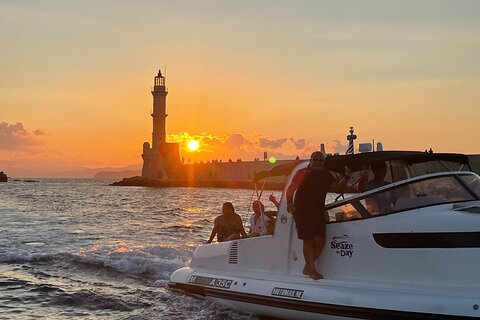
GetYourGuide does not provide a product photo for this activity — the image shows the meeting point, photographed by us.