What is actually left on the plateau
Postcards and hotel brochures still show the Lasithi plateau the way it looked in the 1960s: a wide green basin ringed by mountains, dotted with thousands of canvas-sailed windmills turning in the wind. That picture is out of date. The plateau sits at roughly 850 m, enclosed by the Dikti range, and its fertile floor really was once worked by an estimated ten thousand or more of these small metal-framed, white-sailed pumps, drawing irrigation water up from wells for the potato and cereal fields below. Diesel and electric pumps replaced almost all of them from the 1970s onward, and the sails were never re-hung once the pumping stopped paying its way.
What remains today is mostly rusted iron skeletons standing in rows at the field edges — no canvas, no motion, quietly rotting in the wind that once turned them. A small number, concentrated near the village of Psychro and along the main road, have been restored with fresh sails specifically so visitors have something to photograph. They are real windmills and worth a stop, but they are a curated remnant, not a working landscape, and treating the whole plateau as a field of spinning mills sets up a flat afternoon.
Go for the mountains, the cave and the villages, and let the windmills be a detail rather than the headline. Photographers who want to see how this rusted-frame motif compares with other classic Cretan images can browse the wider photography spots in Crete guide for other frames worth planning a stop around.
Away from the windmills, the plateau’s villages carry a food and craft identity worth knowing before you sit down for lunch. The saint’s-day festivals typical of rural Crete, described more broadly in the Cretan villages and festivals guide, still happen here on the same informal terms as anywhere inland.
Cretan pottery has its own dedicated centre elsewhere on the island, at Margarites over toward Rethymno, but the plateau’s own tavernas lean on the same potato-and-lamb cooking covered in what to eat in Crete and, for the small-plates version most of them actually serve, dakos and the Cretan mezze.
Honey from the mountain slopes around the basin, and the mizithra and graviera cheeses on most menus, are worth buying here rather than from a coastal souvenir shop — see honey and herbs of Crete and Cretan cheese: mizithra, graviera and staka for what to look for.
Saint’s-day festivals in these villages often end with live lyra and mantinades verse-singing, the traditional soundtrack detailed in Cretan music: lyra and mantinades, and a visit that happens to land around the holiday follows a rhythm of its own, covered in Easter in Crete.
The Dikteon cave: Zeus’s mythical birthplace, taken slowly
The plateau’s other reason to visit sits at its southern rim, above the village of Psychro: the Dikteon cave, which Greek mythology names as the birthplace of Zeus, hidden here by his mother Rhea to keep him from his child-devouring father Cronus. Archaeological finds inside — bronze votive offerings, double axes, figurines — go back to the Minoan period, confirming this was a genuine cult site for a very long time before the myth was ever written down.
The approach is straightforward: a short paved path and steps climb from the car park near Psychro to the cave mouth, about 15 minutes on foot, with donkey rides available for those who would rather not walk it. Inside is where the visit changes character. A metal staircase descends into a large chamber of stalactites and stalagmites, the ceiling dripping and the steps frequently damp or slick with condensation even in dry weather above ground.
It is not a difficult climb for someone reasonably fit, but it is a real descent with real footing to manage, not a quick photo stop you can rush through in flip-flops. Budget closer to 45 minutes to an hour once you are moving through the cave itself, go at a pace that matches the steps rather than the queue behind you, and wear shoes with grip. Guided visits, including several of the tours below, generally build in the time the cave actually needs rather than treating it as a brief add-on to a longer day.
Travellers with mobility limitations should treat this as one of the less accessible sites on the island — see accessible Crete for destinations that manage better without steep internal stairs — and anyone wanting general precautions for a slippery descent like this one can check the safety and health in Crete guide for footwear and pacing advice.
For the mythology in more depth, and a closer look at what has and hasn’t been confirmed archaeologically about the site, see the dedicated Dikteon cave guide.
For a sense of how this descent compares with the island’s other show caves, the chamber at Melidoni cave near Rethymno and the show cave detailed in Sfendoni cave and Zoniana are both easier underfoot than the steps at Psychro.
Getting there: no KTEL, a car is not optional
This is one of the clearest cases on the island where the coastal coach network simply does not help. KTEL buses run a genuinely usable service along the north coast — Chania, Rethymno, Heraklion, Agios Nikolaos — but service into the Lasithi plateau’s interior is minimal to nonexistent for a visitor working around a normal holiday schedule. If you’re staying in Agios Nikolaos, Elounda or Heraklion without a car, this is one of the destinations where an organised tour, rather than public transport, is the practical way in, alongside the option of a rental car for the day.
Driving here is not difficult by Cretan standards. The road climbs in switchbacks through the Dikti foothills before opening onto the plateau floor, and the driving itself is more scenic than technical — see the general notes on driving in Crete for how locals use the hard shoulder to let faster traffic pass, which applies here as much as anywhere. From Heraklion the drive takes about an hour and a quarter; from Agios Nikolaos, closer to 45 minutes. Once on the plateau, the main loop road that rings the basin and passes through Psychro, Tzermiado and several smaller villages is easy, well-surfaced driving with frequent pull-offs for photographs of the windmill fields.
Travellers landing at Heraklion airport can fold the plateau into the same day if the onward drive already passes close to the Dikti foothills, rather than treating it as a separate trip from the coast. Those without a rental car booked can still arrange a private airport transfer that detours via the plateau on the way to a coastal hotel, rather than ruling the visit out.
For visitors who would rather not drive the mountain roads themselves, an organised day covers the same ground. One option pairs the cave with a wider sweep of the region: a guided day through east Crete’s main sights, which typically folds in the plateau alongside other regional highlights. For a trip built specifically around Knossos and the Zeus cave together, a combined Knossos-and-Zeus-cave day that also stops at a traditional village and an olive farm covers Minoan history at both ends without you needing to plan the route yourself.
When to go: staying cool above the coastal heat
The plateau’s altitude, around 850 m, is its own microclimate, and it is worth building a visit around that rather than around whatever the coast is doing that week. In July and August, when Heraklion and Agios Nikolaos regularly sit at 30-35°C, the plateau runs several degrees cooler and the air moves more freely — genuinely more comfortable for the walk up to the cave and the climb down into it. That said, “cooler” does not mean cool: midday sun on the open plateau floor in high summer is still strong, and the cave interior itself is humid rather than refreshing.
The better windows are either side of peak summer. Late April through June brings wildflowers across the plateau floor and comfortable daytime temperatures for walking; September into October keeps the same balance as the crowds thin and the light turns softer for photographs of the windmill rows. Winter is the plateau’s quiet season in a different way: the surrounding Dikti range, cresting at 2,148 m, holds snow into May or June in most years, which makes for a striking backdrop from the basin floor but also means colder, sometimes wet conditions at altitude and reduced village opening hours.
There is, worth repeating, no ski lift or winter sports infrastructure anywhere on the island — the snow up there is scenery, not a resort. See snow in Crete for how that plays out islandwide, and the month-by-month detail in the general Crete weather guide or best time to visit Crete if you’re still choosing dates for the whole trip.
The Dikti range that rings the plateau is not the island’s highest ground. That title belongs to Psiloritis, at 2,456 m, covered in the Psiloritis summit hike guide, with Pachnes and the Lefka Ori close behind at 2,453 m and detailed in Pachnes and the White Mountains. The mountain village of Anogia, at Psiloritis’s foot, is the usual base for climbers tackling that summit rather than the Lasithi side.
Dikti’s more modest 2,148 m is still enough to hold snow well after the plateau floor below has warmed up. For the exact conditions in a given month rather than the general late-spring-or-autumn advice above, the dedicated Crete in May and Crete in September guides go further into what to expect.
What else fills a day on the plateau
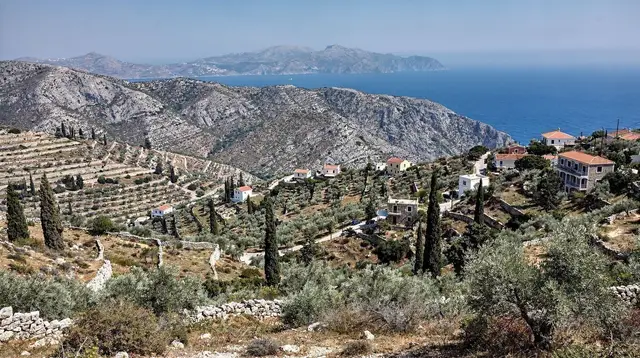
The cave and the windmill viewpoints are the anchors, but a full day here has more to offer than a there-and-back drive. The plateau’s villages — Tzermiado, the largest; Agios Georgios, home to a small folklore museum; and Psychro itself — sit at the edge of fields that are still actively farmed, mostly potatoes now rather than the mixed cereals of a century ago, and several tavernas serve genuinely local, unfussy Cretan food rather than a tourist-menu version of it.
For travellers who want the plateau folded into a broader look at Minoan mythology and the island’s agricultural traditions in one guided day, a guided safari through the plateau’s mythology park with an olive-oil tasting pairs the Zeus story with a hands-on look at how Cretan olive oil is actually produced.
Families or groups who’d rather explore at a slower, more flexible pace than a coach itinerary allows might prefer a jeep safari across the plateau with a family-style lunch and local tastings, which gets off the main loop road and into some of the smaller lanes between fields. Anyone unsure what that actually involves before booking can check what a jeep safari really is first.
Those who’d rather cover the same farmland on two wheels under engine power can compare the quad and buggy tours in Crete running on this side of the island, and travellers wanting a slower, animal-powered look at the fields can check horse riding in Crete for stables operating near the plateau.
Travellers who’d rather cover the plateau’s lanes under their own power can look instead at cycling and e-bike routes in Crete, several of which start from villages on this side of the Dikti range.
If your base is Agios Nikolaos or Elounda, the plateau also fits neatly alongside the region’s coastal sites. The market town of Kritsa, known for its weaving and the Byzantine frescoes of Panagia Kera, sits on a natural route between the coast and the plateau’s southern approach.
Coastal Agios Nikolaos itself, and the boat-only former leper colony of Elounda and Spinalonga — covered in full in the Spinalonga island guide — make sensible pairings for the days either side of a plateau visit rather than the same day, given the driving involved. Travellers continuing further east instead can extend a different day toward Ierapetra and Chrissi, detailed in the Ierapetra town guide, or toward Sitia further along the coast, though either adds a considerably longer drive than pairing with Agios Nikolaos.
Unlike the package resorts of Gouves and Hersonissos, compared in full in Hersonissos vs Malia vs Stalida, the plateau’s villages have no beach-resort economy at all — farming and family-run tavernas are still the point.
Wine lovers based nearby might pair a plateau day with the vineyards of Archanes and Dafnes, covered in a Peza and Archanes winery day, rather than trying to fit both into one long drive.
The cliffs ringing the basin also shelter some of the last bearded vultures on Crete, the subject of bearded vultures of the White Mountains. The birdlife above the basin is part of a wider island pattern worth knowing about before you go looking for a kri-kri here — the wild goats are far more reliably seen in the Samaria gorge or on the offshore islets, as explained in the kri-kri and Cretan wildlife guide — while the wildflowers that carpet the plateau floor in spring belong to the same bloom described island-wide in wildflowers and herbs of Crete.
Travellers who’d rather not choose between a fixed-itinerary coach tour and driving the mountain roads themselves can book a driver for the day instead — see private tours and drivers in Crete — and the wider mistakes to avoid in Crete guide covers most of the small missteps that catch out first-time visitors here, from arriving without cash for a village taverna to underestimating the cave descent.
Where the plateau fits in a longer trip
Because the plateau sits inland and off the coastal highway, it works best as a dedicated half-day or full day rather than a stop squeezed between coastal towns. If you’re building a multi-day route through the region, the Lasithi and the east in three days itinerary slots the plateau in alongside Agios Nikolaos, Elounda and the eastern coast at a pace that doesn’t rush the cave.
For a wider view of how much time to give each part of the island, including how a detour like this one competes for days against the coast and the gorges, see how many days in Crete. Visitors building a full island route rather than an eastern-only trip can see how a day like this fits into the Crete in seven days, west to east itinerary, and anyone still deciding how much of the island to attempt on a first visit can start with Crete for first-timers.
For a fuller loop of the plateau’s minor roads and viewpoints beyond the cave and the main circuit, the Lasithi plateau day loop guide lays out a route through the smaller villages. Travellers spending several days in the region rather than a single day trip can fold the plateau into the east Crete in four days itinerary alongside the coast.
Families weighing whether the cave descent suits younger children can check the general advice in Crete with kids before booking the jeep safari above, and for how this eastern detour weighs against the island’s western highlights, east Crete vs west Crete lays out the trade-off.
Practical tips for visiting
Wear proper shoes, not sandals — the cave steps are the reason, not the walk up to it. Bring a light jacket even in summer: the plateau’s altitude and the cave’s damp interior both run cooler than a beach day would suggest. For a fuller packing list beyond those two items, see what to pack for Crete. Arrive at the cave earlier in the day if you can, both for lighter crowds on the narrow internal staircase and for cooler driving conditions on the approach roads. Fuel up before you leave the coast — petrol stations thin out once you’re on the plateau loop — and note that several of the smaller village tavernas keep shorter hours outside the main season, in keeping with how much of rural Crete quietens down from November through March.
If you are driving yourself, treat the mountain road as you would any other in Crete’s interior: narrow in places, with locals pulling onto the hard shoulder as a courtesy to let faster traffic through rather than an invitation to overtake blind. None of this makes the plateau a difficult destination — it is one of the more approachable inland detours on the island — but it rewards going in with the current picture rather than the one from the postcards.
For the wider cost picture behind that day-budget figure, see Crete on a budget, and general guidance on tipping, money and prices in Crete applies to the plateau’s village tavernas just as it does anywhere else on the island. For choosing a base within reach of the plateau, where to stay in Crete covers the trade-offs between the coast and inland towns.
FAQ: visiting the Lasithi plateau and the Zeus cave
Are the Lasithi windmills still working?
No. Thousands of canvas-sailed windmills once pumped irrigation water at about 850 m, but almost all now stand as rusted metal frames. A handful near Psychro have been restored for photographs, and none turn water any more.
How do I get to the Dikteon cave at Psychro?
Drive to the village of Psychro, at the plateau’s southern edge, then walk or take the short paved path and stairs up to the cave entrance, roughly 15 minutes on foot from the car park. The descent inside is steeper and takes longer than the approach.
Is the Dikteon cave visit difficult or dangerous?
It is not dangerous if you go slowly, but the stone steps inside are steep, uneven and often wet or slippery from condensation. Sturdy shoes and a free hand for the railing matter more here than at most Cretan sites, and it is not a five-minute stop.
Can I get to the Lasithi plateau by bus?
Not practically. The KTEL coach network runs well along the north coast between Chania, Rethymno, Heraklion and Agios Nikolaos, but it barely reaches this inland plateau. A rental car or an organised tour is the realistic way to visit.
When is the best time to visit the Lasithi plateau?
Late April to June or September to October, when the plateau’s altitude keeps it noticeably cooler than the coast without the crowds or heat of July and August, which can still be intense here despite the elevation.
Is there snow on the plateau or nearby mountains?
The plateau floor itself rarely holds snow long, but the surrounding Dikti range, reaching 2,148 m, keeps snow on its upper slopes into May or June in a normal year. There is no ski lift or resort infrastructure anywhere on Crete to make use of it.
How long should I spend on the Lasithi plateau?
Half a day covers the Dikteon cave and the main viewpoints. A full day lets you add a village lunch, a walk among the remaining windmill frames, and a slower drive across the plateau floor rather than a straight there-and-back.
Is the Lasithi plateau worth visiting if the windmills don’t turn?
Yes, for the cave, the mountain scenery and the sense of a working agricultural landscape rather than a resort. Go expecting rusted frames and a handful of restored examples, not a field of spinning white sails, and the visit holds up on its own terms.
Is the Dikteon cave accessible for visitors with limited mobility?
No, not really. The internal staircase is steep, uneven and often damp, which makes this one of the harder Cretan sites to manage without solid footing — see the accessible Crete guide for destinations that cope better without stairs.