Crete Versus the Cyclades: Why It's Not a Substitute
A friend messaged me before her first trip here with a question I now hear often enough to expect it: “Crete’s basically the Cyclades, right, just a bigger version, I can treat it the same way?” I understood the instinct. Both are Greek, both are in the Aegean orbit, both show up on the same shortlist when someone types “Greek islands” into a search bar. But I told her the honest answer, which is no, and which took me a full trip to actually believe myself. Crete is not a bigger Santorini. It is a different kind of island entirely, built from different rock, at a scale that makes the comparison misleading rather than helpful.
Limestone, Not Lava
The thing people picture when they picture the Cyclades — the whitewashed rim of a collapsed caldera, black sand underfoot, the smell of sulphur drifting up from a fumarole, a warm patch of sea where the volcano still breathes — is a Santorini scene, not a Crete scene. Santorini is volcanic. It is, geologically, the site of one of the largest eruptions in recorded history, and everything about how it looks and how you move through it follows from that: a caldera, a rim town perched on the collapsed edge, a harbour reached by switchback or cable car straight down the cliff face.
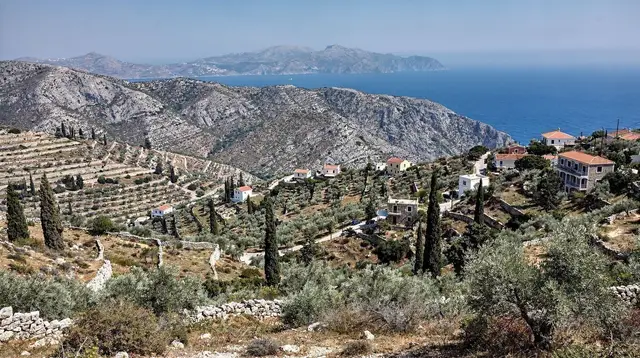
Crete is a limestone island. It has no caldera, no fumarole, no thermal bathing basin, and no lava anywhere on it. What it has instead is a spine of mountains — the White Mountains in the west, Psiloritis in the centre, the Lasithi range in the east — worn and cut over millennia into gorges rather than blown open in a single event. The Samaria gorge is the famous one, but it is one of dozens, and that gorge-cut, folded terrain is the actual signature of the island: water and time working on rock, not magma reshaping a coastline overnight. If you come looking for a caldera view, you will not find one on Crete, because there has never been one to find.
That gorge country carries its own set of misconceptions, and not only geological ones: it was Gortyna, not Knossos, that served as the island’s Roman capital, one more case of what people assume about Crete turning out wrong in a way that has nothing to do with volcanoes. If the terrain itself is what draws you rather than a caldera view, the fullest way to feel the difference in person is to walk it, and a complete guide to the Samaria gorge sets out exactly what that involves, from the descent at Xyloskalo to the boat out from Agia Roumeli at the far end — nothing like a caldera hike, and nothing like it should be.
An Island, Not an Island-Hop
The other habit that transfers badly from the Cyclades is the rhythm of the islands themselves. On a small Cycladic island you can plausibly try one beach, decide you don’t love it, and be somewhere else in ten minutes. The whole appeal of that kind of hopping is scale: the island is small enough that indecision costs you almost nothing.
Crete does not work that way, because Crete is not small. It covers 8,336 km², the largest island in Greece, and it runs for roughly 260 km from its western tip near Kissamos to the beaches below Sitia in the east. Drive that full length — Chania to Sitia — and you are looking at more than four hours behind the wheel, on a road with no shortcut through the mountainous middle. There is no train line anywhere on the island and no cable car or lift shortcutting any of that distance; every kilometre of it is a driven kilometre, on ordinary roads, through ordinary traffic. Changing beaches on Crete because the first one didn’t suit you is not a ten-minute decision. It is often a regional one.
That scale is exactly why the Cyclades comparison breaks down as a planning tool. Someone island-hopping the Cyclades for a week can realistically see three or four islands. Someone treating Crete the same way, expecting to “cover” it the way you’d cover a cluster of small islands, ends up instead driving across one enormous one, arriving everywhere late and tired, and mistaking a road trip for a holiday.
I’m not the only one making this argument on this site — Crete keeps surprising visitors who expected something more compact, and the confusion is common enough to deserve its own answer. The better question isn’t how many islands you can fit into a week, but how many days the region you actually want deserves, which is exactly what a guide built around that question works through.
The same logic applies to picking sides of the island: the north coast and the south coast behave differently enough in weather, crowds and character that choosing between them matters, and so does choosing between the island’s eastern and western halves, which barely resemble each other beyond sharing a coastline.
The Ferry That Tempts You to Try Both
I don’t want to overstate the separation, because there is a genuine, sanctioned way to have both experiences on one trip: seasonal boats run between Crete and Santorini, and you can book a day excursion across, typically departing from Heraklion, Rethymno, or Chania depending on the season and the operator. It’s a real option, and a reasonable one if the caldera view is something you specifically want to see with your own eyes rather than take my word for.
What that boat trip is not, though, is proof that the two islands are interchangeable. Spend a day crossing to see Santorini’s rim towns and its volcanic caldera, and you’ll come back to a Crete that still has no caldera, no fumarole, no lava, and no thermal basin of its own — because a day trip visits the geology, it doesn’t import it. The boat is a way to see both islands honestly, each for what it actually is, not a shortcut that lets you skip choosing.
Time that crossing carefully: the meltemi, the strong north wind that blows hardest in July and August, can cancel ferry crossings along with the boats to Balos and Gramvousa on the days it picks up, so a fixed-date booking to Santorini is worth checking against the forecast rather than assumed. And if the pink sand at Elafonissi is the specific postcard you’re chasing rather than a caldera, it’s worth knowing how that beach actually compares to the equally photographed lagoon at Balos before committing a day to either.
Santorini, Rhodes, and Where Crete Actually Sits
It’s worth being precise about which comparison you’re actually making, because Crete gets pulled into more than one shorthand. A dedicated side-by-side of Crete and Santorini goes further into the geology and the practical differences than this piece has room for, and if Rhodes is also on your shortlist, a separate comparison of Crete and Rhodes covers a rivalry with a different shape entirely — both are large by Greek standards, but Rhodes carries a walled medieval old town at its centre in a way Crete’s Venetian harbours don’t quite replicate.
Pick a Region, Not a Postcard
This is really the point I want to leave you with, more than any single geological fact: don’t come to Crete holding a Santorini-shaped picture in your head and expect the island to fill it in. Come with a sense of what Crete actually offers on its own terms — limestone coastline, gorge country, mountain villages, a scale that rewards depth over hopping — and then, because the island is too large to do all of it on a short trip, pick a region and commit to it.
In the west, that might mean a day built around the coastline rather than a caldera: I’ve had one of my best afternoons on a guided visit to Falassarna beach paired with a stop at a local winery, which gets you sand, sea and a taste of the island’s wine country without any driving of your own to manage. Further along the coast, the pink-tinged sand at Elafonissi is the closest thing Crete has to a postcard beach moment, and a day trip down to Elafonissi from Chania makes the distance somebody else’s problem rather than yours.
And if what you actually want out of the trip is the inland, agricultural side of the island — the olive terraces and mountain villages that have nothing to do with any coastline at all — a tasting day through wine, olive oil and historic villages shows you a Crete that no Cycladic island, volcanic or otherwise, has any equivalent of.
Once you’ve settled on a piece of the island, logistics follow from that choice. A base in Chania sets you up differently than one in Rethymno or Heraklion, and it’s worth reading how those three towns actually compare before booking, or working through a fuller guide to where to stay if your shortlist runs wider than three towns.
How you move around matters just as much: a week built on a rental car opens up villages no coach reaches, a trade against organised day trips worth weighing deliberately. For a first visit, a route moving west to east over one week covers a realistic slice without the backtracking a shorter trip forces, and two weeks is enough to slow down in more than one region.
None of this is a knock on the Cyclades, or on Santorini specifically. They’re extraordinary for what they are: compact, volcanic, built for movement between islands in a single week. Crete is extraordinary for something else — for being large enough and geologically varied enough that one region of it can occupy an entire trip on its own. Treat it as a substitute for the Cyclades and you’ll spend the week driving, disappointed there’s no caldera at the end of the road. Treat it as its own island, choose one piece of it, and you’ll understand why I stopped trying to compare the two at all.
Top-Rated Crete Tours on GetYourGuide
Verified deep-linked GetYourGuide tours. Book through these links and we earn a small commission at no cost to you.
GetYourGuide does not provide a product photo for this activity — the image shows the meeting point, photographed by us.