Crete Is Not a Small Island
I have watched a lot of people plan Crete the way they would plan a city break, and I understand why. It reads as one place on the map, one name, one flight number. It is not. Crete is 8,336 km², the largest island in Greece and the fifth largest in the Mediterranean, and it runs for about 260 km from the tip near Kissamos in the west to the beaches below Sitia in the east. Drive that distance, Chania to Sitia, and you are looking at roughly 270 km and over four hours behind the wheel, on a good day, on a road with no motorway shortcuts through the middle.
I say this because I made the mistake myself on my first visit, booking five nights in a resort near Chania and assuming I would “pop over” to see Spinalonga. I did not pop over. I looked at the map on day three, did the math, and left it for another trip. That is the real shape of Crete: not one destination, but four, and no single base gets you close to all of them.
The island runs west to east in four unequal pieces
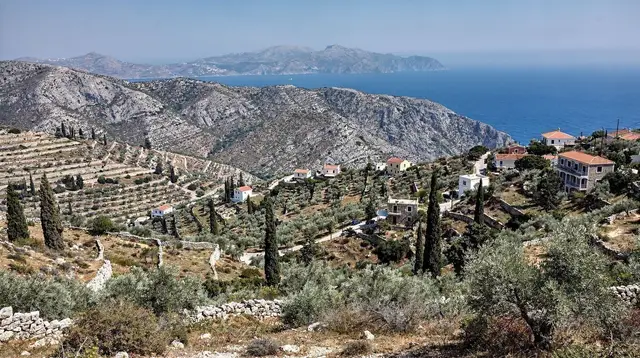
Officially Crete splits into four regional units, and they are not administrative trivia — they are the honest geography of what a day trip from your hotel can and cannot reach.
Chania, in the west, is the Venetian harbour town most people picture when they picture Crete, plus the White Mountains behind it and the entrance to the Samaria gorge. From a base in Chania town you can reasonably reach Balos and Gramvousa, Elafonissi, and the Akrotiri peninsula. You cannot reasonably reach Knossos and back in a half day, and Spinalonga is out of the question as a casual add-on.
Rethymno, next along the coast, has its own old town and its own mountains — Rethymno town, the monastery at Arkadi, the pottery village of Margarites, and the Libyan coast around Plakias and Preveli. It sits close enough to Chania to combine the two in one region-scale trip, which is exactly why most good week-long plans treat “the west” as Chania plus Rethymno together.
Heraklion, in the centre, is the busiest and most visited unit because it holds Knossos and the Heraklion Archaeological Museum, the wine villages around Archanes and Dafnes, and the resort strip running east from Gouves through Hersonissos to Malia. A lot of travellers land at Heraklion airport, see Knossos, and quietly assume they have “done” Crete’s centre. They have seen one corner of it.
Lasithi, in the east, is the quietest and the one people underestimate the distance to. The Lasithi plateau with its old windmill frames, Agios Nikolaos on the gulf of Mirabello, Elounda and Spinalonga island, and finally Sitia and the palm beach at Vai sit far enough east that they belong to a separate trip, not a side quest from anywhere else on the island.
Why “central” doesn’t mean what it sounds like
I still hear the logic: pick a hotel in the middle, near Heraklion or Rethymno, and everything is within reach. On a map that looks true. On a road it is not, because the middle of Crete is mountainous, the coastal highway does most of the work, and “central” only shortens the drives that were already short. A hotel outside Heraklion puts Knossos and Phaistos within an easy morning. It does nothing for Balos in the far west or Vai in the far east, both of which stay a two-and-a-half to three-hour drive away regardless of where in the middle you sleep. Centrality buys you a slightly better average, not access to the whole island.
The full loop looks efficient and isn’t
The other plan I see constantly is the seven-day loop: land in Chania, drive the full length of the island over a week, fly out of Heraklion or double back. It is possible. It is not, in my experience, a good holiday. It means two to three hours in the car on most transfer days, one night in most towns, and a itinerary built around moving rather than being somewhere. You end up seeing the Venetian harbour in Chania and the palace at Knossos on the same trip, technically, but you never go back to the beach you liked, you never eat at the same taverna twice, and by day five the gorges and the harbours start to blur into one long road trip with photo stops.
A loop can work if you accept it as a road trip and plan for it explicitly — see our seven-day west-to-east itinerary or the fuller ten-day full-island route if you genuinely have the time and want the whole island rather than a deep look at part of it. What I would not do is default into a loop because nobody told you Crete was this big.
What I’d actually tell a first-time visitor
Pick one region, or at most two adjoining ones, and go deep. Chania and Rethymno together make a complete first trip: old towns, mountains, gorges, and the best-known beaches, all within about ninety minutes of each other. If ancient sites and museums matter more to you, base around Heraklion and add Lasithi as a genuine extension rather than a day trip — read our comparison of east versus west Crete before you commit. If you have two weeks, split the trip cleanly: a week in the west, a moving day, a week in the east, rather than trying to touch every region on the way through.
None of this is really about logistics. It is about what kind of trip you want. Crete rewards travellers who let one part of it become familiar — who know which bakery opens early in Chania, which taberna in Sitia does the best raki, which stretch of the north coast versus the south coast suits them. It punishes travellers who treat it as a single stop on a Greek islands checklist.
Choose your region the way you would choose a neighbourhood in a city you actually want to know, not a point to land on. Our guide to how many days you actually need and our notes on where to stay both start from the same premise this piece does: Crete is not one destination, it is four, and the sooner you accept that, the better the trip you build.
For history-focused days that anchor well from a Chania base, the region’s WWII sites make a strong half-day, including a two-day tour tracing the Battle of Crete or a shorter historical tour through the WWII battlefields.
In the west specifically, a day built around a guided visit to Falassarna beach and a local winery or a private boat trip to the Balos lagoon and Gramvousa island is a far better use of one region’s worth of time than trying to also reach the other end of the island the same week.
FAQ: planning a multi-base trip across Crete
Is Crete really too big to cover in one trip?
You can cross it, but you cannot see it properly on one pass. The island is about 260 km east to west and 8,336 km² across, with four distinct regional units. A week gives you two of them well, not four.
How far apart are Chania and Heraklion, really?
About 140 km and roughly two hours on the VOAK highway, traffic and town driving included. That is a full half-day round trip if you are basing in one and day-tripping to the other.
Should I book a hotel in the middle of the island to be central?
Central usually means Heraklion or Rethymno, and it does buy you shorter drives to Knossos, Phaistos or Arkadi. It does not buy you closeness to Balos in the far west or Vai in the far east, both still two-plus hours away.
What’s wrong with a one-week loop around the whole island?
Nothing is wrong with it as a driving exercise. As a holiday it means two or three hours in the car most days, arriving places tired, and never returning to a beach or a taverna you liked. Most travellers regret it by day four.
Which region should a first-time visitor pick?
Chania and Rethymno together cover the old towns, the White Mountains and the Samaria gorge, and suit most first trips. Heraklion and Lasithi suit travellers prioritising Knossos, the museum and Spinalonga. See our comparison of the three main bases for the full trade-off.
Can I do Chania in the west and Spinalonga in the east on the same trip?
Only by moving your base partway through, or accepting a very long day. A one-way drive from Chania to the Elounda boats for Spinalonga is close to three hours each way.
Is two weeks enough to see the whole island properly?
Two weeks lets you cover the island in two halves without rushing: roughly a week in the west, a week in the east, with a moving day between them rather than a daily scramble.
tours.Explainer
Verified deep-linked GetYourGuide tours. Book through these links and we earn a small commission at no cost to you.
GetYourGuide does not provide a product photo for this activity — the image shows the meeting point, photographed by us.