Cretan Music: Lyra and Mantinades Around Anogia
Where can I hear Cretan lyra music and mantinades near Anogia?
Anogia, in the Rethymno highlands below Mount Psiloritis (2,456 m), is the mountain village most associated with Cretan lyra music and improvised sung couplets called mantinades. This page does not name specific venues, performers, or ticket prices — it explains where the tradition is rooted and how the mountain shapes daily and musical life, since Psiloritis has no train and no ski lift despite holding snow into May or June.
Some Cretan traditions live in a museum case. This one does not. The lyra and the mantinada, the improvised sung couplet that trades back and forth between voices at a gathering, are still working parts of daily life in the mountain villages below Psiloritis — and no village on the island wears that connection as visibly as Anogia.
The mountain that shaped a musical village
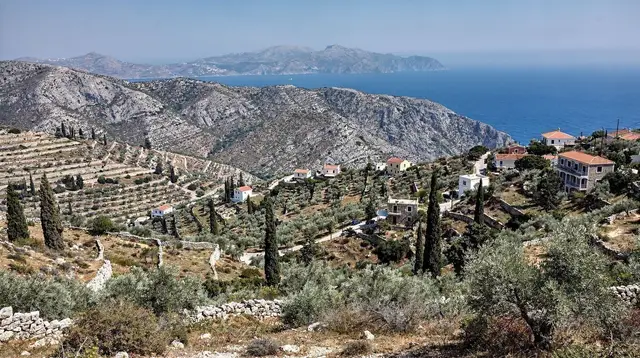
Anogia sits high in the Rethymno regional unit, on the slopes below Mount Psiloritis (also called Mount Ida), which at 2,456 m is the highest point on Crete. The mountain is not a backdrop you glimpse and forget. It holds snow on its upper reaches into May or June most years, which means the village below it has always lived with a genuine mountain climate and a genuine mountain rhythm — long winters, working shepherd families, and a landscape where a car and a good road matter more than almost anywhere else on the island.
That geography is part of why Anogia’s musical identity feels rooted rather than staged. This is shepherd country, and the lyra tradition grew up alongside a way of life built around the mountain, not around a beach schedule. Travellers coming to things to do around Anogia for the music should understand the setting first: a highland village, not a resort town, at real altitude under a real peak.
Getting there: no train, a thinning coach network
Crete has no railway anywhere on the island, a fact worth repeating because visitors sometimes assume a train link exists between the main towns. It does not, in Anogia’s case or anywhere else. The practical default for reaching a mountain village like Anogia is a rental car, and driving in Crete’s mountains means narrow roads where the local habit is to pull onto the hard shoulder to let a faster car pass — a courtesy, not an invitation to overtake blind.
The KTEL coach network is genuinely usable along the north coast corridor connecting Chania, Rethymno, Heraklion and Agios Nikolaos on the VOAK highway. South of that corridor, and on routes up into the mountains, the network thins to a handful of seasonal or infrequent runs. Anogia is reachable by coach from Rethymno or Heraklion, but travellers without a car should check current KTEL timetables directly rather than assume coastal-route frequency applies inland.
And despite the snow that Psiloritis holds well into late spring, there is no ski lift on the mountain. The snow here is a hiking-season and shoulder-season consideration, and scenery for a good part of the year — not a winter-sports destination. Anyone drawn to the peak itself, rather than the village below it, can read more in the dedicated guide to the Psiloritis summit hike.
The lyra and the mantinada: what this page can tell you
The Cretan lyra is a small, pear-shaped bowed instrument played upright on the knee, and it is the lead voice of Cretan traditional music. It is usually paired with the laouto, a long-necked lute that carries rhythm and harmonic support underneath the lyra’s melodic line. Together they are the instrumentation you associate with Cretan village music generally, and with the highland villages around Psiloritis specifically.
A mantinada is a rhymed couplet, typically fifteen syllables across two lines, sung or spoken and very often improvised on the spot — traded between singers, sometimes teasing, sometimes celebratory, sometimes mournful, shaped to the moment and the company present. It is a living oral form rather than a museum piece, which is part of why it resists being pinned down to a fixed repertoire or a single performer’s name.
This guide will not invent what it cannot verify. There is no confirmed record here of a specific founding date for Anogia’s musical reputation, no named performer’s biography to recount, and no venue, ticket price, or show schedule to quote — those details change too often, and belong to the businesses that run them, not to a general destination guide. What can be said with confidence is the setting: a mountain village under the island’s highest peak, in a region — Rethymno and its hill country — where lyra music and mantinades remain part of ordinary social life rather than a recreation staged purely for visitors.
Travellers who want a structured way into that world, rather than hoping to stumble on it, can look at an organised evening built around it, such as the Cretan night with dinner and live music in Rethymno, which brings the food and the music together in one planned outing. For a daytime route that folds Anogia’s mountain setting into a themed visit exploring the area’s cave, cheese-making and cultural threads, there is also a guided day exploring Sfendoni cave and Anogia’s cultural heritage.
Raki at the end of the evening
Traditional Cretan gatherings, musical or otherwise, are very often closed with a glass of raki, also called tsikoudia — a clear spirit distilled from the grape marc left over from winemaking. It carries no anise flavouring, which is the single most important thing to know about it, because it is easy to confuse with ouzo, a separate and distinctly anise-flavoured Greek spirit, or with Turkish rakı, which is also anise-based.
Cretan raki is neither. It is typically offered as a free gesture at the close of a meal rather than sold as a headline drink, and it sits naturally alongside an evening of lyra music and mantinades without being the point of the evening itself. Readers who want the fuller picture, including how it differs from every drink it gets mixed up with, can see the dedicated explainer on raki and tsikoudia.
The wider mountain neighbourhood: Rethymno, Arkadi, Margarites, Panormos
Anogia does not sit in isolation. It belongs to a cluster of inland and hill-country places within the Rethymno regional unit that reward being linked together rather than visited as one-off stops. Rethymno’s old town, with its Venetian harbour streets, is the natural coastal base for this whole corner of the island. Inland and uphill from it sits the monastery of Arkadi, a working religious site and a national symbol with its own dress code — covered shoulders and knees — that travellers should respect on arrival; the fuller context is in the Arkadi monastery guide.
Further into the hills, the pottery village of Margarites keeps its own craft tradition alive in much the way Anogia keeps its musical one — a place where a trade is still practised rather than only displayed, covered in more depth in the guide to Margarites pottery and Cretan crafts. On the coast below, Panormos offers a smaller, quieter alternative to Rethymno town itself for travellers who want a base with sea access close to the mountain villages.
Together, Rethymno town, Arkadi, Margarites, Panormos and Anogia form a realistic loop for a day or two spent in this half of the island, mixing coastal old-town streets, a historic monastery, a craft village, and the mountain village most tied to Cretan lyra music. Anyone weighing how the three main towns compare as a base for this kind of trip can also check Chania versus Rethymno versus Heraklion before deciding where to sleep.
Planning a visit around Anogia and Psiloritis
Because Anogia sits at real altitude below a 2,456 m peak, the season matters more here than it does on the coast. Late April through June and September into mid-October give the most comfortable combination of open mountain roads, mild temperatures and thinner crowds — details covered more broadly in the guide to Crete’s weather month by month. Visitors coming in deep winter should expect the possibility of snow lingering on Psiloritis itself, and should check road conditions before heading up; the general picture for that period is in the guide to Crete in winter.
For travellers building a longer route around the island rather than a single mountain excursion, a west-to-east itinerary such as Crete in seven days, west to east can be adapted to swing through the Rethymno highlands, and hikers with a specific interest in the island’s other major range can compare notes with the White Mountains and Sfakia three-day route.
Several organised options bring the mountain, the caves and the village culture of this area together for travellers who would rather not self-drive every leg. A guided route through the region’s karst landscape and dairy tradition is available as the Sfendoni cave and traditional cheese-making tour near Anogia, while travellers who prefer a private vehicle and a flexible pace can look at the private jeep route up to Anogia and a Psiloritis mountain chalet.
A broader small-group option covering the cave, the mountain and several Cretan villages in one outing runs as the 4x4 tour linking Psiloritis mountain, Sfendoni cave and Cretan villages.
None of these bookings are the point of coming here — the mountain, the village, and the music are. But for travellers without a car, or without the confidence to navigate mountain roads on their own, a structured route up to Anogia is often the difference between reading about Cretan lyra music from a coastal hotel room and actually spending an evening in the village where the tradition is still part of ordinary life.
Frequently asked questions about lyra music and mantinades near Anogia
What is a mantinada?
A mantinada is a rhymed, improvised couplet sung or recited in Crete, often traded back and forth between singers at gatherings. It is a living oral form rather than a fixed set of lyrics, and it is closely tied to the lyra tradition of the mountain villages, including Anogia.
What is the Cretan lyra?
The lyra is a small, pear-shaped bowed string instrument held upright on the knee, the lead instrument of Cretan traditional music. It is typically accompanied by the laouto, a long-necked lute that provides rhythm and harmony, in the villages around Psiloritis and across the island.
Is raki the same as ouzo?
No. Raki, also called tsikoudia in Crete, is a grape marc spirit with no anise flavouring, traditionally offered free at the end of a meal. Ouzo is a separate, anise-flavoured Greek spirit, and the two should not be confused when travelling in Crete.
How do I get to Anogia without a car?
The KTEL coach network is genuinely useful along the north coast route linking Rethymno and Heraklion, but it thins out on mountain routes off that main axis. Anogia sits inland below Psiloritis, so travellers relying on public transport should check current KTEL schedules and expect fewer, less frequent connections than on the coast.
When does Psiloritis have snow?
Mount Psiloritis, also called Mount Ida, rises to 2,456 m and holds snow on its upper slopes into May or June in a typical year. There is no ski lift on the mountain, so the snow is scenery and a hiking-season consideration rather than a winter-sports draw.
Can I combine a visit to Anogia with Arkadi monastery or Margarites?
Yes. Anogia, Arkadi monastery and the pottery village of Margarites all sit within the Rethymno regional unit’s mountain and hill country, along with Rethymno’s old town and the coastal village of Panormos, making them realistic to link on a single mountain-focused day.
Is there a train to Anogia or anywhere else in Crete?
No. Crete has no railway anywhere on the island. A rental car is the practical default for reaching mountain villages like Anogia, since the KTEL coach network is strongest on the north coast and thinner on inland and southern routes.
What season is best for visiting the Anogia and Psiloritis area?
Late April to June and September to mid-October give the best balance of open mountain roads, mild temperatures and thinner crowds. In deep winter, snow can linger on Psiloritis and some routes are less comfortable to drive, though Anogia itself, like Crete’s main towns, does not close down for the season.
Nightlife & Shows in Crete on GetYourGuide
Verified deep-linked GetYourGuide tours. Book through these links and we earn a small commission at no cost to you.
GetYourGuide does not provide a product photo for this activity — the image shows the meeting point, photographed by us.