Cretan Villages and Festivals: What Traditional Life Looks Like
What is left of traditional village life in Crete?
Away from the roughly 20 km package coast between Hersonissos and Malia, most of Crete's 260 km length is still mountain and farming villages. Tourist-facing shops in these villages often close from November to March, while tavernas, churches and monasteries in the historic towns stay open year-round.
Most visitors to Crete spend their days somewhere within sight of the sea, and the image that travels home is usually a beach, a harbour or a hotel pool. That picture is not wrong, but it is partial. Crete is home to roughly 620,000 people spread across four regional units, from Chania in the west to Lasithi in the east, and the package-holiday coast between Hersonissos and Malia — the strip most associated with mass tourism — runs for about 20 km out of an island that stretches some 260 km end to end.
Everything past that strip, which is most of the island, is still largely villages: farming communities, mountain hamlets, plateau settlements and small market towns that go on with their own rhythm whether or not a tour bus passes through.
An island held together by villages, not resorts
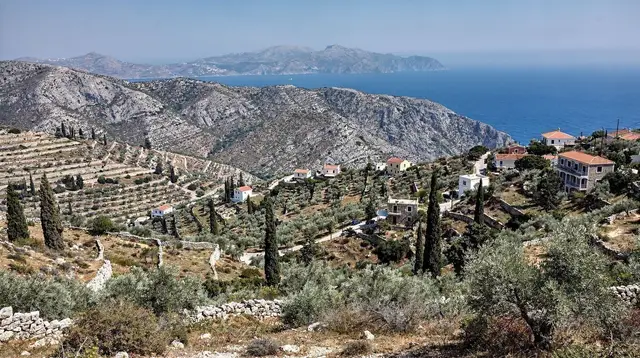
It helps to hold the scale in mind. Crete is not a single destination but four, arranged west to east: Chania and its coast, the wilder south-west around the Samaria gorge, Rethymno and its mountains, Heraklion and the centre, and Lasithi in the east. Between and above the coastal towns sit hundreds of villages, many of them centuries old, built around a church, a square with plane trees, and a kafenio where older men still gather over coffee or raki in the late morning. Some villages sit directly on tourist routes and have adapted, gently or not so gently, to visitors. Others are a genuine detour, reached by a narrower road, and carry on largely as agricultural communities: olives, grapes, herds of goats and sheep, small vineyards.
This is worth stating plainly because it is easy, from a week based in Gouves or Hersonissos, to come away thinking Crete is a resort island with some ruins attached. It is closer to the reverse: an island of villages and small towns, with a narrow, heavily developed strip of coastline serving the package trade. Recognising that changes how a trip is worth planning — a rental car and an afternoon off the main highway does more for a sense of the island than another hour on a sunbed.
West to east: village life across four regions
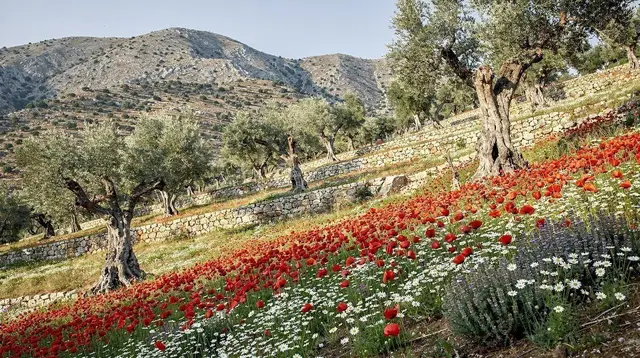
In the west, around Chania town, villages in the foothills of the Lefka Ori — the White Mountains — still keep small terraced groves and flocks that move seasonally. Villages such as those explored on an Apokoronas villages tour sit inland from the coast, close enough for a day trip but far enough to feel like a different pace of life. Further south, villages like Therisso, reached through its own gorge, carry real historical weight — it was a base for Cretan resistance movements against Ottoman rule, and later Venizelos’s revolt of 1905, long before it became a lunch stop for visitors.
a private day among the villages of Apokoronas, with a home-style lunch included, gives a fairly direct route into this side of Crete without needing to plan the back roads yourself.
Moving east into the Rethymno region, the mountain villages around Anogia, high on the slopes of Psiloritis, have a reputation within Crete itself for a fierce independence, a strong tradition of lyra music, and a history that includes being burned by German occupying forces in 1944 in reprisal for resistance activity — it was rebuilt, and the memory of that history is still part of how the village understands itself. Nearby, Margarites has been a pottery village for generations, its workshops still turning and firing clay using techniques passed down through families rather than reproduced for a gift-shop shelf.
In the Heraklion regional unit, the wine villages of Archanes, Dafnes and Peza sit inland from the coast in gently rolling country, growing the indigenous grapes — Vidiano, Vilana, Kotsifali, Mandilari among them — that go into Cretan wine. Archanes in particular is a well-kept small town with a Venetian-era core, working squares, and none of the resort infrastructure of the coast twenty minutes away. Further east, in Lasithi, villages such as Kritsa above Agios Nikolaos keep a weaving and embroidery tradition, and the approach roads into the Lasithi plateau pass through a string of smaller farming settlements that most itineraries drive past rather than through.
The Lasithi plateau: windmills that no longer turn
The Lasithi plateau, at around 850 m, is one of the clearest places on the island to see how the picture-postcard version of a place and its present reality have drifted apart. For much of the twentieth century, thousands of white canvas-sailed windmills stood across the plateau’s fields, pumping groundwater up for irrigation on a plain that has no river of its own. Photographs of that white-sailed plateau are still what many people expect to see on arrival.
That landscape is gone. Diesel and electric pumps replaced the windmills decades ago, and almost all of the original structures have fallen into disrepair — what a visitor sees driving across the plateau today is mostly rusted metal skeletons standing in fields, stripped of their sails, alongside modern pump housing doing the actual work. A small number of windmills have been restored and re-sailed, mainly at accessible points along the main road, specifically so that visitors have something photogenic to stop for.
It is a reasonable thing to stop and photograph — the restored windmills are attractive, and the plateau itself, ringed by mountains and still farmed in strips the way it has been for centuries, is genuinely worth the drive. It simply is not the working landscape of moving white sails that older photographs suggest, and a guide that let that impression stand uncorrected would be doing readers a disservice.
The villages around the plateau’s edge — Tzermiado, Agios Georgios, Psychro among them — are themselves modest farming settlements, home to the Dikteon cave at Psychro and to a scatter of tavernas that lean on plateau produce: potatoes, apples, and the plateau’s own honey. A full day loop around the Lasithi plateau is the practical way to take in both the windmills and the villages that surround them without rushing either.
When the season ends: what closes and what doesn’t
Crete’s villages run on a genuinely seasonal economy, and it shows most clearly between November and March. Many of the businesses that exist specifically to serve visitors — souvenir stalls, some seasonal tavernas, certain guided activities — scale back or close entirely for the winter months, particularly away from the three historic towns. A village that feels lively and well-stocked in July can feel considerably quieter, and some streets genuinely shuttered, in January.
What stays open is telling in itself: the churches, the working monasteries such as Arkadi, and the tavernas that primarily serve local residents rather than tour groups tend to carry on through the winter, because their purpose was never tied to the tourist calendar.
The same pattern holds in the historic towns — Chania, Rethymno and Heraklion keep their old towns, museums and core restaurants running year-round, even as the resort strip along the north coast largely goes quiet. A traveller planning a winter visit does better basing themselves in one of the three towns and treating village visits as day trips, rather than expecting village-level infrastructure to be waiting in the off season.
Panigiria: festivals that happen, without a fixed calendar printed here
The clearest surviving expression of communal village life in Crete is the panigiri, a village festival usually built around a saint’s day on the Orthodox calendar, or occasionally a harvest, and centred on a church or a monastery. A panigiri typically means an open-air gathering with long tables, grilled meat, local wine or raki, and live lyra and laouto music that can run late into the night, with dancing that draws in most of the village rather than staying as a spectator event.
These are not staged for visitors, and that is exactly what makes them worth attending if the timing lines up — but it also means this guide is not going to print a specific festival calendar with fixed dates. Saints’ days, harvest timing and local custom vary from village to village and year to year, and a date printed here in September 2026 would be stale, or simply wrong for a given village, well before most readers travel. The honest approach is to ask locally, close to your dates — a hotel, a taverna owner or a local tour operator will usually know what is happening nearby that week — rather than relying on a list assembled in advance from outside the island.
Where to meet village life today
For travellers who want more than a drive-through impression, the most reliable route in tends to be through food, craft or a guided day with someone who actually lives in the villages being visited. A cooking class on a working farm, for instance, puts you inside a kitchen and often a garden rather than past one, and usually includes the kind of dishes covered in more depth in this site’s guide to what to eat in Crete and to dakos and the Cretan mezze table.
a culture tour paired with a hands-on pottery workshop is a direct way to spend time with a craft, like the one still practised in Margarites, that has been passed down inside families rather than packaged for a factory line. For a broader single-day introduction to several villages at once, without the planning of a self-drive route, a private tuk-tuk tour through seven villages with tastings along the way covers more ground in less time than most visitors would manage on their own.
Travellers building a longer trip around this side of the island might also look at the four-day food and wine itinerary, which links several wine villages and farm visits into a single route, or at the deeper dive into Cretan music, lyra and mantinades, the improvised rhyming couplets still sung at village gatherings.
None of this requires abandoning the coast entirely — a stay based in Chania, Rethymno or Heraklion still gives easy access to village day trips — but it does mean treating the villages as a destination in their own right, not a backdrop glimpsed from a bus window between a beach and a museum.
A few notes on visiting respectfully
Village life in Crete is lived, not curated, and a handful of habits go a long way. Dress modestly around churches and monasteries — covered shoulders and knees, as required at Arkadi and elsewhere — even in villages where no one enforces it. Ask before photographing people at a kafenio table or inside a panigiri; a festival is a private community occasion that happens to be visible, not a public performance. And keep in mind, particularly outside July and August, that a quiet village street may simply mean the businesses there have closed for the season rather than that anything is wrong with the place — the same village that feels sleepy in February can be full of life again by May.
Read next: this site’s broader look at why Crete is not a small island and at what actually closes in Crete over winter both expand on themes touched on here, as does the dedicated piece on the Lasithi windmills that are no longer there.
Cretan village life and festivals, answered
Are the famous Lasithi plateau windmills still working?
No. The white-sailed canvas windmills that once pumped irrigation water across the plateau, at around 850 m, have almost all stopped turning. What remains today is mostly rusted metal frames, with a handful restored and re-sailed for visitors to photograph rather than for daily use.
Is the resort strip near Hersonissos and Malia typical of Crete?
No. That built-up coast runs for roughly 20 km, out of an island that stretches about 260 km from Chania in the west to Sitia in the east. The great majority of Crete’s territory is mountain range, plateau and farmland, dotted with villages that have little to do with the package coast.
What happens in Cretan villages during the low season?
From roughly November to March many tourist-facing businesses in villages, such as souvenir shops and seasonal tavernas, close for the winter. Village churches, working monasteries and the tavernas that serve local residents rather than passing tour groups tend to stay open, because they are not there for tourism in the first place.
Can visitors attend a traditional Cretan festival, or panigiri?
Panigiria, village saint’s-day festivals with food, wine and live lyra music, are a real and ongoing part of Cretan life, usually tied to the calendar of the Orthodox church and to a particular village’s patron saint. Dates and details vary by village and by year, so this guide does not print a fixed festival calendar; check locally, close to your travel dates, for what is actually happening.
Where can a traveller actually experience village life, rather than just drive through it?
The clearest way in is usually food and craft: a cooking class on a working farm, a pottery workshop in a village that still makes it, or a guided day through several villages with a local host. These put you inside a kitchen, a workshop or a family table rather than past it through a car window.
Do mountain villages have the same facilities as the coastal towns?
Not always. Smaller villages, especially in the mountains around Psiloritis or on the Lasithi plateau, may have one taverna, a kafenio and a church rather than a full range of shops, and some of that closes outside the main season. Chania, Rethymno and Heraklion remain the reliable year-round bases.
Village Tours in Crete on GetYourGuide
Verified deep-linked GetYourGuide tours. Book through these links and we earn a small commission at no cost to you.
GetYourGuide does not provide a product photo for this activity — the image shows the meeting point, photographed by us.