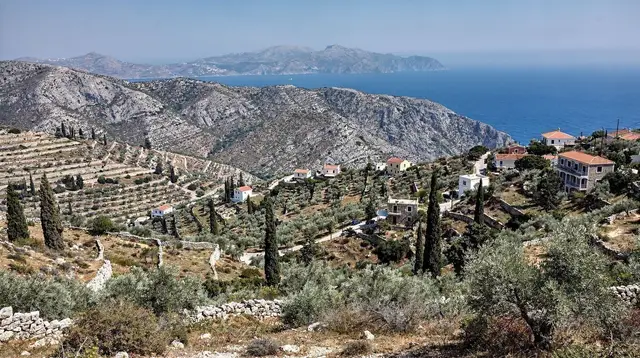
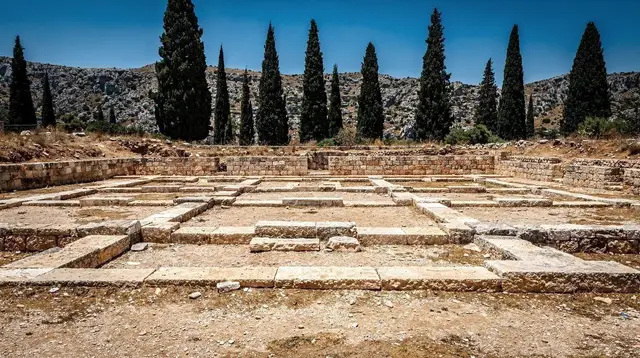
Margarites and the Melidoni cave sit a short drive apart in the hills above Rethymno, on the lower slopes of Psiloritis, and between them they make one of the more honest half-days inland Crete has to offer. Neither place is trying to be a resort attraction. Margarites is a working pottery village where the craft is still made in front of you, not staged for a photo, and Melidoni is a natural limestone cave with a heavy history, one of dozens that riddle the island’s interior. There is no beach here and almost no organised entertainment. What there is, is worth the drive if you go in with the right expectations.
Why this pairing works
Margarites and Melidoni are separated by about 4 km of winding hill road, close enough that most visitors do both in the same stop rather than choosing one. The village gives you the human side of the region: workshops, wheels, kilns, and generations of potters who never stopped supplying tavernas and homes with the ordinary vessels of Cretan cooking. The cave gives you the geological side: cool stone passages under the hillside, part of the same limestone bedrock that also carves the island’s gorges further south and west. Together they explain something about inland Rethymno that the coast doesn’t: this is a folded, porous, mountainous interior, not a flat strip of sand and sunbeds.
It helps to be clear about scale before you go. This is a rural corner of one regional unit, not a headline sight. Accommodation options in Margarites itself are few, there is no beach for miles, and neither stop offers a large-scale organised experience — you’re looking at a village square, a handful of workshops, a church, and a cave with a marked path. Visitors expecting a curated attraction with facilities to match will be disappointed; visitors who want an unhurried look at how Cretan pottery is actually made, plus a genuinely different kind of sight underground, tend to leave satisfied.
Margarites: a village that still throws pots
Margarites has made pottery for centuries, using the same red clay that runs through this part of the Psiloritis foothills, and the trade is still visible rather than folklorised. Walk the village’s narrow lanes and you pass workshop after workshop, several with a wheel turning inside and a kiln out back, selling directly from where the work happens. Sizes range from large traditional storage jars, the kind once used for oil and wine, down to everyday tableware, decorative pieces and small souvenirs that actually come from the potter rather than a wholesaler.
The honest way to see Margarites is slowly: stop in more than one workshop, watch a piece being thrown if the potter is working, and buy from someone whose hands you’ve just watched. Prices vary by size and technique — a small glazed piece might run a few euros, a large hand-thrown jar considerably more — and most workshops will discuss shipping for anything too large or fragile to carry home in a suitcase. There’s no fixed circuit and no entry fee to the village itself; you’re simply walking a hill settlement whose main trade happens to be one you can watch and buy.
Beyond the pottery, Margarites has a modest church and a few tavernas serving straightforward village food, but this is not a place with a long list of sights. It rewards an hour or two of unhurried walking rather than a tight itinerary. For travellers who want a fuller sense of the craft’s history and techniques before or after visiting, a dedicated look at the pottery and crafts tradition of this region fills in the background the workshops themselves won’t have time to explain.
Melidoni cave: crete’s limestone underground
A short drive from Margarites, the Melidoni cave is a natural cavity in the same limestone that shapes so much of inland Crete — the island’s mountains and gorges are folded rock and karst, never volcanic ground, and Melidoni is one small, accessible example of what that limestone does underground. Inside, a lit path leads through a series of chambers with the usual cave features: stalactites and stalagmites built up over an immense stretch of time, cooler air than the surface outside, and an uneven, sometimes slippery floor that calls for proper shoes rather than sandals.
Melidoni’s history is heavier than its geology. In 1824, during the Cretan uprisings against Ottoman rule, several hundred villagers who had taken refuge inside the cave were killed when their pursuers set fires at the entrances and suffocated them with smoke — one of several such episodes across Crete’s long resistance history that locals still speak of as recent rather than distant. A memorial inside the cave marks the site, and the visit reads differently once you know this: it is not only a geological curiosity but a place of memory for the villages around it, in the same register as the wartime cemeteries and monasteries elsewhere on the island.
Entry to the cave is ticketed, modest in price, and the visit itself takes well under an hour on the marked path — this is not a multi-hour caving expedition, and no equipment beyond decent footwear and a light layer for the cooler air inside is needed. Travellers curious about how Melidoni compares with Crete’s other underground sites, including the mythologically loaded Dikteon cave on the Lasithi plateau, will find the fuller comparison in a dedicated cave guide.
Getting there: why you need a car
This is the part of the plan that catches visitors out. Crete’s KTEL coach network is genuinely usable along the north coast — Chania, Rethymno, Heraklion and Agios Nikolaos are linked by regular services on the VOAK highway — but that coverage thins out fast once you leave the coast road. Margarites and Melidoni sit inland, off that corridor, and neither village has a practical public bus connection for a day visit. There is no train anywhere on the island to fall back on either.
In practice, this means a rental car is close to essential for combining the two stops in one trip. The roads themselves are unremarkable by Cretan mountain standards — paved, winding, well within the ability of anyone who has driven in Crete before — but they are narrow in places, and the local habit of pulling onto the hard shoulder to let a faster car pass is a courtesy, not an invitation to overtake blind. If self-driving isn’t appealing, an organised tour or private driver is the realistic alternative, since it removes the routing and parking questions entirely while still reaching a genuinely inland pocket of the island that most bus-based itineraries simply skip.
Several small-group and private options run this exact combination. A full look at the route with time built in for both stops is the Arkadi, Melidoni and Margarites half-day tour, which adds the monastery to the pairing described here. Travellers who want the flexibility of a private car and driver, with the itinerary shaped around their own pace, might prefer the private tour to Margarites, Arkadi monastery and Patsos gorge, which extends the day into a nearby gorge as well.
Best time to visit Margarites and Melidoni
Both stops work at almost any time of year, since neither depends on beach weather or a sea crossing, but the season still matters. July and August bring the same 30-35°C heat to this inland pocket as to the rest of the island, without any coastal breeze to soften it, and walking a hillside village or standing outside workshops in that heat is less pleasant than it needs to be. The cave itself stays cool underground regardless of season, but the drive and the village walk do not.
Late April through June, and again from September into October, are the better windows: mild temperatures, decent daylight, and the wildflowers that run through the Psiloritis foothills in spring add something to the drive itself. This lines up with the best time to visit Crete more broadly, and specifically with visiting in September, which combines cooler air with workshops and tavernas still operating on their full summer hours rather than the reduced winter schedule.
Winter visits are possible — the village and the cave both stay open — but some workshops keep shorter hours or close for stretches between November and March, so calling ahead or checking locally before making the drive is worth the extra step outside the main season.
How to combine Margarites and Melidoni in a day
The natural pairing beyond the two core stops is Arkadi monastery, a short drive away and one of Crete’s most significant historical sites — the 1866 siege and explosion there is a national symbol, and the monastery keeps a dress code of covered shoulders and knees, the same as at other working religious sites on the island. Many day tours already link all three, and it’s an easy add for anyone driving independently as well.
Beyond Arkadi, a loop through this part of the Psiloritis foothills opens up further options depending on how much time is available. Anogia, the mountain village under Psiloritis itself, sits further up and adds a different character — more pastoral, higher altitude, known for its weaving as much as Margarites is known for its pottery.
A shepherd-for-a-day style visit into this same landscape is offered as the Rethymno shepherd-for-a-day experience, which trades the pottery workshops for a look at the pastoral side of the same hills. For travellers who’d rather build the day around food and tradition than craft and history, the Rethymno gastronomy, tradition and culture experience covers similar ground from a culinary angle.
Those basing in Rethymno town itself have the shortest drive and can treat this as a half-day out from the old town, returning in time for an evening walk through the Venetian harbour or up to the Fortezza. From Heraklion the drive is closer to an hour, which still leaves the rest of the day free for Knossos or the city itself. Either way, this is not a stop that anchors a multi-day itinerary on its own — it slots into a broader week or ten days across the island as a single, well-chosen half-day rather than a destination in its own right.
Where to stay nearby
Margarites has essentially no hotel infrastructure of its own — a handful of rooms at most, and nothing resembling the resort accommodation of the north coast strip. Almost every visitor treats it as a day stop from a base elsewhere, most commonly Rethymno town, which has the widest range of accommodation, the shortest drive to Margarites and Melidoni, and the old town’s restaurants and harbour to return to in the evening.
Heraklion works nearly as well as a base, particularly for travellers also planning to see Knossos or fly in and out of Heraklion airport. Villages closer to the foothills, such as Spili further south, offer a quieter overnight option for anyone building a longer stay around this inland stretch of Rethymno rather than the coast.
FAQ: visiting Margarites and the Melidoni cave
Is Margarites worth visiting if I’m not planning to buy pottery?
Yes, though buying something is part of what makes the stop worthwhile for most visitors. Even without buying, walking the lanes and watching potters at the wheel gives a look at a working craft tradition that most coastal stops in Crete don’t offer, and the village itself, with its church and hillside setting, is a pleasant walk regardless.
How long does it take to see Margarites and the Melidoni cave together?
Budget around half a day. The cave visit itself takes under an hour on the marked path, and an hour or two in Margarites is enough to walk the lanes and visit several workshops. Add Arkadi monastery and the half-day extends comfortably into a fuller but still relaxed day trip.
Can I reach Margarites and Melidoni by KTEL bus?
Not practically. The KTEL network covers the north coast corridor well but thins out inland, and neither village has a workable public bus connection for a day visit. A rental car or an organised tour is the realistic way to combine the two stops.
What is the Melidoni cave, and is it connected to the Dikteon cave near Lasithi?
They are different sites. Melidoni is a limestone cave in the Rethymno foothills with a marked path and a significant 1824 wartime history, when villagers sheltering inside were killed by smoke during the Ottoman-era uprisings. The Dikteon cave, on the Lasithi plateau further east, is linked in mythology to the birth of Zeus. Both are natural caves in the same limestone bedrock that shapes much of inland Crete, but they sit in different regions and have different stories attached to them.
Is there anywhere to stay in Margarites itself?
Only a small number of rooms, and no resort-style accommodation. Most visitors day-trip from Rethymno town, Heraklion, or a smaller inland base such as Spili, rather than staying overnight in Margarites.
What’s the best season to visit this part of inland Rethymno?
Late April to June and September to October give the most comfortable temperatures for walking the village and driving the hill roads, and workshops tend to keep fuller hours in these months than in the depths of winter. July and August bring the same inland heat as the rest of the island, without a coastal breeze to offset it.
Can Margarites and Melidoni be combined with Arkadi monastery in one day?
Yes, and most organised tours already do exactly this. Arkadi is a short drive from both Margarites and Melidoni, and several half-day and full-day tours link all three stops, adding either a gorge or a food and culture element depending on the itinerary chosen.
Is this a good stop for families or travellers without much time in Crete?
It can be, particularly for families who enjoy watching a craft in progress, but it’s a modest, unhurried stop rather than a headline attraction. Travellers with only a few days on the island and a fixed list of major sights may prefer to prioritise Knossos, Samaria, or a coastal highlight first, and add Margarites and Melidoni only if an extra half-day inland is available.