Dia Island Boat Trips: Kri-Kri, Not Dolphins
Will I see dolphins or whales on a Dia island boat trip?
Rarely, and it's never promised. Crete is not a cetacean-watching destination, and a Dia boat trip is really a short crossing to a protected islet off Heraklion where the Cretan wild goat, the kri-kri, is the main wildlife draw, alongside swimming stops in clear water.
What a Dia boat trip actually delivers
Ask around Heraklion’s old harbour and you’ll find half a dozen operators selling a “Dia island cruise.” The photos on the boards outside show turquoise water and someone snorkelling. What they don’t show, because it would be misleading, is a pod of dolphins riding the bow wave, or a whale breaching offshore. That’s not an oversight. Crete sits on the edge of the Mediterranean’s deep basin, but it is not a cetacean-watching coastline in the way Iceland or the Bay of Biscay are, and no operator running trips out of /destinations/heraklion-city/ can promise you a dolphin sighting, because there is no resident population to point a boat toward.
What a trip to Dia actually is: a short crossing from the mainland to a small, protected, uninhabited island, where the appeal is the island itself - its wild goats, its bare limestone coves, its total absence of development - rather than anything happening in the water around it. That’s worth knowing before you book, because it changes what you should expect to get out of the day, and it’s the same pattern that runs through every boat excursion sold along this coast.
A trip to /destinations/balos-gramvousa/ takes you to a lagoon and a fortress, not a marine reserve. A trip to /destinations/elafonissi/ can be reached by boat from Paleochora in season, and it takes you to a sandspit, not a sighting ground. A trip to /destinations/elounda-spinalonga/ takes you to a Venetian fortress with a human history most visitors don’t expect. Crete’s boats go somewhere. They don’t circle waiting for something to surface.
Where Dia actually sits, and why it’s an Heraklion trip
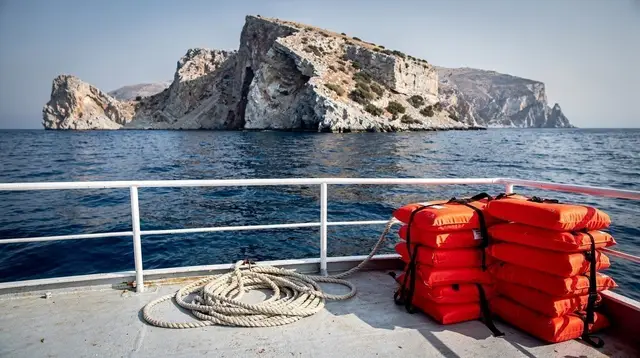
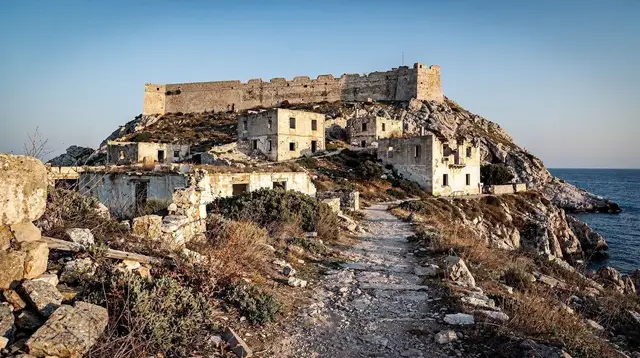
Dia (sometimes written Dhia, and historically identified by some scholars with the “Ogygia” of Homer, though that reading isn’t settled) lies roughly 7 nautical miles, about 13 km, due north of Heraklion port. From the water it reads as a long, bare, hilly silhouette - about 7 km across at its widest, uninhabited except for a handful of seasonal wardens and researchers, and entirely without roads, villages or permanent buildings. It has been a protected nature reserve since the 1970s, which is precisely why it still has something worth protecting.
Because of that geography, Dia is functionally a Heraklion excursion. It sits offshore from the capital and largest city on the island, home to roughly 180,000 people within the city itself and over 200,000 across the wider municipality, and most boats leave directly from the marina beside the old Venetian harbour, a short walk from the /destinations/heraklion-city/ centre and from /guides/heraklion-city-walk/.
A second cluster of departures runs from Gouves and from Agia Pelagia, both resort bases a short drive east and west of the capital respectively, which is why you’ll see Dia trips marketed under both names depending on where you’re staying. None of this makes Dia a destination you build a day around on its own. It’s an add-on to a Heraklion base, best paired with the city’s Venetian walls, its market streets, or a morning at /guides/heraklion-archaeological-museum/ before an afternoon on the water.
If you’re staying near Knossos or planning a Minoan-focused day, it’s worth being honest about the order of priorities. The frescoes on display at the palace of Knossos are reproductions - the originals live in the Heraklion museum, five kilometres away - and that museum, not the boat trip, is where you actually see Minoan Crete up close. See /guides/knossos-and-the-heraklion-museum/ for how to sequence the two sites. Dia is the afternoon that follows a morning of ruins and galleries, not a substitute for either.
The real reason to go: the kri-kri
The kri-kri, the Cretan wild goat, is the animal actually worth watching for on a Dia excursion, and it’s a genuinely rare sight rather than a marketing flourish. Once widespread across Crete, the kri-kri was hunted close to extinction on the main island and now survives as a truly wild population in only a handful of protected places: the /destinations/samaria-gorge/, and three small offshore islets - Dia, Theodorou and Agii Pandes - where the absence of predators, traffic and hunting has let the population hold on.
That’s a meaningfully different animal from the goats you’ll see grazing roadside verges all over rural Crete, which are domestic herds. The kri-kri is stockier, paler, with backward-curving horns on the males, and it is genuinely shy of people. A Dia boat trip gives you a chance, not a guarantee, of spotting one on the hillside above a cove, usually at a distance and usually for only a few seconds before it moves off.
Bring binoculars if you have them; a phone camera won’t do much from a moving boat. If wildlife is really what’s drawing you to Crete rather than the coastline, it’s worth reading /guides/spinalonga-island-guide/ alongside this one only for context on what the other protected islets offer - Spinalonga’s story is historical, not zoological, but the two are often confused by first-time visitors scanning excursion boards for “island boat trip.”
a private snorkelling cruise out to Dia is the version of this trip built around the water rather than the goats, and it’s worth choosing deliberately depending on which one you actually want.
What Dia is not: a beach day or a wildlife park
It bears repeating, because the marketing photography rarely makes it clear: Dia has no organised beach. There are no sunbeds, no beach bars, no facilities of any kind beyond what the operator carries on the boat itself. Swimming happens from the vessel or at a small, unimproved cove where the water is clear but the shoreline is bare rock and scrub, not sand. If a soft-sand swimming stop is what you’re after, that’s a Balos or Elafonissi trip, not a Dia one - see /guides/balos-lagoon-boat-or-road/ and /guides/elafonissi-beach-guide/ for those.
It is also, again, not a wildlife-viewing platform in the way an aquarium or a safari park is. This is a nature reserve, not an attraction built to guarantee sightings. Operators cannot herd the kri-kri toward the boat, cannot call in dolphins that aren’t there, and shouldn’t be expected to. What they can offer is a quiet crossing over open water, a swim in a place most visitors never reach independently, and the outside chance of watching a genuinely wild animal on genuinely wild terrain. Treat the wildlife as a bonus, not the reason to book, and the day tends to land well. Treat it as the main event and it’s easy to come back disappointed by something the operator never actually promised.
Choosing a Dia island boat trip
The trips on offer split roughly into three categories: straightforward swimming-and-snorkelling crossings, trips built around a specific extra (music, food, sailing technique), and trips that combine Dia with another stop rather than treating it as the sole destination.
| Style of trip | Typical length | What it adds | Good for |
|---|---|---|---|
| Snorkelling cruise from Heraklion | 4-5 hours | Snorkel gear, one or two swim stops | Visitors based in Heraklion city wanting a half day on the water |
| Boat trip from Gouves | 3-4 hours | Departure closer to the eastern resort strip | Guests staying around Gouves or Hersonissos |
| Combined tour from Agia Pelagia | 4-6 hours | Pairs Dia with the Agia Pelagia coastline | Guests based west of Heraklion |
| Themed cruise (music, celebration) | 3-4 hours | Live Cretan music or an event focus | Groups wanting atmosphere over wildlife |
| Sailing and light fishing trip | Half day | Trolling fishing, sailing technique | Visitors who want an active day on the water rather than a lounging one |
For a trip departing the eastern resort belt, a boat trip to Dia island from Gouves saves the drive into Heraklion itself. For visitors staying west of the capital, a Dia island tour departing Agia Pelagia works the same way from the other side, combining the crossing with the Agia Pelagia coastline on the way out or back.
Practical planning
Boats generally run daily in season, roughly May to October, with the calmest, warmest sailing conditions from June through September. Outside that window departures thin out fast and many operators stop altogether over winter, in keeping with how much of the island’s boat-dependent coast quiets down between /blog/what-closes-in-crete-in-winter/ months.
The meltemi, the strong seasonal north wind that peaks in July and August, is the biggest single risk to a Dia departure: it can delay a sailing by a few hours or cancel it outright, the same way it periodically shuts down boats to Balos, Gramvousa and Chrissi. Build a day around a Dia trip, don’t build a whole itinerary on one specific departure time, particularly in mid-summer.
Bring the basics: a swimsuit under your clothes, a towel, reef-safe sunscreen, a hat, and water. Shade on board is often limited to an awning over part of the deck, and the crossing plus swim stops can run four to six hours depending on the operator. Sea state around Dia is usually mild in summer since the islet sits in the lee of the coast for most wind directions, but anyone prone to seasickness should take the usual precautions before boarding, not after.
If snorkelling is genuinely the point of your day rather than the destination, it’s worth comparing a Dia trip against the alternatives directly. a live-music cruise that stops at Dia leans toward atmosphere and a shared table on deck rather than time in the water, which suits groups and celebrations better than it suits anyone chasing a long swim.
How Dia compares to Crete’s other island boat trips
It helps to place Dia against the other classic Cretan “boat to an island” excursions, because visitors regularly conflate them when browsing an activity board.
| Islet | Departs from | Known for | Not known for |
|---|---|---|---|
| Dia | Heraklion, Gouves, Agia Pelagia | Kri-kri wild goats, quiet coves | Sand beaches, cetacean sightings |
| Balos / Gramvousa | Kissamos | A shallow lagoon, a Venetian fortress | Wildlife watching |
| Chrissi | Ierapetra | A juniper forest, sandy beaches | Facilities, off-season access |
| Spinalonga | Elounda, Plaka, Agios Nikolaos | A former leper colony, Venetian fortifications | Swimming or wildlife |
None of these four islets is a whale or dolphin destination, and none of them should be booked expecting one. Each earns the trip on its own terms: history at Spinalonga, scenery at Balos, sand at Chrissi, and at Dia, the rare chance of a wild kri-kri against a backdrop of open water and the Heraklion coastline receding behind you.
Dia island boat trips: the questions that come up
Can you see dolphins or whales on a Dia island boat trip?
Sightings are rare and never guaranteed. Crete is not a whale-watching destination, and Dia trips are sold as swimming and snorkelling excursions to an island, not as marine-life safaris.
What wildlife will I actually see on Dia?
The main draw is the kri-kri, the Cretan wild goat, which survives in the wild here along with the islets of Theodorou and Agii Pandes and inside the Samaria gorge. A sighting from the boat or a landing point is possible but not guaranteed on every crossing.
How far is Dia from Heraklion?
Dia lies about 7 nautical miles, roughly 13 km, north of Heraklion port. Most organised boat trips take 20 to 30 minutes each way.
Is there a beach or facilities on Dia island?
No. Dia is a protected, largely uninhabited islet with a couple of coves used for swimming stops from the boat. There are no organised beaches, sunbeds, restaurants or fixed facilities.
Can I visit Dia independently, without a tour?
Access is by boat only, and almost all crossings are organised excursions departing Heraklion, Gouves or Agia Pelagia. There is no public ferry line, so an independent visit means chartering a boat.
What’s the best month for a Dia island boat trip?
May to September gives the calmest seas and warmest water, around 21 to 27 degrees Celsius, though the meltemi wind in July and August can delay or cancel crossings.
Boat Cruises in Crete on GetYourGuide
Verified deep-linked GetYourGuide tours. Book through these links and we earn a small commission at no cost to you.
GetYourGuide does not provide a product photo for this activity — the image shows the meeting point, photographed by us.