Wildlife in Crete: Kri-Kri, Snakes and Vultures
Do I need to worry about snakes or wild animals hiking in Crete?
No. Crete has only four snake species and none are vipers, so there is no serious snake risk on the Samaria gorge trail or anywhere else. The island's notable wildlife, the kri-kri goat and the bearded vulture, are shy, protected species you might glimpse rather than reliably encounter.
Snakes, goats and vultures: what actually lives in Crete’s wild places
Most questions about Cretan wildlife arrive from the same place: someone is about to walk 16 km down the Samaria gorge and wants to know what they might meet on the way. The honest answer sits at two extremes. On one side, a fear that turns out to be almost groundless. On the other, two genuinely remarkable animals that most visitors will never see up close, because they are rare, wary and protected rather than tame or habituated to tourists. This page covers both halves plainly, without turning either one into more than it is.
Do you need to worry about snakes in the Samaria gorge?
No. Crete has exactly four snake species, and not one of them is a viper. There is no medically dangerous snake anywhere on the island. That single fact settles most of the anxiety that shows up before a first hike through the Samaria gorge guide trail, the Imbros gorge or any of the smaller canyons that cut through the Lefka Ori.
Snakes here are shy, cold-blooded animals that avoid the vibration and noise of a trail full of walkers. The overwhelming likelihood on the 16 km descent from the Xyloskalo above Omalos down to Agia Roumeli is that you finish the walk having seen none at all, and that stays true whether you go with a group or read the Samaria gorge from Chania planning guide and set out on your own schedule. If you do see one, the practical response is the same as almost anywhere in southern Europe: leave it alone, let it move off, and keep walking. There is nothing here worth a change of route or a change of plan.
The kri-kri: Crete’s own wild goat
The animal people actually hope to see is the kri-kri, the Cretan wild goat, and it is worth being precise about what that means. It is not a farm goat that wandered off. The kri-kri is recognised as a distinct wild form, with a stocky build, curved horns on the males and a grey-brown coat that blends into limestone scree almost perfectly. It has lived on Crete long enough to become part of how the island tells its own natural history, and it has come close to disappearing more than once, largely through hunting.
Two kinds of ground protect it today. The first is the Samaria gorge itself, a national park since 1962, where kri-kri share the cliffs and scree slopes with walkers on the main trail without being fed, tracked or herded for viewing. The second is a set of small, uninhabited islets off the north coast: Dia, opposite Heraklion, and Theodorou and Agii Pandes, both near Chania.
These islets have no foxes, no dogs, no introduced predators and no permanent human presence, which is exactly why the more stable kri-kri populations live there rather than on the mainland of the island. A boat trip that passes Dia island, covered in more detail in the Dia island boat trips guide, is one of the few settings where the goats are not competing with thousands of hikers a day for the same quiet ground.
None of this should be read as a promise. Kri-kri are genuinely wary animals. They tend to move at the cooler edges of the day, early morning and late afternoon, and they keep to terrain that is awkward for people: steep scree, narrow ledges, the upper flanks well above the gorge floor where most walkers stay. A guided descent of the gorge with someone who knows the trail well gives you a better chance simply because a guide knows where sightings have happened before, not because any operator can arrange an encounter. Framing a kri-kri sighting as the point of the day, rather than a possible bonus on top of one of Europe’s great gorge walks, is the surest way to leave disappointed.
a guided day trip down the full length of the Samaria gorge, the kri-kri’s main mainland stronghold covers the classic one-way descent with transport and a boat connection built in, which matters more for logistics than for wildlife odds, but it does put you on the ground where Crete’s wild goat actually lives.
The bearded vulture over the White Mountains
The other animal worth knowing about before you look up into a Cretan sky is the bearded vulture, also called the lammergeier: a huge raptor, wingspan well over two metres, that feeds largely on bone marrow and drops bones from height to crack them open on rock. It is one of the rarest birds in Europe, and Crete’s Lefka Ori, the White Mountains, hold one of its last reliable footholds in the country.
The Lefka Ori are not a single peak but a whole range in the island’s south-west, culminating at Pachnes, 2,453 m, just short of Psiloritis as the island’s true high point. They stay capped with snow well into late spring, and their cliffs and gorge heads, including the upper rim above the Samaria gorge itself, are the kind of open, thermal-rich terrain a bird that size needs to soar for hours without much wingbeat.
Anyone spending real time in this range, whether on the approach described in Pachnes and the White Mountains or further along the E4 trail across Crete, has a realistic, if still unpredictable, chance of watching one ride a thermal along a ridge line. A single day trip through the gorge floor, by contrast, gives you far less of that open sky and far less of a chance — most walkers on Samaria are looking at rock walls and a riverbed, not scanning ridgelines for raptors.
As with the kri-kri, resist the idea that a Lefka Ori hike comes with a vulture attached. This is a species clinging on in low numbers across a genuinely vast range of cliff and scree. Binoculars help more than luck, and a guide who hikes these mountains regularly will know which ridgelines have produced sightings recently, which changes from one season to the next.
What else actually lives here, and what does not
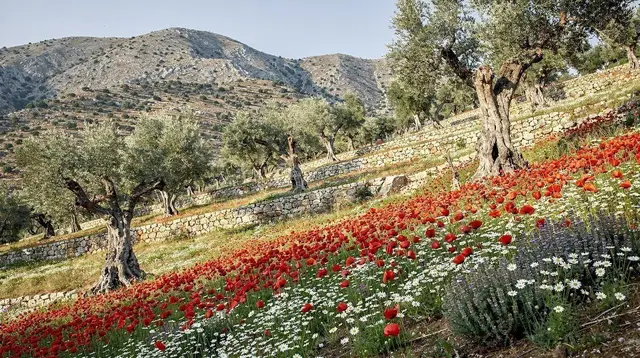
Crete’s wildlife story is defined as much by what is absent as by what remains. There are no large land predators left on the island, which is part of why the kri-kri and other species have survived at all on the mainland rather than only offshore. There are no wolves, no bears, nothing that makes the mountains genuinely risky after dark. Alongside the vulture, other raptors including griffon vultures and various falcons work the same cliffs and gorges, and wildflowers carpet the hillsides through April and May, covered separately in Wildflowers and herbs of Crete — herbs like thyme, oregano and sage that scent the air on almost every mountain path from spring into early summer.
What Crete is not is a destination where wildlife shows up on demand. There is no fenced reserve where a kri-kri is guaranteed to appear, no viewing platform timed to a vulture’s feeding schedule. The animals worth knowing about here are wild in the plain sense of the word: present, protected, genuinely at home in these mountains and gorges, and seen by people who spend time in the right terrain rather than people chasing a single sighting on a single afternoon. That is a different, more honest promise than a safari, and it is worth arriving with the right expectation rather than a checklist.
Boat trips and coastal hikes along the wilder stretches of the south coast put you in a different kind of habitat again, one shaped more by cliffs dropping into the Libyan Sea than by high mountain scree, and they are worth folding into the same trip for their own sake, not purely as a wildlife add-on.
a private guided hike out to the ancient site at Lissos along an isolated stretch of coast near Sougia and a south coast nature walk with swimming stops along the Libyan Sea both move through the kind of quiet, undeveloped coastline where birdlife is easier to notice simply because there are fewer people and less noise than on a beach strip further north. If your route runs instead toward the boat-only village covered in Loutro, the village with no road, a day trip to Loutro by boat with a guide along the same wild south-west coastline adds a stretch of open sea where gulls, shearwaters and occasional raptors working the cliffs are far more visible than they ever are from a gorge floor.
Setting realistic expectations before you go
The single most useful thing to carry into a hike here is a correctly sized expectation. A day on the Samaria trail, a night in Loutro or Chora Sfakion, or a morning on the water near Dia island can all be excellent on their own terms, as gorge walks, coastal villages and boat trips, regardless of whether a kri-kri or a bearded vulture ever comes into view. Treat any sighting as a genuine stroke of luck layered on top of a trip that already justifies itself, not as the reason the day succeeded or failed.
| Species | Where it actually lives | Realistic chance on a single visit |
|---|---|---|
| Kri-kri (Cretan wild goat) | Samaria gorge; islets of Dia, Theodorou, Agii Pandes | Possible, not guaranteed; better odds early or late in the day |
| Bearded vulture | Lefka Ori (White Mountains), up to Pachnes 2,453 m | Low but real on longer mountain hikes with open ridgelines |
| Snakes (4 species, no vipers) | Widespread, low ground to mid-altitude trails | Uncommon and harmless if encountered |
| Griffon vultures, raptors | Cliffs and gorges across the west and south-west | Moderate on longer hikes and coastal cliff routes |
FAQ: snakes, kri-kri and wildlife in Crete
Are there dangerous snakes in Crete?
No. Crete has four snake species and none of them are vipers. There is no medically dangerous snake on the island, which makes the Samaria gorge and every other Cretan trail safer underfoot than most southern European hiking regions.
Will I see a kri-kri while hiking the Samaria gorge?
It is possible but not guaranteed. Kri-kri are shy, alert animals that keep to the steep, rocky flanks of the gorge and tend to move at dawn and dusk, away from the main flow of hikers on the trail.
What is a kri-kri exactly?
The kri-kri is the Cretan wild goat, a distinct wild subspecies rather than an escaped farm animal. It survives today mainly in the Samaria gorge and on three small offshore islets: Dia, Theodorou and Agii Pandes, where hunting and introduced predators are kept out.
Where can I reliably see a kri-kri?
The islets of Dia, Theodorou and Agii Pandes hold the most stable populations because they have no land predators and restricted access, but even there sightings depend on the animals coming into view rather than any staged encounter.
What is the bearded vulture and where does it live in Crete?
The bearded vulture, or lammergeier, is a large bone-eating raptor that survives in Crete in the Lefka Ori, the White Mountains, which rise to Pachnes at 2,453 metres. It is one of the last strongholds of the species in Greece.
Can I book a wildlife safari in Crete?
Not in the sense of a guaranteed-sighting safari. What exists are guided hikes and boat trips through the gorges, coastline and mountains where kri-kri, vultures and other species happen to live, with no promise of an encounter on any given day.
Is it safe to hike alone in the Lefka Ori or Samaria gorge because of wildlife?
Yes, wildlife is not the risk. The real hazards in these mountains are heat, dehydration, loose rock and the length and one-way nature of routes like Samaria, not the animals living there.
Wildlife Tours in Crete on GetYourGuide
Verified deep-linked GetYourGuide tours. Book through these links and we earn a small commission at no cost to you.
GetYourGuide does not provide a product photo for this activity — the image shows the meeting point, photographed by us.