A village built around its fountains, not its hotels
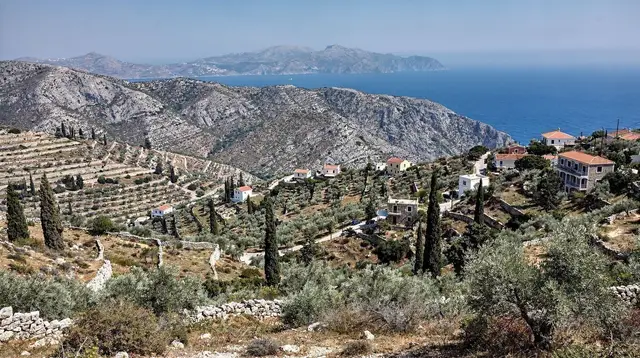
Drive the inland road south of Rethymno town and the coast disappears within minutes, replaced by olive terraces, then pine, then the first switchbacks toward the Psiloritis foothills. Spili appears as a single main street wrapped around a spring, shaded by tall plane trees, with a row of carved stone lion heads spouting cold water into a long trough along its length. That fountain, fed by the hillside above the village, is the reason most people stop here at all: it turns what would otherwise be a pass-through hamlet into a five-minute landmark worth the short detour, and a good excuse to fill a water bottle before or after a walk.
Spili is not trying to be Rethymno’s old town in miniature. There is no Venetian harbour, no fortress walls, no grid of restored merchant houses — just a church, a square, a couple of tavernas under the plane trees, and a scattering of rooms for the handful of travellers who stay the night. Treat it as what it is: a well-placed stop on the road between the north coast and the mountains, not a destination that rewards a multi-night stay.
The honest pitch is narrow and specific — stop here before or after the Patsos gorge, drink from the fountain, eat lunch under the trees, and move on to a base with more going on, whether that is Rethymno, Plakias on the Libyan coast, or Agia Galini further east.
That narrowness is also what makes Spili easy to plan around. It asks for an hour, or two with a slow lunch, not a day carved out of an itinerary. Pair it with the gorge a short drive away, or slot it into a longer loop that also takes in Margarites and its potters, or Arkadi monastery on the way back down to the coast.
The Patsos gorge: a shorter walk, not a smaller one
About 20 minutes from Spili, the road drops into a narrow ravine below the village of Patsos, where a stream cuts through limestone shaded by plane trees, oleander and wild fig. This is the Patsos gorge, sometimes signed as the Agios Antonios gorge after the tiny chapel built into a cave partway along the path. It is the reason a lot of drivers find their way to this stretch of inland Rethymno in the first place, and it earns the detour on its own terms.
The comparison worth making explicit is with the Samaria gorge, which every visitor to Crete hears about sooner or later. Samaria runs 16 km one-way from the Omalos plateau down to Agia Roumeli, a village with no road, which means the only way out is a boat to Chora Sfakion, Sougia or Palaiochora followed by a coach back around the island. It is a full-day commitment that has to be planned around a single exit point. Patsos asks for none of that.
The walk follows the streambed from a trailhead near the village, past the cave chapel and a series of small pools and waterfalls, and back the same way — a there-and-back walk of a couple of hours rather than a one-way traverse with a boat schedule attached. For a full breakdown of the route, the Patsos and Kourtaliotiko walking guide covers the nearby Kourtaliotiko canyon as well, which shares the same stretch of mountain road and makes a reasonable double for a longer day.
None of that makes Patsos a stroll. The path is uneven limestone, shaded but often wet underfoot near the pools, and sturdy shoes matter here as much as anywhere else on the island. What it removes is the logistics that make Samaria a once-a-trip commitment: no ferry ticket to buy in advance, no coach connection to time, no risk of missing the last boat out.
That is the honest version of “easier” worth putting in front of anyone choosing between the two, and it is why Patsos suits a traveller based on the north coast or the Libyan coast who wants a real gorge walk without giving up a whole day to it. Travellers who want the walk guided, with the cave chapel and the fjord-like pools pointed out along the way, can book the Spili, Kourtaliotiko gorge and Kalypso fjord tour, which runs from the same stretch of road as Spili itself.
Getting here: there is no KTEL shortcut
Rethymno’s coastal road, part of the VOAK highway linking Chania, Rethymno, Heraklion and Agios Nikolaos, carries the island’s only genuinely useful bus network. South of that road, once the route climbs into the foothills toward Spili and Patsos, KTEL coverage drops to a handful of seasonal or market-day runs, if that. Relying on a bus timetable to combine a village stop with a gorge walk on the same afternoon does not work in practice here.
A rental car is the realistic way to reach both, and the driving guide to Crete is worth a read before setting out, since inland mountain roads have their own etiquette — drivers pulling onto the hard shoulder to let a faster car pass is courtesy here, not an invitation to overtake blind. Anyone curious about what the coastal buses do cover, for context, can check the KTEL buses in Crete guide.
Drivers based on the coast have a few reasonable approaches. From Rethymno town, the run to Spili takes about half an hour on a signed inland road, with Patsos a further 15 to 20 minutes beyond it. From Plakias or the Libyan coast, the road climbs north through the mountains rather than along the shore, a scenic but slower route. From further afield — Chania or Heraklion — Spili and Patsos work best as one stop within a longer loop through inland Rethymno rather than a dedicated round trip, since the drive each way already runs well over an hour.
For travellers who would rather not self-drive the mountain roads, small-group tours package the village and the gorge together. The Spili, Maravel Garden lunch and Patsos gorge minivan tour covers exactly that pairing in one outing, and a private option, a private day combining Margarites village, Arkadi monastery and the Patsos gorge, folds in the pottery village and the 1866 monastery for a fuller inland day without touching a steering wheel.
When to come
May to October is the working window for the Patsos gorge, in line with every other gorge on the island — Crete’s mountain paths close after heavy rain or in fire-risk conditions, and the shoulder months can go either way, so it is worth checking locally rather than assuming the trail is open in April or November. Spili itself, the village and its fountain, is a year-round stop; the tavernas under the plane trees just thin out considerably once the gorge season ends and the day-trip traffic stops passing through.
Midsummer brings the heat that makes the shaded gorge walk genuinely pleasant compared with an exposed coastal path, but it also brings the crowds that every inland stop on a tour-bus route sees in July and August. Late spring, when wildflowers still line the approach roads and the stream in the gorge is running fuller, or September, once the peak has passed, are the more comfortable windows for both the fountain square and the walk beneath it.
What Spili is not, and what to pair it with instead
It is worth being blunt about scale before arriving with the wrong expectations. Spili has no Venetian old town to wander — that belongs to Rethymno, 24 km away, and to Chania further west. Accommodation is thin: a handful of rooms and small guesthouses, not the range of choice a coastal resort offers, so most visitors pass through rather than book a multi-night stay. There is no beach within walking distance, and no evening scene to speak of once the tavernas around the fountain close for the night. None of that is a flaw so much as the point — Spili is a mountain village doing what mountain villages do, not an understudy for a bigger town.
That makes it a strong link in a longer day rather than a standalone plan. A loop from Rethymno might take in Arkadi monastery, the pottery workshops of Margarites, lunch and the fountains at Spili, then the Patsos gorge before heading back down to the coast — a full but unhurried day that a self-drive itinerary can complete in an afternoon and evening.
Travellers building a longer inland route can also look toward Anogia and the Psiloritis foothills for mountain villages with a similar character, or extend south to Plakias and Damnoni for the Libyan coast that Spili itself does not offer. The seven-day west-to-east itinerary and the dedicated hiking week itinerary both have room for a detour like this one without derailing the rest of the plan.
For a wider view of the 4x4 and village-touring options that cover this stretch of Rethymno, the Psiloritis mountain, Sfendoni cave and Cretan villages 4x4 tour runs a broader loop through the foothills above Spili, useful for travellers who want the mountain villages without planning the route themselves. Those already touring Rethymno’s coast can also fold the village into a day that starts on the water: the Bali, Panormo, Matala and Spili villages trip strings Spili together with coastal stops on both sides of the island for a single long day out.
Practical notes for the stop
Parking in Spili is on-street around the square and along the main road; it fills up around lunchtime in high season but rarely takes more than a few minutes to sort out. The fountain water is drawn from the spring above the village and locals drink it freely, though anyone unsure should stick to bottled water as a rule of thumb inland, where a few villages rely on brackish supplies. Cash is worth carrying for the smaller tavernas, even though card readers are now common. The Patsos gorge trailhead has limited parking near the chapel of Agios Antonios; arriving before midday in July and August avoids both the heat inside the ravine and the queue for the small car park.
None of this requires much planning once the shape of the day is clear: reach Spili and Patsos by car, allow half a day for the fountain square and the walk together, and treat the village as the pleasant stop it is rather than a base it was never built to be.
Questions about Spili and the Patsos gorge
Is Spili worth a stop on the way to or from the Patsos gorge?
Yes, as a stop rather than a base. Spili is a small mountain village in the Rethymno foothills known for its row of carved stone lion-head fountains and its shaded plane-tree square, about 20 minutes from the Patsos gorge trailhead. The gorge itself is a shorter, easier walk than the Samaria gorge, with no single exit by boat required, which makes the pair a manageable half-day rather than a full expedition.
Is the Patsos gorge as demanding as the Samaria gorge?
No. Samaria is 16 km one-way and forces a boat and coach return from Agia Roumeli. Patsos is a short there-and-back walk from a single trailhead, over in an hour or two, with no mandatory exit by sea and no coach connection to arrange.
Can I reach Spili and the Patsos gorge by KTEL bus?
Not comfortably. The KTEL network is strong along the north coast between Chania, Rethymno, Heraklion and Agios Nikolaos, but inland villages south of the VOAK highway see few or no scheduled runs. A rental car is the practical way to reach both Spili and Patsos.
When is the Patsos gorge open?
Roughly May to October, in line with the rest of Crete’s gorges. Outside that window, and after heavy rain, the path can close for flood risk, so check locally before driving out in the shoulder months.
Is there a beach near Spili?
No. Spili sits inland in the Rethymno foothills with no coastline of its own. The nearest sea, around Plakias and Agia Galini on the Libyan coast, is a separate drive of 30 to 45 minutes, not a walk from the village square.
Does Spili have much nightlife or nightlife-style restaurants?
No, and it is not trying to. Spili is a quiet mountain village with a handful of tavernas around the fountains and the church, aimed at lunch stops and overnight guests passing through, not an evening scene.
Should I stay overnight in Spili, or just pass through?
Most visitors pass through. Spili has a small number of rooms and guesthouses, enough for a night if the timing works, but nothing close to the range of Rethymno town, so most itineraries treat it as a stop of an hour or two rather than a base for several nights.
What is the lion-head fountain in Spili actually for?
It carries spring water down from the Vorizi hillside above the village into a stone trough at the main square, a working water source long before it became a photo stop. Villagers still fill bottles there, and the row of carved heads has given the village its best-known landmark.