Kourtaliotiko Gorge: A Morning Walk Above Preveli
Can you walk the Kourtaliotiko gorge in one morning?
Yes. The main walkable stretch of the Kourtaliotiko gorge, from the roadside chapel of Agios Nikolaos down toward the Preveli dam, is a short, well-marked route of roughly one to two hours round trip. It is not the multi-hour trek that Samaria or Imbros are, but the path is rocky, largely unshaded, and drops toward the Libyan Sea, so it rewards an early start rather than a midday one.
What the Kourtaliotiko gorge actually is
Most travellers meet the Kourtaliotiko gorge from a car window, not on foot. The road south from Rethymno town toward Plakias and Damnoni and the coast drops through a narrow limestone cut, with a small roadside chapel, Agios Nikolaos, set into the rock about two-thirds of the way down. That chapel is also the trailhead for the part of the gorge that people actually walk: a rough path that descends from the road to the old Preveli dam, where the seasonal river that formed the gorge is held back before continuing toward the sea.
It is a real gorge, cut by water through folded rock over a long span of time, the same kind of geology that produced Imbros and Samaria further west. But it is a short one to walk, not a day’s commitment, and that is the honest way to size it against the island’s bigger gorge hikes. Where Samaria is 16 km one-way and ends with a boat because there is no road out, the walkable stretch of Kourtaliotiko is a there-and-back of a kilometre or two, doable in a morning without a support plan.
The walk, in practical terms
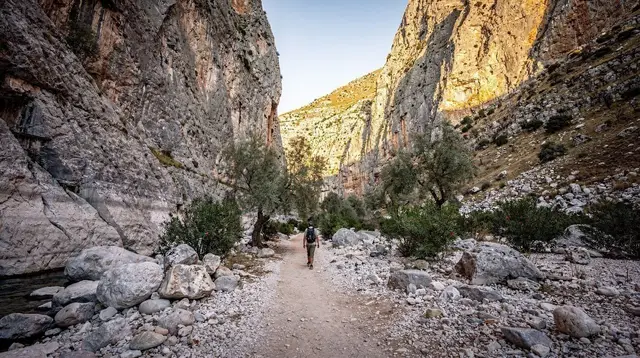
The route starts near the Agios Nikolaos chapel, where there is roadside parking, and drops through rock and scrub toward the riverbed and the dam. The path is uneven underfoot — loose stone, some scrambling in short sections — and firm closed shoes matter more than fitness here. Most people cover the descent, a look at the dam and pools, and the return climb in one to two hours, which is why this reads as a morning add-on rather than a dedicated hiking day.
Two things shape how comfortable that morning is. First, the gorge runs roughly north-south and gets sun through a large part of the day; second, the vegetation that would otherwise soften that heat has not fully recovered everywhere. That second point is worth being precise about, because it is easy to look at old photographs of a green, closed canopy and assume the same cover exists now.
Why the palm gorge below did not stay the same
The Kourtaliotiko gorge feeds the same watercourse that reaches the sea at Preveli beach, where a grove of native palms lines the river mouth below the coast road. In 2010, wildfire burned through that palm gorge and the slopes around it. The trees have regrown since — palms of this species resprout from the base rather than dying outright — but “regrown” is not the same as “restored to how it was.” Cover is patchier in places, and both the beach grove and the drier upper gorge sit in a landscape that can burn again in a hot, dry summer.
That matters for anyone reading a route description written a few years ago and assuming the shade it promised is still there. It may not be. Treat any claim of a fully shaded path through Kourtaliotiko, in either direction, as something to verify on the day rather than take on faith — ask locally, or check conditions with a guided operator, before committing to a midsummer midday descent.
The palm itself, Phoenix theophrasti, is worth knowing by name. It is endemic to Crete, meaning it grows wild nowhere else, and on this island it exists in only two significant wild concentrations: here at Preveli, at the foot of this gorge, and at Vai on the far eastern tip, which holds the largest natural palm forest in Europe. A visitor who walks Kourtaliotiko and then swims at Preveli beach is, without necessarily realising it, standing in one half of a two-site botanical story that only repeats itself roughly 300 km away at the opposite end of the island.
Where this sits on the map
Kourtaliotiko belongs to the south of the Rethymno regional unit, on Crete’s Libyan Sea coast — the side of the island that faces Africa rather than mainland Greece. That geography has a practical consequence in high summer: the strong north wind known as the meltemi, which blows hardest in July and August and can shut down boat trips to Balos and Chrissi on the north and east coasts, generally leaves this southern coast calmer. A hot, windless morning at Kourtaliotiko in August is entirely plausible even when the north coast is being scoured by wind — which cuts both ways, since it also means less natural cooling on the walk itself.
The gorge, the dam, Preveli monastery and Preveli beach form a natural cluster: they sit within a few kilometres of each other on and around the same road, and most visitors see two or three of them in a single outing. Spili, a mountain village with its own charm, and the resort strip around Plakias are both a short drive further on, which is why this stretch of the south coast supports a loop rather than a single stop.
Getting there without a train that does not exist
Crete has no railway and no cable car or lift of any kind, a fact worth stating plainly because visitors from countries with dense rail networks sometimes assume a mountain road like this one will have some kind of shuttle. It will not. Renting a car is the practical way to reach Kourtaliotiko, and driving in Crete on a route like this means a narrow, winding road with limited passing space — locals here pull onto the hard shoulder to let faster traffic by as a courtesy, not an invitation to overtake on a blind bend.
The KTEL coach network is genuinely useful along the north coast highway between Chania, Rethymno, Heraklion and Agios Nikolaos, but it thins to a handful of seasonal runs south of the mountains. Reaching the Agios Nikolaos chapel trailhead by public transport on a flexible schedule is not realistic for most itineraries, and a self-drive or a booked tour are the two workable options.
a guided day out that covers the gorge and Preveli together removes the driving question entirely and pairs naturally with a swim afterward, since most versions build in beach time at the end.
When the roadside fills up
The parking near the Agios Nikolaos chapel is not a car park in any formal sense — it is a widened stretch of roadside shoulder, and it serves several different kinds of visitor at once: gorge walkers heading down to the dam, people stopping only for the chapel itself, and canyoning groups gearing up for the upstream route. In July and August, especially between about 10:00 and 13:00, that shared space fills, and a jeep safari or a coach-based tour can arrive and occupy a disproportionate share of it in one go. Arriving before 09:00 avoids most of this; arriving at midday in peak season sometimes means continuing a short distance along the road and walking back rather than parking directly at the trailhead.
None of this is dangerous or even especially inconvenient — it is a narrow mountain road, not a stadium car park, and the crowd thins as fast as it builds once the tour groups move on to Preveli. But it is worth knowing before you plan a late start, since the walk itself is short enough that arriving late compounds two problems at once: less shade and less parking.
The other way to do the gorge: canyoning
The roadside walk described above is not the only way people experience Kourtaliotiko. Upstream, sections of the gorge are narrower and steeper, with rope work and short abseils involved, and that stretch is handled as a canyoning route rather than a walking path. It is a different activity aimed at a different visitor: guided, equipped, and generally not attempted independently.
If a slow morning walk under the sun is not what you are after, a guided canyoning descent through the narrower sections of the gorge is the version built for that. It is worth being clear with yourself, and with anyone you are travelling with, about which of the two you are signing up for before you book — “the Kourtaliotiko gorge” covers both, and they share almost nothing beyond the rock.
Building it into a morning or a full day
Because the walkable part of Kourtaliotiko is short, most visitors treat it as the first stop in a longer south-coast morning rather than a destination on its own. A common sequence: park near the chapel, walk down to the dam and back, drive the short distance on to Preveli monastery, then finish at Preveli beach for a swim once the palms and the water are in view rather than imagined. That whole sequence fits comfortably before a late lunch if you start early, which also means walking the gorge itself before the rock has spent hours absorbing sun.
For travellers who would rather not plan the logistics themselves, a private tour taking in the gorge, Preveli beach and Spili in one day strings those same stops together with a driver, and a similar all-in-one option, a jeep safari through Preveli, Lake Kournas and the gorge villages, extends the same idea further inland to villages and a lake that are awkward to reach independently in one day.
If the beach is the real draw and the gorge is secondary, a boat trip direct to Preveli’s palm-lined beach reaches the coastal payoff without the walk at all, which is a reasonable choice for anyone travelling with young kids or limited mobility.
If you only have half a day
Not everyone has a free morning to give to gorge, monastery and beach together, and it is worth being honest about what to drop rather than rushing all three and enjoying none of them properly. If you have to pick one stop, Preveli beach is the safer bet: it does not depend on how much shade the gorge happens to have that year, and it rewards anyone regardless of fitness or heat tolerance. The gorge walk is the first thing to cut if time or energy is short — it adds a rocky, sun-exposed hour or two that a car-window view from the road already partly substitutes for.
If instead you want to walk something and skip the beach, the gorge is a better use of a short morning than the monastery, which rewards a slower, unhurried visit that a tight schedule tends to undercut anyway. Either way, resist the temptation to add Spili or the Plakias resort strip to a half-day plan built around Kourtaliotiko — that turns a manageable morning into a rushed one, and this stretch of coast rewards not rushing it.
When to go, and when to rethink it
Late April through June and September into mid-October are the most comfortable windows for this kind of exposed, partly shaded walk — the rock has not yet absorbed a full summer of heat, or has started to release it, and daytime temperatures sit well below the 30–35 °C that July and August routinely bring. Best time to visit Crete and Crete weather month by month lay out those seasonal patterns in more depth if you are still choosing dates.
In July and August, when the meltemi is at its strongest, the wind’s main effect is on the north and east coasts and their boat trips; it does relatively little to cool a south-facing gorge walk at midday. If your trip lands in peak summer, the trade you are making is a walk best started at or near opening light, not late morning, and a realistic expectation that shade will be partial rather than complete.
Winter brings the opposite risk. Rain across the Rethymno mountains can turn a dry streambed into a genuine watercourse without much warning, and while the gorge is not formally closed the way Samaria is each winter, conditions underfoot deserve the same respect. Ask locally, or check with a tour operator, before a winter or early-spring descent after heavy rain.
What tends to disappoint
The single biggest mismatch between expectation and reality here is scale. Photographs of “the Kourtaliotiko gorge” online are often taken from a drone or from partway up the canyoning route, and they suggest a dramatic, plunging canyon on the scale of Samaria’s Iron Gates. On foot from the Agios Nikolaos chapel, what you actually get is a modest, rocky descent to a dam and some pools — worthwhile, but closer to a pleasant scramble than a landmark hike. Visitors who come expecting an equivalent of Samaria or Imbros sometimes leave a little underwhelmed by the short walking stretch, even while the wider landscape around it — the chapel, the dam, the road cut through rock — remains genuinely striking.
The second disappointment is more seasonal: the shade. Route descriptions written before 2010, or copied uncritically from older sources since, describe a canopy that no longer exists in the same form. Arriving at midday in August expecting relief from tree cover and finding instead bare rock and scrub is a common, avoidable letdown — avoidable simply by reading current information and timing the walk for early morning rather than trusting an old photograph. For a wider sense of where expectations and reality diverge across the island, mistakes to avoid in Crete covers several of the same patterns.
Is the Kourtaliotiko gorge suitable for young children or limited mobility?
Not really, for the walking part. The path from the Agios Nikolaos chapel to the dam involves loose stone and short scrambling sections, with no barriers or graded surface, and it is not stroller- or wheelchair-accessible at any point. Families who still want the experience can see the chapel and the view into the gorge from the road without descending, then drive on to Preveli beach, which is flat and easy by comparison. For a broader look at what does and doesn’t work with kids or reduced mobility elsewhere on the island, Crete with kids and accessible Crete cover the wider picture.
How early should I arrive to get parking at the trailhead?
Before 09:00 in July and August is the safe answer. The roadside space near the chapel is shared by gorge walkers, chapel visitors and canyoning groups, and a single jeep safari or coach tour can fill a large share of it within minutes. Outside peak season, or before mid-morning even in summer, parking is rarely an issue. What to pack for Crete is worth a look the night before an early start like this one, so you are not improvising water and sun cover at 07:30.
Practical notes before you go
- Wear closed shoes with grip — the path is loose stone in places, not a groomed trail.
- Carry more water than a one- to two-hour walk seems to warrant; shade is not guaranteed.
- Start early in summer. This is a sun-exposed south-facing gorge, not a cool retreat.
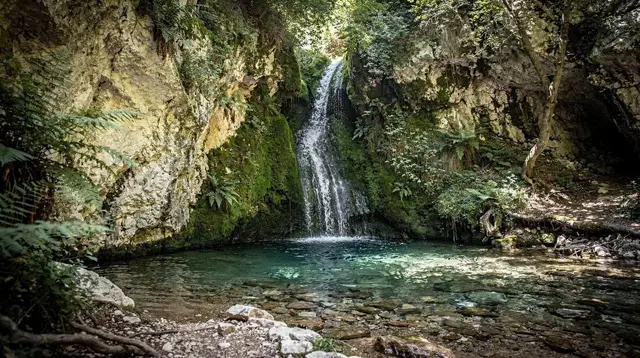
- Treat swimming in the gorge pools as opportunistic, dependent on the season’s rainfall, and save the reliable swim for Preveli beach below.
- If a description of the route promises full canopy shade, check the date it was written — the 2010 fire and its uneven regrowth make older accounts unreliable on this specific point.
- A car is the realistic way in; budget the driving time on a narrow mountain road, not just the walking time.
Gorge Hikes in Crete on GetYourGuide
Verified deep-linked GetYourGuide tours. Book through these links and we earn a small commission at no cost to you.
GetYourGuide does not provide a product photo for this activity — the image shows the meeting point, photographed by us.