Malia Palace: Is It Worth Visiting Besides Knossos?
Is the Malia palace worth visiting if I've already planned Knossos?
Malia is a genuine Minoan palace, one of several the civilisation left on Crete, and it draws far fewer visitors than Knossos. It suits travellers already based on the north coast around Hersonissos or Malia town, or anyone curious about Minoan sites beyond the most famous one. It is not a substitute for Knossos and this page makes no claim that it is.
The honest question behind this page
Most people who type “Malia palace” into a search bar have already booked, or are already considering, a day at Knossos. The real question isn’t whether Malia exists — it does, and it’s a genuine Bronze Age Minoan palace — it’s whether it earns a place on an itinerary that already has the island’s most famous archaeological site on it. This page won’t oversell that answer. It also won’t borrow facts that belong to Knossos and hand them to Malia, which is a common shortcut in Crete travel content and one worth naming plainly before going further.
Where Malia actually sits
Malia is on Crete’s north coast, in the stretch of resort development that runs from Gouves and Hersonissos through Stalida and Malia itself. That corridor covers roughly 20 km of coastline. Crete, west to east, runs about 260 km, from the Venetian harbour at Chania to the palm beach at Vai near the island’s eastern tip. The resort strip that Malia sits inside, in other words, is a narrow slice of a long island — not a cross-section of what Crete is, and not a stand-in for the mountains, gorges or south coast that make up most of it.
That geography matters for how to think about the palace. It isn’t buried in countryside the way Phaistos overlooks the Messara plain, or the way Zakros sits at the end of a long drive into eastern Crete. Malia is a short trip from package hotels, sunbed rows and beach bars, which shapes who visits it and when: it’s realistic as a half-day add-on for someone already staying on this coast, less realistic as a reason to build a trip around on its own.
What the site actually is
Malia is one of several palatial centres that Minoan civilisation built on Crete during the Bronze Age, alongside Knossos, Phaistos and Zakros. That’s worth stating plainly, because a lot of casual travel writing treats Knossos as if it were the only Minoan palace on the island and everything else as a footnote. It wasn’t, and they aren’t. Each of these sites was excavated separately, by different archaeological teams, at different times, and each has its own layout, history and state of preservation. Malia was investigated by the French School at Athens, work that began in the early twentieth century and has continued in phases since.
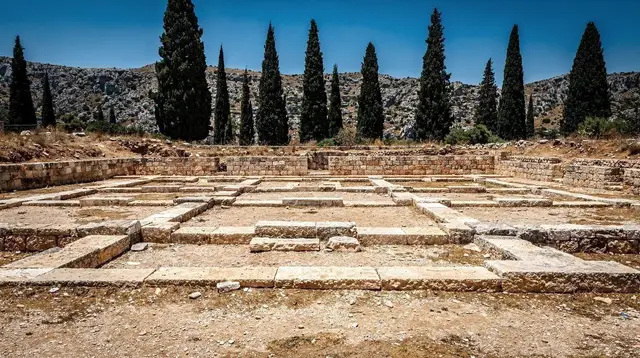
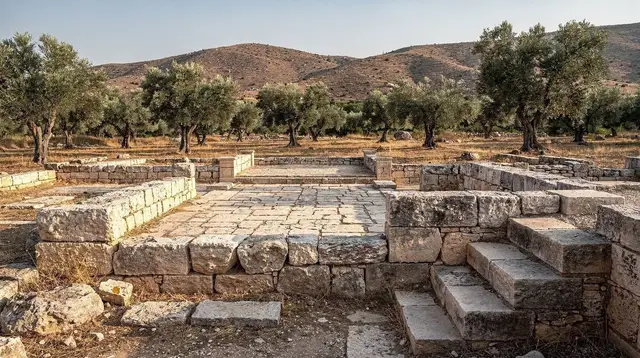
The site preserves the ground plan of a large palace complex: a central court, surrounding storage magazines, and the kind of stone foundations and low standing walls typical of an excavated — rather than rebuilt — Minoan site. Like the island’s other palatial centres, Malia was constructed, damaged, rebuilt and eventually abandoned across the second millennium BCE, a pattern tied to the earthquakes and wider upheavals that affected Minoan sites across Crete. Walking it takes most visitors well under two hours.
What surprises people on site
Malia doesn’t reward a rushed visit, and it doesn’t try to. There’s no reconstructed fresco, no partially rebuilt staircase to photograph, and no single dramatic feature that anchors the whole visit the way Knossos’s Throne Room does for that site. What’s there is foundations, low walls and the footprint of storage rooms — a plan you have to read rather than a scene you can simply look at. Visitors expecting a smaller, quieter version of Knossos’s visual impact are often surprised by how much of the value depends on understanding what a Minoan palace complex was for, rather than on what it looks like from the entrance.
That’s not a criticism specific to Malia. Excavated-but-not-reconstructed sites across Crete share the same trait, and it’s worth knowing before arriving rather than discovering it on site. A guidebook, an audio guide, or fifteen minutes reading about Minoan palace layout beforehand changes the experience of the visit more than any amount of extra time spent walking the ruins themselves. Travellers who arrive expecting Knossos’s scale and colour, without having reset that expectation first, are the ones most likely to leave disappointed — not because Malia is a poor site, but because it was never trying to be a second Knossos.
What this page won’t claim
It would be easy to pad out a page like this by lending Malia details that belong to Knossos: reconstructed frescoes, a next-door museum holding the originals, the crowds and the queue. None of that is specific to Malia, and this page isn’t going to present it as if it were.
What Knossos is known for — including the fact that the brightly repainted frescoes visitors see there are modern reconstructions, with the originals held at the Heraklion Archaeological Museum a few kilometres away — is a Knossos story. Malia has its own excavation history and its own physical remains, and the responsible way to write about it is to describe what’s there rather than borrow the more famous site’s highlight reel.
The same caution applies to Malia’s condition and scale relative to Knossos. Without a verified, site-specific source describing exactly how reconstructed or how large Malia is compared to Knossos, this page won’t rank them for you beyond what’s already established: Knossos is the most visited and most extensively presented Minoan site on Crete, and Malia draws a fraction of that traffic. Fewer people on site is a real, verifiable difference in visitor experience, and it’s the one worth building expectations around.
A writing system nobody has read
One thread runs through every Minoan palace on Crete, Malia included: the script the civilisation used to keep records, known as Linear A, has never been deciphered. It appears on clay tablets and other objects across Minoan sites, and despite decades of study, nobody currently knows how to read what it says. That’s different from Linear B, the script that followed it and was used to write an early form of Greek by the later Mycenaeans — Linear B was deciphered in the 1950s and can be read today.
Standing in the storage rooms of a palace like Malia, it’s worth remembering that the people who filled those magazines left records of what they held, and that record is still, in a literal sense, unread. For more on how the two scripts relate, and on Minoan civilisation more broadly, see the Minoans in one hour.
Malia palace versus Malia town
The name causes real confusion, because “Malia” refers to two different things a short drive apart: an archaeological site with Bronze Age walls, and a resort town with a beachfront, bars and package hotels. They don’t overlap in what they offer, and conflating them sets the wrong expectations either way.
| Malia palace | Malia town / resort strip | |
|---|---|---|
| What it is | Excavated Minoan palace site | Beach resort within the Hersonissos-Malia strip |
| Typical visit length | Under 2 hours | A full holiday base |
| What’s there | Foundations, storage rooms, central court | Beaches, bars, restaurants, watersports |
| Best paired with | Other Minoan or archaeological sites | Beach days, boat trips, nightlife |
| Crowd level | Light, especially outside midsummer | Busy in July and August |
If you only have half a day on this coast
Travellers based around Hersonissos, Stalida or Malia town sometimes have to choose between the palace and something else on a single free half-day, rather than treating this as a multi-day archaeology trip. The honest guidance: if you haven’t yet been to Knossos and can reach it in the time available, go there first. It’s the site with the reconstructions, the scale and the name recognition that most people are actually after when they say they want to see Minoan Crete, and Malia won’t substitute for that experience.
If Knossos is already checked off, or genuinely out of reach for the day, Malia is a reasonable use of a half-day for anyone with a real interest in archaeology rather than a checklist to complete. It’s not a reasonable use of a half-day for someone who would rather be on a beach or a boat — the resort strip it sits inside offers plenty of both, and there’s no obligation to spend a holiday half-day on Bronze Age foundations just because they happen to be nearby. Matching the choice to what you actually want out of the day matters more here than at more famous sites, where the decision tends to make itself.
The coast around it
The Hersonissos-Malia strip is a genuine package-holiday coast, and there’s no reason to pretend otherwise on a page about a Minoan ruin. If you’re staying anywhere along it — Gouves, Hersonissos, Stalida or Malia itself — the palace is one option among a fairly wide range of things to do, from beach time to boat parties to inland excursions. A guided outing that pairs Knossos with the Lasithi plateau is a common way to combine Crete’s best-known Minoan site with a very different, mountain landscape in a single day:
a private guided day covering Knossos palace and the Lasithi plateauFor travellers who’d rather see several sides of the region in one trip, there are full-day options that combine Knossos with Zeus’s cave on the Lasithi plateau and a working olive oil producer, which at least sets Minoan history against the island’s agricultural present:
a full-day tour taking in Knossos, the Lasithi plateau’s cave of Zeus and an olive oil factoryNot every day on this coast has to be archaeology. For a lighter, low-effort way to see the resort strip itself, a tuk-tuk tour through Stalida and Malia is a simple way to get oriented without renting a car for the day:
a tuk-tuk tour through Stalida and MaliaPracticalities worth knowing before you go
Crete runs on Eastern European Time, one hour ahead of Paris, Berlin and Rome, and that affects when sites open and close — never assume central European hours here. The euro is the currency, prices already include VAT at Greece’s standard 24% rate, and Crete has never had the reduced rate given to some other Greek islands. A rental car remains the practical way to combine a site like Malia with anything further along the coast; the KTEL coach network is genuinely workable along this stretch of the north coast, linking Heraklion, Hersonissos and Agios Nikolaos, but it won’t get you everywhere on the same schedule as your own car.
Like other outdoor Minoan sites on Crete, Malia offers little natural shade — there’s no substantial tree cover over the foundations and low walls, and the stone underfoot holds heat through the afternoon in summer. Visiting earlier in the day, before the midday sun is at its strongest, makes for a considerably more comfortable walk in July and August than arriving after lunch. A hat, water and sun protection matter more here than the site’s modest walking distance might suggest, precisely because there’s so little built or natural shelter to retreat to partway through a visit.
Does Malia palace have much shade in summer?
No. As with most outdoor Minoan sites on Crete, tree cover is minimal and the stone surfaces hold heat, so a summer visit is more comfortable earlier in the day than in the early afternoon, when there is little relief from direct sun.
Can Malia be visited as part of a cruise stop at Heraklion?
It’s close enough to the Heraklion area to be logistically possible on a longer port day, though most cruise itineraries built around this coast focus on Knossos rather than Malia specifically, given its scale and name recognition. For the general logistics of fitting an archaeological site into a single port day, see shore excursions from a cruise ship.
If archaeology is the actual draw rather than a coastal add-on, it’s worth reading about Knossos itself and about Phaistos and Gortyna in the south before deciding how much time Minoan sites deserve on a given trip. A dedicated five-day archaeology itinerary is one way to give the island’s palatial sites the attention they need without treating any single one of them as the whole story of Minoan Crete.
Making a realistic plan around it
Because Malia sits inside a resort corridor rather than out on its own, most visitors treat it as one stop among several rather than the centrepiece of a day. Pairing it with a wine tasting inland, for instance, gives the day some contrast between ancient walls and the island’s working vineyards:
a cellar wine tasting with a sommelier near MaliaFor a broader sense of how this end of the island fits together, it’s worth reading how Hersonissos, Malia and Stalida compare as bases, and how the things to do around Stalida and Malia break down beyond the archaeological site itself. Browsing the wider Minoan and Knossos category is also a fair way to see how Malia sits alongside the island’s other palatial sites before deciding how much time it deserves on your own itinerary.
The short version
Malia palace is real, it’s Minoan, and it’s one of several palatial sites the civilisation left on Crete rather than a lesser copy of the most famous one. It sits inside a 20 km resort corridor on a 260 km island, which makes it a sensible add-on for travellers already on this coast and a less obvious reason to build a trip elsewhere. What it isn’t, on the evidence available for this page, is Knossos — no reconstructed frescoes, no adjoining museum holding originals, no claim here about matching that site’s scale. Go in with that distinction clear, and it becomes a straightforward, low-crowd half-day rather than a disappointment measured against a different site altogether.
Knossos Tours in Crete on GetYourGuide
Verified deep-linked GetYourGuide tours. Book through these links and we earn a small commission at no cost to you.
GetYourGuide does not provide a product photo for this activity — the image shows the meeting point, photographed by us.