Cooking Classes in Crete
What do you actually learn in a Cretan cooking class?
A real Cretan cooking class teaches how the island's food grows out of its farms and villages, not a fixed national menu: seasonal vegetables, olive oil, mountain herbs, and dishes that shift from the west of Crete to the east. Most classes end with raki, a grape-marc spirit with no anise, and menus and drinks are priced with Greece's standard 24 percent VAT already included.
Beyond the demonstration plate
A cooking class sold in a resort brochure is often a stage show: a chef in an apron cooks in front of a room, guests photograph the process, and everyone sits down to a plate that was mostly finished before they arrived. That format exists in Crete too, and it can be a pleasant hour. But it teaches very little about how Cretan food actually works, and it tends to present the island’s cuisine as a fixed, exportable menu — moussaka, tzatziki, a Greek salad — when Cretan cooking is neither fixed nor generic. It is built from what a particular village, a particular family, and a particular season put on the table, and it changes noticeably as you move across the island.
The better classes in Crete are built the other way around: they start on a farm, in a garden, or at a family’s own kitchen table, and the cooking is the middle of the visit rather than the whole of it. What follows is a guide to what a class like that can actually teach you, how it connects to the island’s real wine and food geography, and what to expect — and not expect — from the experience itself.
What a class actually teaches, when it goes beyond the show
The difference between a demonstration and a class worth your afternoon usually comes down to three things: whether you do anything with your own hands, whether the ingredients are traced back to a place, and whether anyone explains why a dish is made the way it is rather than just how.
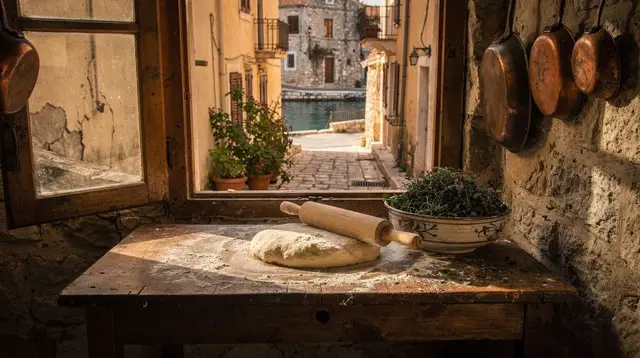
Doing something yourself. Rolling dolmades, shaping kalitsounia — the small cheese or herb pies found across the island — kneading a dakos rusk dough, or grinding olives by hand for a taste test, gives you a sense of the labour behind a dish that watching never does. A class that hands you a spoon and steps back is worth more than one that hands you a camera.
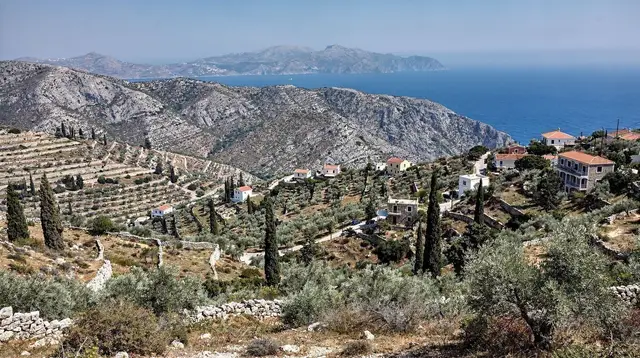
Tracing the ingredients. Crete’s food starts on small farms and in kitchen gardens, not in a supermarket aisle. A class held on or near a working farm, or one that begins with a walk through an olive grove or a vegetable patch, shows you where the wild greens (horta), the herbs, and the olive oil in the dish actually come from, and why Cretans still talk about oil and greens as staples rather than garnish.
Our Cretan cooking class with a farm visit and a shared meal is built around exactly that sequence: farm first, kitchen second, table third. Farm ground is often uneven, with steps between rooms and no paved path down to the grove, so anyone planning around mobility should check our guide to accessible Crete before booking a farm-based class rather than a kitchen-only one.
Explaining the why, not just the how. Why is Cretan food heavy on olive oil, pulses and wild greens rather than meat? Partly geography — much of the island is mountain and scrubland, better suited to olives, herbs and grazing than to intensive farming — and partly history, since Cretan households have long cooked around what a hard landscape actually produces. A good host will explain this in passing, while a pure demonstration usually skips it.
One of the most grounded versions of this idea is a shepherd’s table: a class that starts with how mountain families have raised sheep and goats for generations, moves through cheese-making or a lamb dish cooked slowly over coals, and ends with the kind of feast a family would actually put out for guests.
Our shepherd experience with a cooking class and feast follows that structure, and it is a useful contrast to a hotel demonstration kitchen because the setting itself — a working farm rather than a function room — is part of the lesson. Anogia itself is known as much for its lyra music and mantinades verses as for its shepherds, a tradition covered in our guide to Cretan lyra music and mantinades, and it is not unusual for a feast like this to end with both.
Cretan food is not one menu — it changes across the island
The single biggest myth a resort demonstration tends to reinforce is that “Cretan food” is a settled, uniform list of dishes. It is not. Ingredients, techniques and even the everyday staples shift as you move from west to east and from coast to mountain, shaped by what each area actually grows and raises. Our guide comparing east and west Crete covers this same divide in more general terms, well beyond just what ends up on a plate, and our guide to mistakes to avoid in Crete lists assuming a single fixed Cretan menu as exactly the kind of misread that a demonstration class can leave you with.
In and around the Chania region and the White Mountains, wild greens, snails, and pies filled with soft cheese or nettles are everyday food, reflecting a wetter, greener corner of the island. Around Rethymno and up into the hills near Spili and Anogia, sheep and goat farming dominates, and so does mizithra and graviera cheese, and slow-cooked lamb or goat. Rethymno’s own old town, walked through in our Rethymno old town walk guide, sits a short drive from these mountain villages, and the hill village of Spili itself is worth a stop on the same route.
Head east past Heraklion toward Sitia, and the balance shifts again: almonds, carob, and some of the island’s oldest olive groves take a bigger role, alongside a drier, more Aegean feel to the produce. Basing a night or two in the town itself, covered in our Sitia town guide, makes that eastern belt of farms and olive groves far easier to reach than a day trip from Heraklion. None of this is exotic or hidden — it is simply how food geography works on an island 260 km long — but a single tourist-menu class rarely has the time or the setting to show it.
If you want to taste that regional range rather than one fixed version of “Cretan food,” our guide to what to actually eat in Crete and our guide to dakos and the Cretan mezze table are a useful starting point before you book anything, and pairing a class with a short stop at Archanes and Dafnes or a few days built around food, explored in our four-day food and wine itinerary, will show you more of that variation than a single afternoon can.
The wine connection almost no demonstration mentions
Crete is not a footnote to mainland Greek wine — it grows its own grapes, several of which exist nowhere else in meaningful quantity. In white wine, the main indigenous varieties are Vidiano, Vilana, Dafni and Thrapsathiri; in red, Kotsifali, Mandilari and Liatiko. These are not imported international grapes grown on the side — they are the backbone of Cretan wine, and most producers on the island are built around them rather than around Cabernet or Chardonnay.
The heart of that wine country sits around Archanes, Dafnes and Peza, a cluster of villages in the hills south of Heraklion where vineyards have been worked for centuries, with a smaller but distinct wine tradition also centred on Sitia in the far east. A cooking class that sits near this belt, or that is paired directly with a tasting, closes a loop that a hotel kitchen demonstration cannot: you taste a Liatiko or a Kotsifali alongside the lamb or the slow-cooked dish it was actually made to accompany, rather than a generic house red poured because a glass came with the package.
Our wine and olive oil tasting is the more direct way to focus on that side of the island’s food culture, either on its own or as a companion to a cooking class earlier or later the same day. For more on the grapes themselves, our guide to Crete’s wine regions and grapes and our day trip guide to Peza and Archanes wineries go into more depth than any single class visit will.
Raki: the end of the meal, not a shot at the bar
Almost every home-style meal in Crete, and most cooking classes that end with a shared table, finish the same way: a small, unlabelled bottle of clear spirit appears, unasked and usually uncharged, and glasses are poured for a final toast. This is raki, also called tsikoudia — a spirit distilled from the skins, stems and pulp left over after the grape harvest is pressed for wine. It carries none of the anise flavour that defines ouzo, and it is a different drink entirely from Turkish rakı, despite the similar name. Offering it at the end of a meal is a genuine gesture of hospitality in Crete, not an upsell, and turning it down is entirely normal too.
If a class or a taverna presents raki as a novelty shot to knock back quickly, that is a sign the format has drifted toward performance. In a Cretan home or a farm kitchen, it is sipped slowly, often alongside a small sweet or a piece of fruit, and it is worth treating it that way. Villages such as Zoniana, near the Sfendoni cave and covered in our guide to the Sfendoni cave and Zoniana, have long been associated with raki distilling specifically, alongside their better-known limestone cave. Our full explainer on raki and tsikoudia covers how it is made and why it turns up at the end of almost everything in Crete, from a wedding to a simple Tuesday dinner.
Where these classes tend to cluster
Cooking classes are not evenly spread across the island, and where you base yourself shapes which format you are likely to find. Around Chania, several classes sit close to the covered market and the surrounding streets, covered in our guide to the Chania market and food streets, an easy stop the same morning if you want to see the produce before you cook it, and easy to combine with the rest of Chania’s old town on our Chania old town walk.
Inland toward the White Mountains, villages near Anogia and Mount Psiloritis lean hardest on the shepherd’s-table format, since sheep and goat farming still shapes the local economy there more than tourism does.
Choosing which of Chania, Rethymno or Heraklion to base near matters more for a cooking class than it might seem, since each town sits closest to a different style of class. Our guide comparing Chania, Rethymno and Heraklion lays out the trade-offs, alongside our broader guide to where to stay in Crete.
Many of these farm and shepherd-table venues sit down narrow hill roads rather than on a main route, so it is worth reading our guide to driving in Crete before you book one inland. Travellers who would rather navigate those roads with someone else at the wheel can look at our guide to private tours and drivers in Crete instead, and anyone planning to self-drive from scratch can start with our guide to renting a car in Crete.
In the east, classes cluster loosely around Sitia’s producers rather than around a single town centre, reflecting how spread out that end of the island is — our guide to Sitia’s wine and olive oil covers the same belt of farms a class there is likely to draw on. Further inland, the Lasithi plateau keeps a shepherd-style tradition of its own, covered in our Lasithi plateau day loop guide.
None of this is a reason to plan a whole day around one class: a half-day slot fits easily around a morning among the potters of Margarites, whose workshops our guide to Margarites pottery and Cretan crafts covers in more detail, or an afternoon by the lake at Agios Nikolaos, covered in more depth in our guide to Agios Nikolaos and Lake Voulismeni.
What a class typically covers, roughly compared
Formats vary by host and by season, so treat the table below as a general shape rather than a fixed itinerary — no two classes run to an identical script, and none of the figures here are prices or timings for a specific booking.
| Format | Typical focus | What makes it worthwhile |
|---|---|---|
| Hotel or resort demonstration | A chef cooks a short, familiar menu while guests watch | Convenient and low-commitment, but closest to a show rather than a lesson |
| Traditional class in a village kitchen | Guests prepare several dishes themselves, often pies, dips and a main | Hands-on work, closer to how a Cretan household actually cooks day to day |
| Class with a farm or garden visit | Starts among the vegetables, herbs or olive trees before moving to the kitchen | Shows where the ingredients come from, not just what to do with them |
| Shepherd’s table or farm feast | Built around cheese-making, grazing land and a slow-cooked dish | Connects the meal to mountain farming rather than presenting it in isolation |
| Class paired with a wine or olive oil tasting | Adds a guided taste of local grapes or oils alongside the food | Ties the cooking to the island’s actual wine and oil regions, not a generic pour |
For the hands-on, village-kitchen version of this list, our Cretan traditional cooking class is the most straightforward starting point if you want the cooking itself, without a farm or a wine tasting built around it.
What can catch you off guard
A few things about these classes surprise visitors who arrive expecting a fixed, year-round experience. The menu genuinely moves with the calendar: wild greens and herbs gathered for a spring class, covered in our guide to Crete’s wildflowers and herbs, are simply not there by August, so a dish demonstrated in April may not appear on the table at all in high summer.
The contrast is sharpest between a class taken in May, when the hillsides are still green, and one taken in August, when the same greens have dried and gone to seed. Our month-by-month weather guide is a useful companion when timing a class around what will actually be growing. Around Easter, many family kitchens are absorbed in their own preparations rather than hosting visitors — our piece on Easter in Crete explains why availability tightens sharply that particular week.
Classes tied to village life can also overlap with a local festival, covered in our guide to Cretan villages and festivals, which is a welcome bonus if you land on one by chance and a scheduling headache if you do not check first. And a class that sends you home with a bottle of oil is not always selling what it claims to be: our piece on buying olive oil that is actually Cretan is worth reading before you pay extra for a bottle pressed somewhere else entirely.
Prices, tax and tipping — what to actually expect
This guide will not quote a price to the cent or a fixed start time for any class, because both vary by host, by season, and by group size, and a number printed here would be stale within months. What is stable, and worth knowing before you book anything in Crete, is the tax and tipping picture.
Greece applies a standard VAT rate of 24 percent, and Crete has never received the reduced rate given to some smaller Aegean islands — so whatever a class, a tasting or a meal displays as its price is already tax inclusive, with no separate island discount to hunt for. Tipping, where you choose to leave one, follows the same modest Greek norm as elsewhere on the island: a round-up of the bill or roughly 5 to 10 percent, well below the 15 to 20 percent expected in North America, and often waved off entirely in a small family-run setting. Our guide to tipping, money and prices in Crete covers this in more detail if you are budgeting a longer trip.
Pairing a class with the rest of your trip
A cooking class sits naturally alongside a handful of other things in the same part of Crete. If you are staying near Heraklion, a half-day built around a visit to the wine villages and a cooking class can sit either side of a stop at the Heraklion Archaeological Museum or a stroll covered in our Heraklion city walk guide. If lamb and mountain cooking interest you more than wine, our guide to antikristo and Sfakian-style slow-cooked lamb explains a cooking method a shepherd’s-table class will often demonstrate directly.
And if cheese is the draw, our guide to Cretan cheese — mizithra, graviera and staka, alongside our guide to honey and herbs and our guide to olive oil mills and tastings, will round out the picture a single class only starts. The area around Kolymvari in the west is one of Crete’s most concentrated olive-growing belts, and several of the mills covered in that guide sit along its back roads.
For travellers building food into a longer stay rather than a single afternoon, a class or two dropped into our four-day food and wine itinerary is the easiest way to see how much the island’s cooking really changes from one region to the next, rather than taking one class as the whole story of what Cretan food is.
If a class has to compete for time
A cooking class is easy to justify on a longer stay, but it competes for time on a shorter one. Anyone working through our guide to how many days you actually need in Crete will find that a half-day class sits more comfortably inside a week than a rushed three-day loop, where beaches, a gorge and one old town already fill the schedule. First-time visitors following our guide for first-time visitors are usually better served slotting a class into a rest day near their base than driving across the island for one.
Travellers watching costs, covered in our guide to Crete on a budget, should treat a class as one deliberate splurge rather than a daily habit, since a farm or shepherd’s-table format typically costs more than a hotel demonstration does. Families following our seven-day itinerary for Crete with kids will usually find the hands-on formats — kneading dough, shaping pies, grinding olives — hold children’s attention far better than a wine-focused tasting does. Couples building a slower trip around our guide to Crete for couples often pair a class with a tasting rather than a full sightseeing day, while our broader guide to Crete with kids has more on which other activities hold children’s attention beyond the kitchen.
Cretan cooking, in the end, is not a script
The most useful thing a class can teach is not a recipe you could not find written down elsewhere — it is a sense of place: which greens grow wild near a particular village, which grapes a particular family has always poured, why raki appears at the end of the table rather than the start, and how differently a kitchen in the mountains above Rethymno works from one on the coast near Sitia. Choose a format that puts you in a farm, a garden or a real kitchen rather than a function room, and the demonstration becomes something closer to an actual lesson in how this island eats.
Cooking Classes in Crete on GetYourGuide
Verified deep-linked GetYourGuide tours. Book through these links and we earn a small commission at no cost to you.
GetYourGuide does not provide a product photo for this activity — the image shows the meeting point, photographed by us.