Chrissi Island Day Trip: The Reality Behind the Postcard
Can you visit Chrissi island any day of the year?
No — Chrissi, also called Gaidouronisi, is a protected, uninhabited islet about 15 km south of Ierapetra, and boats run in season only, roughly May to October, weather permitting. The meltemi and other strong winds cancel sailings with no notice, there is no accommodation on the islet, and removing sand or shells is illegal. Treat it as a weather-dependent day trip, not a guaranteed outing.
An Uninhabited Islet, Not a Resort
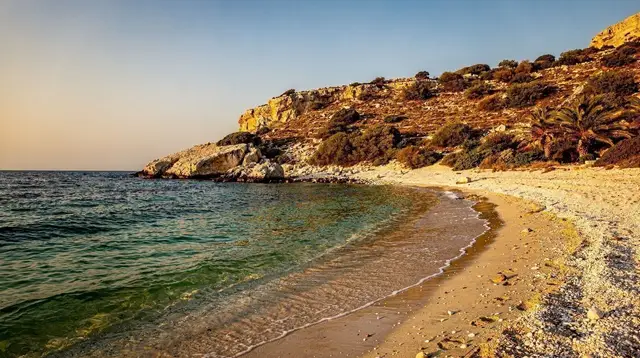
Photos of Chrissi’s turquoise shallows and white sand circulate widely enough that a lot of visitors arrive in Ierapetra assuming it works like any other beach excursion — hop on a boat whenever you feel like it, spend the day, maybe find somewhere to stay if you like it that much. None of that is quite right. Chrissi, also known by its older local name Gaidouronisi (“donkey island”), is a small, uninhabited islet protected under the EU’s Natura 2000 network, sitting about 15 km south of Ierapetra in the Libyan Sea. Nobody lives there. Nothing is built there beyond a few seasonal huts near the main landing beach. And the only way on or off is a boat that does not always run.
That is not a reason to skip it — the beach at Belegrina is genuinely beautiful, and the juniper forest behind it is a rare piece of natural Crete you will not see elsewhere on the island. But a day trip here needs realistic expectations: a weather-dependent crossing, no guarantee of departure in the shoulder season, no accommodation whatsoever, and a set of conservation rules that are enforced, not suggested.
What Makes Chrissi Different From a Normal Beach Day
Most of Crete’s beach excursions — Elafonissi, Balos, the resort strip around Hersonissos and Malia — sit on the coast of the main island, reachable by road even if the road is a poor one. Chrissi is offshore, uninhabited, and legally protected, which changes the character of a visit in a few concrete ways:
- No permanent population. There are no villages, no year-round residents, and no infrastructure beyond what operators bring in for the season.
- A rare habitat. The islet holds one of the largest surviving stands of Juniperus macrocarpa, a large coastal juniper, growing in dune sand rather than rock — an ecosystem scarce enough in the Mediterranean that the site has formal protected status.
- A single access point. Every visitor arrives and leaves by the same means: a boat from Ierapetra harbour, with no alternative route, no private mooring for casual sailors without a permit, and no bridge or causeway of any kind.
- A day-trip-only model. There is nowhere to sleep. A trip to Chrissi is bounded by the boat’s outbound and return times, typically five to seven hours door to door.
Getting to Chrissi: The Boat Is the Whole Trip
Boats to Chrissi leave from Ierapetra harbour, on the south coast roughly midway between Agios Nikolaos and Sitia. The crossing takes around 45 minutes to an hour each way depending on the boat, and most operators run one or two daily departures in high season, dropping to a handful of weekly sailings — or none — outside it.
| Season | Typical sailing frequency | What to expect |
|---|---|---|
| July - August | Daily, sometimes twice daily | Busiest crossings, highest cancellation risk from meltemi winds |
| May - June, September - early October | Most days, weather permitting | Calmer seas, thinner crowds, still weather-dependent |
| November - April | Little to none | Most operators suspend the route entirely |
A standard crossing lands at Belegrina beach, the islet’s main beach and the only spot with any seasonal facilities. Several boats also work a route that combines the crossing with a short stop near other coves, and a handful run later departures that stay for sunset before returning after dark — worth checking if you want the islet without the midday crowds.
If a fixed-schedule crossing with lunch on board suits your plans, the Chrissi Island yacht cruise from Ierapetra with lunch included covers the round trip and a meal in one booking, which removes some of the day’s logistics. For a smaller, more comfortable boat, the luxury Chrissi Island cruise with lunch and drinks on board runs on the same principle with a higher-end vessel and fewer passengers per sailing.
Why Sailings Get Cancelled — and Why That’s Not Rare
The crossing to Chrissi runs across open water, with no headland or bay to shelter it, so wind is the deciding factor every single day. The meltemi, the strong, dry north wind that peaks across July and August, is the best-known cause of cancellations on Crete’s boat trips generally, and it does reach the south coast around Ierapetra even though it is felt most on the north. But it is not the only wind that matters here: southerly and south-easterly blows, more common in spring and autumn, can make the Chrissi crossing choppy or unsafe even on a day when the north coast is calm.
In practice this means:
- Cancellations happen in every month boats run, not only in peak meltemi season.
- Operators typically decide the morning of departure, sometimes only a couple of hours ahead.
- A cancelled sailing is usually refunded or rescheduled, but there is no way to guarantee a specific day’s crossing in advance, however far ahead you book.
- Building a single day around Chrissi with no flexibility either side is a risk; a multi-day base in Ierapetra with a spare afternoon gives the booking a second chance if the first one falls through.
Operators running smaller or faster boats sometimes sail in conditions that keep the larger day-boats in harbour, so if the standard cruise is cancelled it is worth checking whether the smaller Chrissi Island boat trip departures are still running before writing the day off entirely.
No Accommodation, No Exceptions
It bears repeating because it trips people up every season: there is nothing to book to stay overnight on Chrissi. No hotel, no rooms, no legal campsite, no glamping setup — the islet’s protected status specifically rules this out, and no operator sells an overnight package because none exists. Everyone who lands on Chrissi in the morning leaves on a boat that same day. If the appeal is an island escape with a bed at the end of it, that experience belongs to places with an actual settlement, such as Spinalonga’s neighbouring towns of Elounda and Plaka, not to Chrissi.
What this means for planning a day trip:
- Check the boat’s return time before you commit to anything else that day — most crossings land back in Ierapetra by mid-to-late afternoon or early evening on a sunset sailing.
- Bring everything you need for the day: water, sun protection, snacks if your boat does not include lunch, and cash, since card payment on the islet itself is unreliable at best.
- Do not plan a tight onward connection immediately after — a delayed return crossing, even a short one, can eat the buffer you were counting on.
Sand, Shells, and the Rules That Are Actually Enforced
Chrissi’s Natura 2000 status is not a decorative label. Removing sand, shells, pebbles, dead wood or plant material from the islet is illegal under Greek environmental law, and it is enforced — rangers are present in season, and bags have been checked on the return crossing. The same logic that protects Elafonissi’s pink-tinged sand applies here: the beach looks the way it does because visitors, collectively, leave it alone.
A short, practical list of what that means on the day:
- Leave shells, sand and driftwood where you found them, however small or “just one.”
- Stay on marked paths through the juniper forest rather than cutting across the dunes — the root systems that hold the dune in place are shallow and easily damaged.
- Take your rubbish back to the boat; there is no waste collection infrastructure to speak of on the islet.
- Respect any roped-off or signed sections, which usually protect active nesting or particularly fragile dune growth.
None of this makes a visit feel restrictive in practice — most people never notice the rules because they were never planning to pocket a shell anyway — but it is worth knowing before you go, especially if travelling with kids who collect things on every beach out of habit.
What a Day on Chrissi Actually Looks Like
Once the boat ties up at Belegrina, the shape of the day is straightforward: swim, walk, eat if your boat includes a meal or a beach taverna is open, and be back at the boat for the return crossing. The water off Belegrina is shallow and clear for a long way out, which makes it comfortable for weaker swimmers and families, and the beach itself is wide enough that even a fuller boatload spreads out. A short walk inland through the juniper forest — Europe’s most significant example of this particular dune ecosystem — is the one thing on Chrissi that has no equivalent elsewhere on Crete, and it takes twenty to thirty unhurried minutes.
Beyond that, expect very little in the way of built attractions. A couple of seasonal beach tavernas near the landing point sell food and drink at boat-trip prices, sunbed rental is available but limited, and that is essentially the full list of facilities. Travellers looking for a livelier day with more stops along the south coast sometimes prefer a combined itinerary, such as the Ierapetra day tour combining local history and the southern coastline, which pairs the town’s own Venetian and Ottoman old quarter with time by the sea rather than a full Chrissi crossing.
Chrissi at a Glance
| Question | Short answer |
|---|---|
| Distance from Ierapetra | About 15 km, 45 minutes to 1 hour by boat |
| Who lives there | Nobody — uninhabited, protected islet |
| Accommodation | None; day-trip only |
| Boat season | Roughly May to October |
| Main cancellation risk | Meltemi (Jul-Aug) and other strong winds, any month boats run |
| Main beach | Belegrina, near the boat landing |
| Facilities | A few seasonal tavernas and sunbeds; nothing more |
| Sand and shell removal | Illegal, enforced, fines possible |
If the Boat Is Cancelled: Alternatives From Ierapetra
Because Chrissi sailings are genuinely weather-dependent, it helps to have a plan B rooted in Ierapetra itself rather than treating the islet as the only reason to be in town. The Sarakina gorge, a short, accessible walk inland from Ierapetra, works as a half-day alternative that does not depend on sea conditions, and Ierapetra’s own old town, with its Venetian fort and small archaeological collection, fills a morning without a boat at all.
Travellers building a longer stay in the south-east sometimes plan Chrissi as one day within a broader 4-day east Crete itinerary or a 6-day south coast route, which absorbs a cancelled sailing far more easily than a single tightly booked day trip does.
For a wider view of how the south coast’s boat-dependent villages and islets connect, the south coast boat network explainer covers Chrissi alongside Loutro and other places reached only by sea, and what the meltemi does to a holiday is worth reading before locking in any single-day boat plan on Crete’s coast.
Travellers wanting a longer day on the water rather than a straight there-and-back can look at the full-day boat cruise to Chrissi Island or, for an evening option that swaps the beach day for a sunset sailing, the afternoon catamaran trip to Chrissi with dinner and a sunset return.
Practical Notes Before You Book
A few details worth confirming directly with whichever operator you choose, since they vary boat to boat: whether lunch or drinks are included or bought on the islet, whether the price covers sunbed or umbrella hire at Belegrina, and what the refund or rebooking policy is for a weather cancellation. None of Crete’s beach protections — the right to free beach access and a clear path to the water that applies across the island — are suspended on Chrissi; sunbed rows still have to leave public space and a route to the sea, even on a protected islet with limited facilities.
Sun protection deserves more attention here than on a mainland Crete beach: the juniper forest offers some shade on the walking paths, but Belegrina itself has very little natural shade, and a full day on open sand with no early return option is a longer stretch of exposure than most resort beach days. Bring more water than feels necessary, since the seasonal tavernas can sell out on the busiest crossings, and plan for the walk back to the boat to take longer than expected if the whole group wants to see the juniper forest before departure.
Chrissi Island Day Trip: Frequently Asked Questions
What is Chrissi island and where is it?
Chrissi is a small, uninhabited, protected islet in the Libyan Sea, roughly 15 km south of Ierapetra on Crete’s south-east coast. It is part of a Natura 2000 site and is known for a rare, naturally occurring Juniperus macrocarpa forest that anchors the dunes.
Is Chrissi the same place as Gaidouronisi?
Yes. Gaidouronisi is the older, more common local name and Chrissi is the name used on most tourist boats and maps. Both refer to the same islet, and you will see both used interchangeably in Ierapetra.
Can you stay overnight on Chrissi island?
No. There is no accommodation, no hotel, and no legal camping on Chrissi. It is a day-trip destination only, visited on a return boat from Ierapetra, and every visitor leaves on the same boat they arrived on.
How do you get to Chrissi island?
The only way to Chrissi is by boat from Ierapetra harbour, a crossing of around 45 minutes to an hour depending on the vessel. There is no bridge, no ferry from anywhere else, and no way to reach the islet independently by kayak or private boat without a permit.
Does the meltemi affect boats to Chrissi?
Yes. The meltemi, the strong north wind that peaks in July and August, blows across the open water between Ierapetra and Chrissi and regularly forces operators to cancel. Other strong southerly or south-easterly winds can cancel sailings even when the meltemi itself is a north-coast problem, so cancellations are not limited to those two months.
Is it true you can’t take sand or shells from Chrissi?
Correct. Chrissi is a protected Natura 2000 site, and removing sand, shells, pebbles or plant material is illegal and can be fined. Rangers and boat crews do enforce this, and bags are sometimes checked on the return crossing.
Is there any infrastructure on Chrissi island?
Very little. There are a handful of seasonal beach tavernas near the main landing point at Belegrina beach and basic sun loungers for rent, but no shops, no fresh water supply for visitors, no medical facilities and no fixed structures beyond that. Most of the islet is left as wild scrub and juniper forest.
What time of year is best for a Chrissi day trip?
Boats generally run from May to October, with June, September and early October offering calmer seas and thinner crowds than the peak of July and August. Outside that window boats do not run at all, so a winter or early-spring visit to Chrissi is not possible.
Beach Tours in Crete on GetYourGuide
Verified deep-linked GetYourGuide tours. Book through these links and we earn a small commission at no cost to you.
GetYourGuide does not provide a product photo for this activity — the image shows the meeting point, photographed by us.