Cycling and E-Bike Routes in Crete
Where should you actually cycle in Crete?
Crete has two different rides, not one: the VOAK/E75 north-coast highway between Chania, Rethymno, Heraklion and Agios Nikolaos, which is fast and built for cars, and the narrow mountain and village lanes above and south of it, which are quieter but steep and shoulderless. Most visiting cyclists do best sticking to short valley and village loops, or joining a guided e-bike tour, rather than attempting the coast road or a long point-to-point crossing.
Two different islands to ride on
Crete is not one shape for a cyclist, it is two. Run a finger along a map from Chania to Sitia and the island reads as a long, narrow ribbon: about 260 km east to west, but only 12 to 60 km north to south. That narrowness matters more than the length. It means almost every ride on Crete is really a choice between the busy corridor along the top and the quiet, steep tangle of lanes above and below it, and the two behave nothing alike on two wheels.
The corridor is the VOAK / E75, the highway that strings together Chania, Rethymno, Heraklion and Agios Nikolaos. It is fast, it is often two lanes each way, and it is built for cars and coaches, not for a bike. Riding it is less a cycling route than a transfer: useful for covering ground quickly between towns, uncomfortable and genuinely risky to spend much time on. Most of what actually makes Crete good cycling territory lies off it, in the folded hills and valleys the highway skirts rather than climbs.
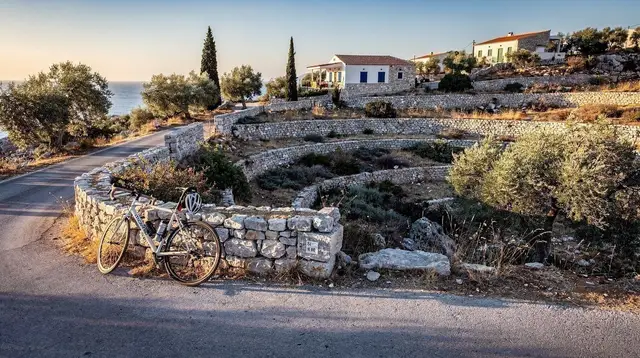
South and inland of that line, the island changes character completely. Roads narrow to a single lane with passing places, climb and drop with almost no flat stretches, and thin out fast once you leave a village. This is where the things to do around cycling and e-biking actually happen on Crete: short valley loops, olive-grove lanes, and village-to-village rides rather than long point-to-point crossings.
The coast road is for getting somewhere, not for the ride itself
It is worth being blunt about the VOAK, because visitors sometimes assume a coastal highway on a Greek island will be scenic and rideable the way a quiet island lane might be. It is not that kind of road. Traffic merges at speed, shoulders come and go, and long tunnel sections near Rethymno and Heraklion are unpleasant and occasionally unsafe on a bicycle. Cyclists who do use it tend to be covering distance between bases rather than sightseeing, and even then, many prefer the older, slower roads that run through the coastal towns just inland of the new highway, where traffic is lighter and stops are more frequent.
That older network connects places worth actually cycling into: the approach to Rethymno’s old town, the lanes around Georgioupoli and Lake Kournas, or the quieter run into Chania’s Venetian harbour. None of it is signed as a cycling route in any formal sense — Crete has no island-wide bike lane network — but it is a far more honest place to ride than the E75 itself.
Mountain roads, and the courtesy every rider should recognise
Move inland and uphill and the roads change again. Village lanes toward the foothills of Psiloritis, into the Lefka Ori, or up onto the Lasithi plateau are narrow, twist constantly, and often have no real shoulder at all. There is one local habit worth knowing before you ride any of them: Cretan drivers, on encountering a faster vehicle behind them on a narrow mountain road, routinely edge onto the hard shoulder or verge to let it pass.
It is a courtesy, deeply embedded in how people drive here, and it applies to cyclists too — a driver pulling over is making space, not issuing an invitation to dart past on a blind bend. Read it as how Cretans drive rather than as licence to overtake without checking sightlines yourself; the same blind corners that make a car pull over make it just as important for a bike to hold its line and wait for a clear view.
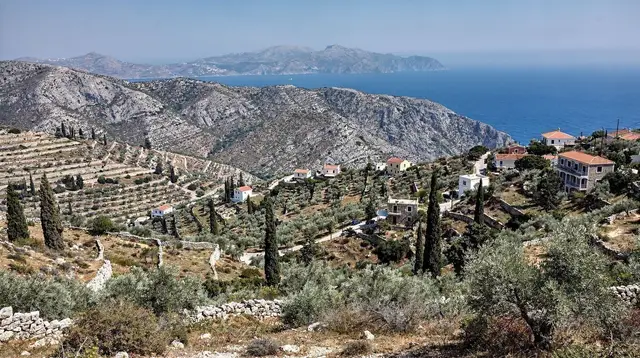
These roads reward caution for a second reason: Crete’s geology. The island is limestone, heavily folded and cut through by gorges, not a volcanic landscape of long gradual slopes. That means climbs tend to be short, steep and repeated rather than long and steady, and a route that looks modest on a map can involve far more total ascent than the distance suggests. Shade is scarce on open hillsides, road surfaces vary from smooth asphalt to patched and gravelly stretches without warning, and villages — with water, shade and a kafeneio to rest at — are genuinely useful waypoints, not just scenery.
No train, and the buses thin out south of the mountains
Anyone planning a longer ride, or simply wanting a fallback if legs or weather turn, should factor in how Crete actually moves people around. There is no railway anywhere on the island — none has ever existed here. The KTEL coach network is genuinely useful along the north coast, running reasonably often between Chania, Rethymno, Heraklion and Agios Nikolaos on the same corridor as the VOAK. South of the central mountains, though, the network thins fast: a handful of routes a day, some seasonal, many timed around school or market schedules rather than tourism.
The practical consequence is straightforward. A north-coast ride has a real bailout option if the heat or an unexpected climb ends the day early — flag down or plan around a KTEL bus, most of which will take a bike if there is room. A ride into the southern foothills or across toward the Libyan coast does not have that safety net in any reliable way. Riders heading south or into the mountains should plan to finish under their own power, renting a car as backup transport rather than counting on public transport to rescue a route that goes wrong.
When to actually get on a bike
Season decides more about a Cretan cycling trip than route choice does. The honest best time to visit for riding is late April through June, then again from September to mid-October. Spring brings cooler air, wildflowers through the hills, and the gorges open; autumn keeps warm, settled weather without the peak-summer extremes.
July and August are the months to plan around rather than through. Daytime temperatures of 30 to 35°C make sustained effort on an exposed road genuinely hard, and this is also when the meltemi is most active — a strong, persistent north wind that batters the north coast in particular.
A rider heading east or west along the VOAK corridor in a meltemi is not just contending with traffic but with a headwind or crosswind that can turn a modest ride into a slog; what the meltemi does to a Cretan holiday applies to a bike saddle as much as it does to a boat trip. The south coast, sheltered by the mountains, is calmer in a meltemi but hotter and drier, which brings its own toll on a rider without much shade.
Outside the loose May-to-October cycling season, the mountains hold snow into May or June and many rural businesses close for winter, so a ride at that time of year needs to be planned around a coastal town base rather than a village crossing.
Where e-bikes make sense
Given the terrain — constant short climbs rather than long flat runs, real heat outside the shoulder months, and limited backup transport once away from the coast — an e-bike is a genuinely practical choice for most visitors rather than a novelty. It takes the edge off repeated steep pitches without removing the ride itself, and it makes a longer valley loop realistic for someone who would otherwise be limited to a short flat stretch near their base.
This page deliberately does not name a rental company or quote a fixed daily rate for hiring a bike independently, because neither is something that can be verified and kept current here; ask locally in Chania, Rethymno or Heraklion once you have a base, or take the simpler route of a guided ride where the bike, the route and the support vehicle are already sorted for you.
A guided bike ride through a hidden watermill valley with food and drink stops along the way is a good example of what a well-built cycling day here actually looks like: a short, scenic valley route rather than a long crossing, timed to avoid the worst of the heat, with the climbing handled by an assisted bike rather than by raw effort. A similar electric-bike tour through Cretan villages with a food stop built in works the same way, linking a handful of hill villages on quiet lanes rather than attempting a headline distance.
Riders drawn to history alongside the exercise can combine both on an e-bike route out to Arkadi monastery with lunch included, riding the approach roads to the 1866 monastery rather than driving in — a different way to arrive at a site with a genuinely heavy history. For travellers who would rather pair a shorter ride with Crete’s other strong suit, a wine and olive oil tasting session near the Archanes and Peza wine country makes a natural, low-effort second half to a cycling day.
What this page will not tell you
Deliberately absent here are turn-by-turn routes measured to the kilometre and the names of specific bike rental firms. Neither can be kept accurate without verified, current data, and a wrong distance or a defunct rental shop is worse than no information at all.
What can be said reliably is the shape of the choice every cyclist on Crete faces: fast and exposed along the VOAK corridor, or slow, steep and quiet in the hills and valleys above it, on an island that is limestone and gorge country, not a volcanic landscape, and considerably longer, corner to corner, than most first-time visitors expect. Plan a day’s ride around a valley, a village loop, or a guided route rather than a crossing, and check the season and the wind before committing to distance on the exposed north coast.
Frequently asked questions about cycling in Crete
Is the VOAK / E75 coast road safe to cycle on?
It is the fastest way along the north coast between Chania, Rethymno, Heraklion and Agios Nikolaos, but it is a highway built for cars and trucks, often two lanes each way with fast-merging traffic and limited shoulder. It is not a scenic cycling road; treat it as a corridor to get past quickly, or avoid it and use the older parallel roads through the coastal towns instead.
What does it mean when a car pulls onto the shoulder ahead of me?
On Crete’s narrow mountain roads, drivers habitually edge onto the hard shoulder to let a faster vehicle pass. It is a long-standing local courtesy, not an instruction to overtake blind on a bend. As a cyclist, read it the same way: it signals space being made, not a green light to dart past without checking the road ahead.
Can I cycle across Crete and take a bus or train back if I get tired?
There is no train anywhere on the island. The KTEL coach network runs well along the north coast corridor but thins to a handful of seasonal routes south of the mountains, so a rider who tires out on a south-coast or upland road may have very few options for getting a bike and themselves back to base that day.
When is the best season to cycle in Crete?
Late April to June and September to mid-October give the best balance of cooler temperatures, open gorges and thinner traffic. July and August bring heat of 30-35 degrees Celsius and the meltemi, a strong north wind that makes the north-coast road and exposed climbs considerably harder going.
Are there mountain passes or climbs suitable for cycling?
Crete is limestone, folded and cut by gorges rather than volcanic, so its roads climb and drop constantly rather than following long gradual grades. Village lanes into the foothills of Psiloritis, the Lefka Ori or above Lasithi offer real climbing, but roads are narrow, surfaces vary, and there is little to no shade, so distances that look short on a map take longer than expected.
Do I need an e-bike rather than a regular bicycle?
An e-bike is the more forgiving choice for most visitors given Crete’s constant gradient changes, heat outside the shoulder seasons and long distances between services. Several operators run guided e-bike routes through valleys and villages that include the climbing for you, which suits travellers who want the scenery without pacing a mountain ascent themselves.
Is there a signed cycling network or bike lanes in Crete?
No island-wide signed cycling network or dedicated bike lane system exists outside short stretches in a few towns. Riders share the road with traffic almost everywhere, which is part of why the north-coast highway and blind mountain bends both call for caution rather than confidence in dedicated infrastructure.
How far is it realistic to ride in a day?
This page does not set fixed kilometre distances because they depend heavily on route, heat and rider fitness, and a wrong number is worse than none. As a general shape, Crete is roughly 260 kilometres end to end and only 12 to 60 kilometres north to south, so plan around a single valley, a coastal town, or a guided loop rather than a cross-island ride.
Cycling & E-Bike Tours in Crete on GetYourGuide
Verified deep-linked GetYourGuide tours. Book through these links and we earn a small commission at no cost to you.
GetYourGuide does not provide a product photo for this activity — the image shows the meeting point, photographed by us.