Imbros Gorge: The Practical Guide to Crete's Other Canyon
How long does it take to walk the Imbros Gorge?
Most visitors walk the roughly 8 km descent from Imbros village to Komitades in a few hours, but the exact time depends on fitness, group size and how many photo and rest stops you take, so this guide will not promise a fixed schedule. Build in a half-day overall once you add parking or drop-off logistics at the top and onward transport from the bottom back toward Frangokastello or Chora Sfakion.
A shorter gorge in the shadow of the White Mountains
Ask how long the Imbros Gorge takes and you are really asking a question about the whole south-west corner of Crete, because the walk cannot be separated from where it sits. Imbros drops from a mountain village of the same name down through folded limestone to Komitades, a hamlet a few minutes’ drive from Frangokastello and from the boat-only harbour at Chora Sfakion.
It is one of several gorge walks that cut south through the Lefka Ori, the White Mountains, toward the Libyan Sea, and it has built a reputation as the practical alternative to Samaria: shorter, lower, less committing, and open on more days of the season.
This page will not hand you a stopwatch schedule. Every gorge walk on Crete depends on the fitness of the slowest person in your group, how many times you stop to look at the walls narrowing overhead, and whether you are hiking at 9am in April or at 2pm in a July heatwave. Anyone promising an exact figure to the minute is guessing, and a guess that is wrong by an hour matters a great deal when the only way out is a walk downhill with no shortcut back up. What this page gives instead is how to plan around that uncertainty: when to go, how to get there and back without a car if you genuinely cannot arrange one, and what the gorge actually is, geologically and logistically, so you are not caught out.
Imbros against Chora Sfakion and Frangokastello
The Sfakia region, the wedge of Crete south of the White Mountains, has always run on its own logic. It is cut off from the rest of the island by mountains rather than distance, and its villages face the sea, not the road network. Chora Sfakion is the region’s small port, reachable by a serpentine descent from the Imbros plateau, and the starting point for boats onward to Loutro, a village that has no road in or out at all. Frangokastello, a few kilometres east along the coast, is known for its Venetian fortress and its wide beach, and it is the natural base for walking Imbros without adding a long return drive at the end of the day.
The gorge walk finishes below both of these places, at Komitades, so a hiker’s day typically looks like: get dropped near the top at Imbros village, walk down, and be collected or bused from the bottom, ending up close to Frangokastello or Chora Sfakion rather than back where the car is parked. That one-way shape is the single most important planning fact about Imbros, more important than any duration estimate, because it decides whether you need two vehicles, a pre-arranged pickup, or a guided tour that handles the logistics for you.
The south stays calmer when the north does not
Crete’s south coast faces the Libyan Sea, and that geography matters most in the two months when it matters least anywhere else on the island. In July and August, a strong north wind called the meltemi blows across the Aegean side of Crete, and it is the boats along the north-west coast, to places like Balos and Gramvousa, that get cancelled by it, sometimes for days at a stretch.
The Libyan coast around Frangokastello and Chora Sfakion is largely sheltered from that same wind by the mountains behind it, so a hike through Imbros and an afternoon on a south-coast beach can stay on plan even when the north coast is blustery and the boat schedules there are in disarray. It is one of the more useful pieces of local logic for anyone building a trip around the meltemi season: when the north gets difficult, look south.
That does not make the south immune to weather in the other direction. Winter rain, and the risk of flash flooding it brings to any gorge on the island, is a real closure trigger here too, just as it is at Samaria, even if Imbros tends to reopen for the season on roughly the same broad window that governs hiking across Crete.
When to hike Imbros
The hiking season on Crete’s gorges runs on the same calendar as the rest of the island’s outdoor activity, and Imbros is no exception. Late April to June and September to mid-October are the strongest months: the gorge is open, the heat is manageable for a few hours of downhill walking, and the light through the narrow sections is at its best.
July and August are workable but hot, and an early start matters more here than almost anywhere else on the itinerary, since there is little continuous shade and no way to shorten the route once you are committed to it. Winter, from November into March, is the genuine off season: the gorge can close after rain, transport south of the mountains thins further, and several businesses in Frangokastello and Chora Sfakion shut for the months when almost nobody comes.
| Season | Gorge conditions | What to expect on the coast |
|---|---|---|
| Late April - June | Open, cool mornings, wildflowers | Sea still cool, fewer crowds |
| July - August | Open, hot, early start matters | South coast calmer than the north under the meltemi |
| September - mid-October | Open, warm sea, good light | Busy but manageable |
| November - March | Closes after rain, unreliable | Many south-coast businesses closed |
For a broader sense of how these windows compare across the whole island, see best time to visit Crete and the month-by-month breakdown at Crete weather month by month.
Getting there: why the car is the honest answer
South of the White Mountains, the transport picture on Crete changes completely. The island has no railway anywhere, and the KTEL coach network that runs efficiently along the north coast between Chania, Rethymno, Heraklion and Agios Nikolaos thins to a handful of seasonal runs once you cross the mountains.
There may be a bus link connecting Imbros, Chora Sfakion and Frangokastello on certain days in season, but frequency and timetable change year to year and should always be checked locally rather than assumed from an old printout. For most visitors, a rental car is simply the practical way to combine a night or two around Frangokastello with a morning at Imbros, and it is the option that gives you control over when you start, which matters more here than the exact duration of the walk itself.
If you would rather not manage the one-way logistics yourself, a guided walk that includes transport is the other realistic route. A day built around the walk through Imbros Gorge followed by a swim on Frangokastello beach folds the transfer, the walk and the return into one booking, which removes the single biggest planning headache: getting back to where you started. For travellers based further along the coast, a combined hiking day through the gorge with time on Frangokastello’s beach afterward covers the same ground with pickup included.
Driving etiquette in the mountains
The road up to Imbros village, like most mountain roads on this side of the island, is narrow and winds hard against the contours of the White Mountains. Local drivers deal with this the same way everywhere in rural Crete: when a faster car comes up behind on a stretch without much visibility, the driver ahead pulls onto the hard shoulder to let it pass.
That is a courtesy gesture, not a signal that the road ahead is clear, and treating it as an invitation to overtake blind is how head-on incidents happen on roads with no real margin for error. Slow down, use pull-outs to let faster local traffic go by, and treat every blind bend on this stretch as occupied until proven otherwise. More on this in driving in Crete, and on the coach alternative, thin as it is south of the mountains, in KTEL buses in Crete.
What the gorge actually is
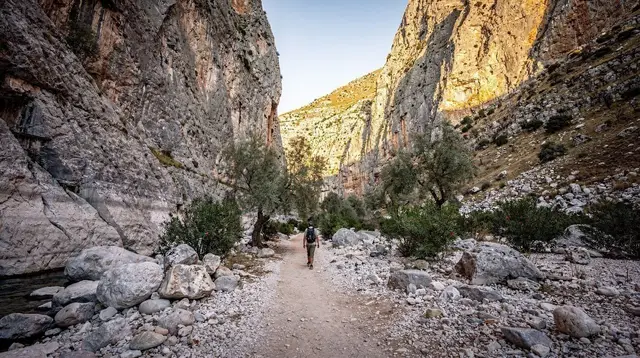
It is worth being clear about what you will and will not see inside Imbros, because Crete attracts a steady stream of visitors expecting volcanic scenery that simply does not exist here. Crete is not a volcanic island. There is no caldera, no fumarole, no hot spring and no lava rock anywhere on the route. What you walk through instead is limestone: folded, fractured and cut by water over a very long time into a corridor whose walls close in and open out as you descend, with loose stone underfoot for most of the way.
It is a striking landscape on its own terms, cool in its shaded sections even in summer heat, but it is geology of a completely different kind from the Cycladic islands to the north, and setting that expectation correctly avoids a genuine disappointment for anyone who has just come from, or is about to go to, a place like Santorini.
The walk itself is downhill, on a marked path, with no technical climbing involved. A managed entrance fee applies at the top, paid in cash, in the same style as the entrance to Samaria and several of the island’s other gorges. There is no facility to buy food or water once you are inside, so carry what you need with you rather than planning to restock partway down.
Imbros next to Samaria
The comparison to Samaria is unavoidable, since the two gorges sit close together geographically and serve a similar kind of day. Samaria is the far bigger undertaking: 16 km one-way from the Xyloskalo above Omalos down to Agia Roumeli, a village with no road, reached out only by boat. Imbros is roughly half that distance, ends at a village with a normal road connection, and asks much less of a hiker’s legs and schedule.
That makes it the realistic choice for a traveller who wants a gorge walk without committing a full day and a boat transfer to it, or for anyone visiting outside the narrower window when Samaria itself is open. For the full picture of what the bigger walk involves, see the Samaria Gorge complete guide; for why that route ends the way it does, why Samaria ends with a boat is worth reading before you decide which gorge fits your trip.
If your interest is less in a single walk and more in stitching several days together around this corner of the island, an itinerary built specifically for the region, such as White Mountains and Sfakia in three days, gives a sense of how Imbros, Frangokastello, Chora Sfakion and Loutro fit into a longer visit.
Options for the walk itself
Beyond the two combined hike-and-beach tours above, a smaller, group-based option exists for travellers who want the walk itself without a beach add-on: an Imbros Gorge walk in a small group with a guide covers the descent with local knowledge of the path and its history, again with transport handled for you rather than left to work out on your own.
Travellers basing themselves further along the south coast, in or near Chora Sfakion, sometimes prefer to combine a boat trip with the beach at Frangokastello rather than the gorge walk itself; a day trip taking in Loutro by boat and Frangokastello beach is worth considering as an alternative or a companion day, especially for anyone who has already walked Samaria and wants a gentler day to follow it.
Practical notes before you go
Wear closed shoes with real grip; the path is loose stone for long stretches, and sandals are a genuinely bad idea here as they are on every Cretan gorge. Bring more water than feels necessary, since there is no shop along the route and no shade for parts of the lower gorge. Carry cash for the entrance fee. Start as early in the day as your logistics allow, particularly outside the cooler shoulder months, since there is no way to bail out partway down other than continuing to the bottom.
And build slack into your day for the return leg, whether that means a car parked and waiting, a pickup arranged in advance, or a guided tour that has already solved that problem for you: the exact number of hours the walk itself takes matters far less than having a plan for what happens once you reach Komitades.
For the region beyond the gorge, Loutro, the village with no road and the quieter coves covered in Glyka Nera and the Sfakia beaches both make sense as a second day alongside Imbros, and the broader question of which coast to base yourself on is covered in north coast versus south coast Crete. For a wider sense of how driving conventions work across the island, not just on this one road, see how Cretans drive and the general list at things to do: gorge hikes.
Frequently asked questions about the Imbros Gorge
How long does it take to walk the Imbros Gorge?
Plan for a few hours of walking, downhill the whole way, plus time at either end for transport. Fitness, footwear, heat and how often your group stops all change the pace more than any single quoted time can capture, so treat any exact number you see elsewhere with caution and build slack into your day.
Where does the Imbros Gorge start and end?
The walk runs from Imbros village, on the road up from Vrysses toward Chora Sfakion, down to Komitades, a small village a short drive from Frangokastello and from Chora Sfakion itself. It is a one-way, downhill route, so you need transport waiting at the far end or arranged back to your car.
Can I get from Imbros to Frangokastello without a car?
Public transport south of the White Mountains is thin and seasonal, and there is no train anywhere on Crete. A rental car is the practical way to link Imbros, Komitades and Frangokastello yourself, or you can book a guided walk that includes transfer as part of the tour.
Is Imbros Gorge open all year?
The gorge is walkable for longer stretches of the year than Samaria, since it sits lower and is less exposed to flash-flood closures, but conditions still depend on winter rain and the season. Late April to June and September to mid-October are the most reliable window, and any closure after heavy rain is a safety call, not a formality.
Is Imbros Gorge harder than Samaria?
No. Imbros is shorter, at roughly 8 km against Samaria’s 16 km one-way, with an easier, more even path and no long uphill effort, which makes it a realistic half-day option next to Samaria’s full-day commitment. It still has loose stones underfoot and narrow limestone walls, so proper shoes matter on either walk.
Is there a fee to enter Imbros Gorge?
A small entrance fee applies at the top of the gorge, in the same style as other managed gorge walks on Crete. Bring cash, since card acceptance at a rural gate entrance should never be assumed.
What should I bring for the hike?
Closed hiking shoes with grip, more water than you think you need, a hat and sun protection, and a light layer, since the gorge walls shade parts of the path even on a hot day. There is no shop inside the gorge, so carry what you need in with you.
Does the meltemi affect a hike through Imbros?
The meltemi is a north wind, and it is the boats along the west coast to places like Balos and Gramvousa that it cancels, not an inland gorge walk on the south side of the mountains. In July and August the Libyan coast around Frangokastello and Chora Sfakion typically stays calmer than the north, which is one reason a south-coast hike works even when the north coast is blustery.
Gorge Hikes in Crete on GetYourGuide
Verified deep-linked GetYourGuide tours. Book through these links and we earn a small commission at no cost to you.
GetYourGuide does not provide a product photo for this activity — the image shows the meeting point, photographed by us.