Climbing and Canyoning in Crete
Do climbing and canyoning in Crete happen in the same mountains as the Samaria gorge hike?
Yes. Therisso gorge sits in the foothills of the Lefka Ori, the White Mountains that also hold the Samaria gorge and rise to Pachnes at 2,453 m, just short of Psiloritis at 2,456 m. Climbing and canyoning here follow the same May-to-October season and the same flood-and-fire closure rules as the island's other gorges.
The mountains behind Chania, not a separate range
Ask whether climbing and canyoning in Crete happen in the same massif as the famous Samaria trek, and the honest answer is yes. Therisso gorge, a short drive south of Chania, sits in the foothills of the Lefka Ori, the White Mountains — the same range whose higher folds hold the Samaria gorge further south. This is one mountain system with several faces, not two unrelated destinations that happen to share a map.
A visitor choosing between a Therisso outing and a Samaria trek is choosing a different entry point into the same limestone block, not a different part of the island. The distinction runs deeper than infrastructure: a canyoning or climbing day near Therisso ends back at the car it started from, while the Samaria descent is strictly one-way and finishes at Agia Roumeli, a village with no road in or out — from there, the only way onward is by boat to Chora Sfakion, Sougia or Palaiochora, followed by a bus.
That matters for how to plan. Weather closes in on the Lefka Ori as a whole, road access narrows as a whole, and the season that governs one gorge broadly governs the others. Treat Therisso as an extension of the same mountain logic that shapes Samaria, Imbros and the rest of the range, rather than as an isolated activity zone.
Where the Lefka Ori sit, and how high they go
The Lefka Ori form the mountainous spine of western Crete, a folded limestone block cut through by gorges on its southern flank. Their high point is Pachnes, at 2,453 m, the second-highest summit on the island. The overall high point of Crete belongs to Psiloritis (Mount Ida), further east in the Rethymno region, at 2,456 m — a difference of three metres between the island’s two giants. Both hold snow into May or June in an average year, which is part of why the climbing and canyoning season here does not start early.
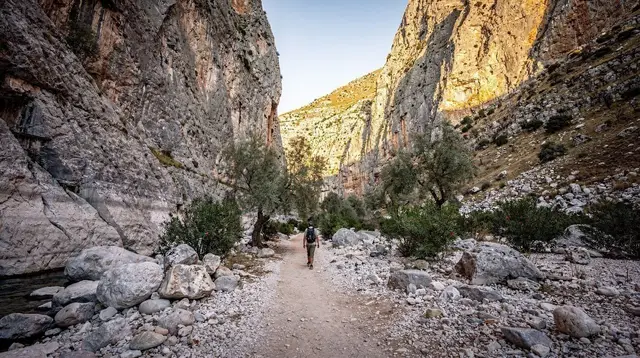
Therisso gorge itself is a lower, more accessible cut into this range: a narrow limestone corridor a short way inland from Chania, historically significant as the base from which Eleftherios Venizelos declared a revolutionary government in 1905, and today reached by a paved but genuinely narrow road that climbs through the gorge walls. It is the practical, easy-to-reach face of a mountain system that gets steeper, higher and more demanding the further south and east it runs — toward Anogia and Psiloritis on one side, and toward the Samaria and Imbros corridors on the other.
Getting there: narrow roads and mountain courtesy
The road into Therisso, like most roads that climb into the Lefka Ori foothills, is a single lane with passing bays rather than a two-lane highway. Local drivers deal with this by pulling onto the hard shoulder when a faster car needs to pass — a courtesy, not an invitation to overtake blind on a bend. Visitors renting a car for the drive should read that gesture correctly: it means “go ahead when safe,” not “the road is wide enough here.” The same etiquette applies broadly across Crete’s mountain roads, from the approach to the Samaria trailhead at Omalos to the tracks around Anogia.
A standard rental car manages the paved road to Therisso village without difficulty. Tracks that continue further into the White Mountains foothills, toward unmarked climbing sectors or old shepherd paths, are rougher, and most rental contracts exclude unpaved roads from cover — the same caveat that applies to the dirt track down to Balos in the island’s far west. An organised trip with a driver who knows the terrain removes that risk. A private 4x4 excursion into the range is one way to see more of the Lefka Ori’s high ground without testing a rental agreement’s fine print:
a private 4x4 safari into the White Mountains above ChaniaWhat “climbing and canyoning” actually means here
Rock climbing near Chania is concentrated on limestone sectors close to the Therisso road and around the wider Chania foothills, with routes typically bolted for sport climbing rather than requiring traditional gear. A local guide handles rope work, route selection and gear on ground that is, in most places, not signposted the way a national-park trail is. For a first outing, a guided half-day session is the standard format:
a guided rock climbing session on the sectors near TherissoCrete’s climbing is not confined to the west. On the Libyan coast near Plakias, a separate set of limestone sectors above the beach offers routes with a different character — shorter approaches, sea views, and a warmer microclimate on the island’s south side:
guided climbing on the sectors above Plakias beachCanyoning proper, in the sense of descending a watercourse with ropes through pools and drops, is a smaller niche on Crete than gorge walking, and it concentrates on specific, guided routes rather than open access. Visitors looking for the closest equivalent to a canyoning experience near Chania are usually better served by a structured gorge walk with a cultural or naturalist framing than by an unguided descent:
a guided walk through Therisso gorge with local history and culture built inTravellers who want the mountains without ropes or a wetsuit have a gentler option nearby, an eco-focused outing through the Rethymno foothills that touches the same range from its eastern side:
a guided eco and nature tour through the mountains from RethymnoThe season: the same rule as the island’s gorges
Climbing and canyoning in the Lefka Ori follow the broad rule that governs every gorge on Crete: the useful season runs roughly May to October. Outside that window, several things work against a visit rather than one. Snowmelt from Pachnes and the surrounding peaks keeps watercourses unpredictable into spring. Crete’s managed gorges, Samaria among them, close outright when park authorities judge the flood or fire risk too high, and the same caution shapes access to the wider range around Therisso even where no formal park gate exists. Rock faces stay damp longer at altitude, and daylight hours shrink.
None of that means the shoulder months are unusable — late spring and early autumn are, if anything, the most comfortable time to climb, once the immediate snowmelt has passed and before autumn rain returns. What it does mean is that a plan built around November through March conditions is not one this page will describe as workable. Winter here is a genuine off-season: colder, wetter, shorter days, and explicitly discouraged by the same closure logic that shuts the trailhead at Omalos each year. If the season and the closure rules are in doubt for a specific week, checking conditions locally before setting out matters more than following a fixed calendar date.
Wildlife: nothing dangerous underfoot
One practical worry visitors sometimes carry into gorge or mountain terrain elsewhere in the Mediterranean does not apply on Crete: there is no dangerous snake on the island. Four species live here, and none of them are vipers. That holds on the climbing sectors around Therisso and Plakias as much as it does on the Samaria trail or anywhere else in the Lefka Ori. It is one fewer variable to plan around on ground that already demands attention to footing, rope work and weather.
Comparing the options
| Activity | Where | Format | Season |
|---|---|---|---|
| Guided rock climbing | Therisso / Chania foothills | Half-day, bolted sport routes | May–October |
| Guided rock climbing | Plakias, south coast | Half-day, coastal sectors | May–October |
| Gorge walk with cultural framing | Therisso gorge | Half-day, guided | May–October |
| Private 4x4 into the range | Chania to the high Lefka Ori | Half to full day | May–October |
| Eco and nature outing | Rethymno foothills | Half-day | Spring–autumn |
Nearby ground worth knowing
Anyone building a trip around Therisso and the White Mountains is already close to several other pieces of the same range. The Therisso gorge drive itself covers the route in more detail, and the E4 trail across Crete shows how these foothills connect eastward toward Psiloritis on a long-distance path. For the range’s two summits, the Psiloritis summit hike and Pachnes and the White Mountains lay out what a serious ascent actually requires, distinct from the shorter outings described here.
For the range’s better-known southern trail, the complete Samaria gorge guide and the Imbros gorge guide cover the managed, one-way treks that draw the bulk of visitors to this mountain system — useful context, not a claim that either is busier or better run than the routes around Therisso, since that comparison is not one this page can back with a source. A three-day loop through the White Mountains and Sfakia strings several of these pieces together for travellers with more time.
Two shorter reads round out the practical side: how Cretans actually drive explains the hard-shoulder courtesy on mountain roads in more depth, and why Crete has no dangerous snakes covers the island’s four harmless species. For the full range of guided activities filed under this category, the canyoning and climbing category page lists what else is bookable across the island, including Samaria gorge as the range’s southern anchor point.
Climbing and canyoning in Crete’s White Mountains: frequently asked questions
Is climbing and canyoning near Therisso the same experience as hiking the Samaria gorge?
They sit in the same range, the Lefka Ori, but they are different activities with different infrastructure. Samaria is a long, one-way, officially managed trek with rangers and fixed exit points. Climbing routes and short canyon walks near Therisso are smaller-scale and less supervised, and this page makes no claim that one is busier, safer, or better organised than the other without stating a source.
When is the best season for climbing and canyoning in the White Mountains?
Roughly May to October, the same window that applies to the island’s gorges in general. Rock faces dry out and canyon beds stabilise once the spring snowmelt has passed, and the season ends as autumn rain returns to the Lefka Ori.
Do the mountain roads around Therisso require a 4x4?
A standard rental car reaches Therisso village on a paved but narrow road. Tracks further into the White Mountains foothills are rougher, and an organised 4x4 safari is the more practical way to get beyond the paved network without testing a rental contract’s terms.
Are there dangerous snakes on the climbing routes or in the gorges?
No. Crete has four snake species and none are vipers, so there is no dangerous snake to plan around here or anywhere else on the island.
Can canyoning or gorge walking in the White Mountains be done in winter?
This is not recommended and operators do not run it. Winter brings snowmelt, unstable water levels and closed gorge access across the island, and this page will not describe a winter visit as workable when the conditions explicitly argue against it.
How does Pachnes compare to Psiloritis?
Pachnes, the high point of the Lefka Ori, reaches 2,453 m. Psiloritis, also called Mount Ida, reaches 2,456 m and is the island’s overall high point. The difference is 3 metres, and both hold snow into May or June.
Do I need a guide for climbing near Therisso?
A local guide handles route-finding, gear and access on unmarked or lightly marked terrain, which matters more here than on a signposted trail. Guided half-day sessions are the standard way visitors climb in this area.
What happens if a gorge or canyon route closes for flood or fire risk?
Crete’s gorges, Samaria included, close when park authorities judge the flood or fire risk too high, and the same caution applies to the terrain around Therisso and the wider Lefka Ori. A closure is a safety call, not a formality, and it is worth checking conditions the same day rather than assuming a route is open because the calendar says it should be.
Canyoning & Climbing in Crete on GetYourGuide
Verified deep-linked GetYourGuide tours. Book through these links and we earn a small commission at no cost to you.
GetYourGuide does not provide a product photo for this activity — the image shows the meeting point, photographed by us.