Melidoni Cave: What to Know Before You Go Down
What should I know before visiting Melidoni Cave in Crete?
Melidoni Cave sits in the Rethymno foothills near the pottery village of Margarites, within reach of Arkadi monastery and the slopes of Mount Psiloritis. The floor is uneven and often damp, so sturdy closed shoes and your own torch matter more than anything else you pack. Crete has no dangerous snakes, so the usual worry about a cave visit here is footing, not wildlife.
A Cave in the Rethymno Foothills, Not a Headline Attraction
Melidoni sits in a quiet stretch of the Rethymno regional unit, inland from the coast and well off the route most visitors drive between the old town and Heraklion. It belongs to a cluster of villages tucked into the lower slopes where the plain gives way to the mountains: Margarites just up the road, known island-wide for its pottery workshops, and Arkadi monastery a short drive beyond that, its blown-open powder magazine still one of the most visited historical sites on Crete.
Further south and higher, the ground climbs toward Anogia and the flanks of Mount Psiloritis, the island’s high point at 2,456 metres, which holds snow into May or June in a good year. Melidoni is not a detour to a famous landmark; it is one stop in a landscape of villages, a monastery and a mountain, and it reads best as part of that loop rather than as a destination on its own.
The village of Melidoni itself is small, the kind of place you pass through rather than linger in, and the cave sits a short distance outside it, reached by a minor road off the route that links the coastal towns to the interior. If you are coming from Rethymno town, the drive climbs gently away from the coast into farmland and olive groves before the ground starts to fold into the low hills that lead toward Psiloritis. From Heraklion, the approach comes from the other direction, through the wine country around Dafnes before the road bends west into Rethymno’s regional unit. Either way, this is inland Crete: dry stone walls, olive terraces, and villages that still run on their own rhythm rather than a tourist season.
Inside the Cave: What You Will Actually Find
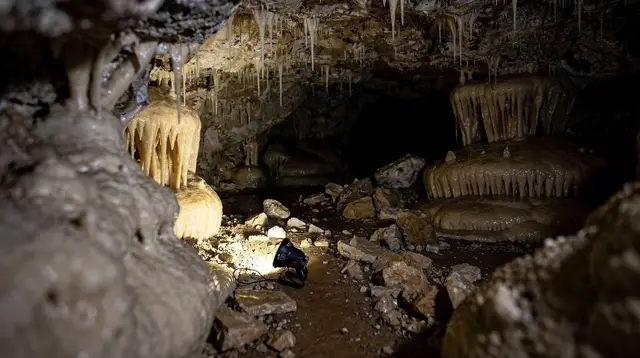
A cave in this part of Crete means limestone chambers carved by water over a very long time, with an uneven floor, damp air even in summer, and stalactite and stalagmite formations built up drop by drop. Melidoni follows that pattern: cool air as soon as you step past the entrance, a floor that is rarely flat and often slick where moisture has settled, and a quiet that has nothing to do with the heat and traffic of the coast a few kilometres away. The temperature difference alone is worth noting if you are coming from a July afternoon on the beach strip near Rethymno: bring a light layer, because the contrast is real.
We are not going to give you a figure for how deep the cave runs or how long its passages are. We looked for a reliable, verifiable number and did not find one we were confident printing, and a wrong statistic on a guide page is worse than no statistic at all. What we can tell you with confidence is descriptive rather than numerical: this is a natural limestone cave with an uneven, humid interior, not a flat, well-lit visitor attraction built for easy walking. Treat any precise depth or length you see quoted elsewhere with some scepticism unless it comes from a source you trust, and judge the site by what you find when you arrive rather than by a number on a website.
The same caution applies to the cave’s history. Sites like this one across Crete often carry layers of use stretching back centuries, and Melidoni is no exception in a general sense, but we are not going to attach a specific date, event or visitor statistic to it without a source we can stand behind. If a page or a guidebook offers you a precise historical claim about Melidoni with total confidence, it is worth checking where that claim actually comes from before repeating it yourself.
No Vipers in Crete, but Respect the Floor
If you are nervous about snakes before going underground anywhere in Greece, Crete is the easiest island in the country to relax about. There are four snake species recorded on the island, and none of them are vipers. There is no dangerous snake here, in Melidoni Cave or on any hiking trail, gorge path or olive terrace you will cross during a Cretan holiday. That fact holds for the whole island, not just for caves, and it is one of the more reassuring pieces of practical information a first-time visitor can carry with them.
That said, “no dangerous snakes” is not the same as “no need for care.” The real hazard in a cave like Melidoni is entirely mundane: a wet, uneven, sometimes slippery stone floor in low light, the kind of surface where a twisted ankle is a far more realistic risk than any encounter with wildlife. Cave floors accumulate moisture from condensation and seepage even when there has been no rain outside for weeks, and that moisture does not announce itself with a change in colour or texture you can spot from a distance. Walk slowly, watch your footing rather than the formations above you while you are moving, and use handholds if the site provides them.
Closed shoes with a real tread are not optional here. Sandals, flip-flops or worn-out trainers with a smooth sole turn an ordinary cave floor into a genuine fall risk, and a fall on wet limestone, a long way from a hospital, is not the way you want to end a day trip. Bring your own torch or headlamp rather than assume the site is fully lit throughout, since cave lighting anywhere can be patchy, can fail, or can simply not reach every corner you want to see. A phone flashlight is a poor backup on its own: bring a proper light and treat the phone as a second option, not your only one.
What This Page Will Not Tell You, and Why
We are deliberately not printing opening hours or an entry price for Melidoni Cave on this page. Both change between seasons and between years at small, rural sites across Crete far more often than official-looking websites update to reflect it, and a specific hour or euro figure printed here would go stale long before this page does. Check current hours and any admission cost locally, ideally on the day or the day before you plan to go, rather than trusting a number fixed in text months or years earlier.
We are also not naming a specific guide, operator or tour company as “the” way to see Melidoni. Small local sites like this one are often shown by more than one operator, arrangements change, and recommending a named guide on a page like this tends to age badly and can read as an endorsement we are not in a position to make. If you want a structured, guided day that includes Melidoni rather than a self-drive stop, look at the bundled itineraries further down this page, which combine the cave with Margarites, Arkadi and the surrounding villages without our naming any single operator as definitive.
Finally, we are not going to describe Melidoni as accessible to visitors with mobility limitations, and we would be doing you a disservice if we did. Cave sites in this part of Crete typically involve uneven natural stone underfoot, steps or slopes with no ramp, and no paved, step-free route from the car park to the interior. If mobility is a real concern for you or someone in your group, contact the site or a local operator directly before you build a day around it, rather than assuming a “guide” post online has already checked that for you.
Pairing Melidoni with Margarites, Arkadi and the Foothills
Melidoni’s real strength as a stop is what surrounds it. Margarites, just up the road, is one of the best-known pottery villages on Crete, with workshops that still throw and fire traditional shapes in narrow lanes built for foot traffic rather than cars. It is an easy, unhurried stop either side of the cave, and a natural place to buy something made on the island rather than shipped to it.
Arkadi monastery lies a short drive from both Melidoni and Margarites, and it carries weight well beyond its size: the 1866 siege and the explosion of its powder magazine, which killed hundreds of defenders and refugees sheltering inside, made it a national symbol of resistance that Cretans still speak of with real feeling. It remains a working monastery today, and it keeps a dress code, covered shoulders and knees, the same as Preveli and Toplou further afield. Budget real time here rather than treating it as a five-minute photo stop.
Further south and higher, the road toward Anogia climbs into the foothills of Mount Psiloritis, the island’s highest point at 2,456 metres. Anogia is a mountain village with its own strong identity, shaped by pastoral life on the slopes above it, and it is the natural next stage if you want to push the loop from a half day into a full one. The mountain itself holds snow into May or June in some years, a detail that surprises visitors who arrive picturing only beaches, and it frames the whole Melidoni-Margarites-Arkadi corner of Rethymno as genuinely mountainous countryside rather than a coastal excursion.
If caves specifically interest you beyond Melidoni, Sfendoni cave near Zoniana sits further into the same hill country and is worth comparing as a second underground stop on the same trip, rather than a substitute for this one.
Getting There from Rethymno, Heraklion and Chania
Rethymno town is the closest base, and the drive inland toward Melidoni takes you away from the coast road through farmland before the ground starts to rise. From Heraklion, the approach runs the other way, through the wine villages around Dafnes before turning west into Rethymno’s territory; expect a longer drive than from Rethymno itself, closer to an hour depending on your exact route and stops. From Chania, this corner of the island is a genuinely long day out rather than a quick side trip, and it makes far more sense as part of a multi-day itinerary that already has you based in or near Rethymno than as a standalone excursion tacked onto a Chania stay.
A rental car is the practical way to reach Melidoni independently; there is no useful public coach service into this part of the interior, and the KTEL network that runs well along the north coast highway thins out fast once you leave the main Chania-Rethymno-Heraklion-Agios Nikolaos corridor. If you would rather not drive the inland roads yourself, the guided day tours below cover the same villages without you needing to navigate them.
Booking a Guided Day Around Melidoni
If you would rather not plan the drive and the stops yourself, a handful of organised day tours out of the Rethymno and Heraklion area combine Melidoni with the villages around it. One half-day option pairs the cave with honey and olive oil tasting and a stop built around local reptiles: a half-day Melidoni cave, honey and olive oil tasting outing that keeps the pace relaxed and the driving to a minimum.
For a tighter loop through the same three landmarks described above, a half-day route linking Arkadi monastery, Melidoni cave and the pottery workshops of Margarites covers the core of this corner of Rethymno in a single outing. If you want to go further into the hills and add a second cave and a mountain village to the day, a full day pairing Sfendoni cave with local culture and music heritage near Anogia extends the trip well past Melidoni alone.
None of these replace checking current details for the day you actually travel, but they remove the need to plan the inland roads and stops yourself if that is not how you want to spend your holiday.
Melidoni Cave: Frequently Asked Questions
Is Melidoni Cave dangerous because of snakes?
No. Crete has four snake species and none of them are vipers, so there is no dangerous snake to worry about in Melidoni Cave or anywhere else on the island. The real hazard underground is a wet, uneven floor, not wildlife.
How deep or how long is Melidoni Cave?
We do not publish a depth or length figure for Melidoni Cave, because we could not verify one from a reliable source. Treat any specific number you see elsewhere with caution and judge the cave by what you find at the entrance rather than by a claimed statistic.
Can I visit Melidoni Cave with limited mobility or in regular sandals?
This is not a step-free or sandal-friendly site. The approach and the interior involve uneven, often slippery stone, and there is no accessible route or paved path. Closed shoes with grip are the minimum, and anyone with mobility limitations should ask locally before planning a visit around it.
What are the opening hours and the entry price for Melidoni Cave?
We deliberately do not list hours or a price here, because both change between seasons and years and a wrong figure printed on a guide page is worse than no figure at all. Check current opening times and any entry fee locally, ideally the same day, before you drive out.
Do I need a guide to visit Melidoni Cave?
You can visit independently, and several organised itineraries out of Rethymno and Heraklion also stop here alongside Margarites and Arkadi. We do not name a specific guide or operator on this page; if you want a fixed itinerary rather than a self-drive stop, the bundled day tours above cover the same corner of the Rethymno foothills.
What should I bring to Melidoni Cave?
A torch or headlamp, closed shoes with real grip, and a layer against the cool underground air, even in high summer. Bring your own light rather than assume the site provides one, and do not rely on phone flashlights as your only source.
How does Melidoni Cave fit into a day near Rethymno?
It pairs naturally with Margarites, a few minutes away and known for its pottery workshops, and with Arkadi monastery a short drive further on. Anogia and the lower slopes of Psiloritis extend the same loop if you have a full day rather than a half day.
Related reading: the pottery workshops of Margarites, the 1866 siege at Arkadi monastery, the second cave at Sfendoni near Zoniana, the climb toward Psiloritis summit, and why Crete has no dangerous snakes island-wide.
If you are planning around the mountain, see how snow lingers on Crete’s peaks into late spring, and if you want the cave inside a longer inland route, look at a five-day archaeology and history itinerary or the broader caves and underground sites category.
For the practicalities of the drive, see our notes on renting a car in Crete and driving in Crete, and for what to bring underground, our packing guide for Crete. Rethymno’s old town makes the most practical base for this loop, and our wider travel tips section covers more of the island’s inland driving basics. Wildlife-curious visitors should also see where Crete’s native kri-kri actually live, a better use of “will I see an animal here” curiosity than worrying about snakes.
Cave Tours in Crete on GetYourGuide
Verified deep-linked GetYourGuide tours. Book through these links and we earn a small commission at no cost to you.
GetYourGuide does not provide a product photo for this activity — the image shows the meeting point, photographed by us.