Sfendoni Cave and Zoniana: Is It Worth the Detour?
Is Sfendoni Cave in Zoniana worth visiting?
Sfendoni is a show cave near the village of Zoniana, on the northern slopes of the Psiloritis massif in central Crete, developed for visitors with a walkway and guided access. It suits travellers already exploring Anogia and the Psiloritis foothills rather than being a reason on its own to cross the island, and it pairs naturally with Zoniana cheese-making or the nearby Melidoni cave.
Where Sfendoni Sits on the Map
Sfendoni Cave is not on the way to anywhere. It sits above the village of Zoniana, on the northern flank of the Psiloritis massif, the mountain range that dominates central Crete and rises to 2,456 m at its summit — the highest point on the island, holding snow into May or June in a normal year.
You reach Zoniana by climbing away from the coastal plain into a landscape of terraced fields, stone walls and grazing sheep, with Anogia a short drive further along the same foothills. This is inland, working Crete, not the resort strip, and the cave has to be judged on those terms: as one stop in a mountain village circuit, not as a headline attraction that justifies a special trip on its own.
That framing matters because Crete already has a famous cave with far more name recognition. The Dikteon Cave at Psychro, on the Lasithi plateau in the island’s east, carries the mythology of the birth of Zeus and pulls coach parties accordingly. Sfendoni carries no such story, and this guide will not invent one for it, or claim a scale, a chamber count or a lighting scheme it cannot verify. What follows is what can be said with confidence: where the cave sits, how people actually get there, what a realistic visit looks like, and how it stacks up in practical terms against the plateau’s better-known site.
Zoniana and the Psiloritis Foothills
Zoniana belongs to the cluster of villages tucked into the northern slopes of Psiloritis, alongside Anogia and the wider Margarites and Melidoni area a little further east. It is sheep and cheese country before it is tourist country: this part of the Rethymno regional unit has supplied mizithra, graviera and other mountain cheeses to the rest of the island for generations, and that tradition is still visible in the village dairies rather than staged for visitors.
It is also, less happily, remembered in Crete for a history of vendettas and, in recent decades, occasional friction with the authorities over illegal cultivation in the more remote folds of the mountain — context that shapes how the village is talked about locally, even if none of it touches an ordinary visitor calling in for the cave and a coffee in the square.
What matters for a trip is the setting rather than the reputation: a stone-built village at altitude, cooler air than the coast, and a direct line of sight up towards the bare grey shoulders of Psiloritis. Anogia, the larger and better-known neighbour, has its own guide to the village and the mountain above it, and pairing the two makes more sense than treating Sfendoni as an isolated errand.
What a Visit to Sfendoni Actually Looks Like
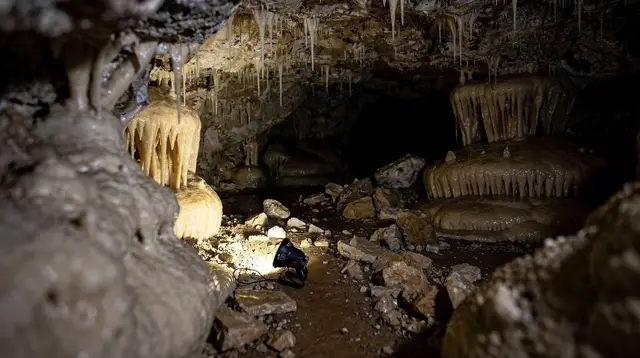
Sfendoni is developed as a show cave: there is a marked route through the accessible part of the cave system, staff on site to manage entry, and a level, short approach rather than the steep scramble some Cretan caves demand.
Beyond that, this guide will not describe specific chamber sizes, name particular formations, or promise a particular style of lighting — verified detail of that kind is not something a general travel guide can responsibly assert, and the temptation to dress up a cave description with invented specifics is exactly what leads visitors astray before they arrive. Expect cooler, damp air underground regardless of the season on the surface, sturdy closed shoes rather than sandals, and a modest entrance fee that covers the guided section.
Because it is a working, staffed site rather than a freely accessible one, opening hours shift with the season and can be reduced or suspended outside the main visitor months. If a visit to Sfendoni is the anchor of your day, it is worth confirming current hours locally — in Anogia or Zoniana itself — rather than assuming a fixed year-round schedule, the same caution that applies to most rural sites across the island’s interior.
Sfendoni versus the Dikteon Cave at Psychro
The comparison Crete’s marketing invites, implicitly, is between Sfendoni and the Dikteon Cave on the Lasithi plateau, the cave tied to the myth of the birth of Zeus. It is a fair question to ask before choosing where to spend a half-day, but it deserves an honest answer rather than a verdict dressed up as fact. What can be said without overreaching is a comparison of setting and logistics, not of which cave is more impressive underground — that claim this guide will not make.
| Sfendoni Cave (Zoniana) | Dikteon Cave (Psychro) | |
|---|---|---|
| Setting | Psiloritis foothills, central Crete | Lasithi plateau, east Crete |
| Mythology | None attached | Mythical birthplace of Zeus |
| Approach | Short, level walk to the entrance | Steep, slippery descent from the car park |
| Typical crowds | Generally quieter | Busier, a regular coach-tour stop |
| Natural pairing | Anogia, Zoniana cheese-making, Melidoni cave | The Lasithi plateau loop, its old windmill frames |
Choosing between them is really a choice about the rest of your day. If you are already routing through Lasithi and its plateau, the Dikteon Cave’s fame and the mythology attached to it make it the obvious stop, slippery steps and crowds included. If your day is built around Anogia, the drive up to Psiloritis or the villages north of Rethymno, Sfendoni fits that route without a long detour, while Psychro would mean crossing a large part of the island. Neither cave should be the sole reason to reshuffle a Crete itinerary; both work better as one stop inside a day that was already headed that way.
Getting There: Why You Need a Car
There is no train anywhere on Crete, and that single fact shapes how every inland village on this list has to be reached. The KTEL coach network is a genuinely useful way to move along the north coast — Chania to Rethymno to Heraklion to Agios Nikolaos runs on the VOAK highway with reasonable frequency — but it thins out fast once you turn off that corridor and start climbing into the Psiloritis foothills. Zoniana is not a village a KTEL timetable is built around, and there is no realistic public-transport route that gets you to Sfendoni Cave and back in a single day without a very long wait between connections that do not exist.
A rental car is therefore not a luxury for this trip, it is the only practical option, and the same applies to Anogia, Margarites and most of the villages folded into the mountains rather than strung along the coast road. Once you are driving, the usual rules for Cretan mountain roads apply: single-lane sections with blind bends, livestock that wanders onto the tarmac without warning, and a local habit of pulling onto the hard shoulder to let a faster car pass — a courtesy, not an invitation to overtake blind on a corner.
Fuel up before you leave the main road; village petrol stations in this part of the interior are not guaranteed, and phone signal can drop in the folds of the mountain. None of this makes the drive difficult, but it does mean building in more time than the map distance suggests, particularly if you are also stopping in Anogia or at the Melidoni cave on the same loop.
Snakes, Wildlife and Other Worries
One genuine reassurance is worth stating plainly: Crete has no dangerous snakes. The island is home to four snake species and none of them are vipers, so the paths around Zoniana, the approach to the cave, and the mountain tracks above the village carry no meaningful risk from wildlife. The animals you are actually likely to meet on this route are domestic — sheep and goats grazing loose on the lower slopes, the odd dog attached to a farmhouse — rather than anything wild that needs managing.
Higher up on Psiloritis and in the Lefka Ori further west, the island’s rarer wildlife, including the kri-kri wild goat and the bearded vultures that still hold on in the White Mountains, keeps well clear of the villages; you are far more likely to see either from a hiking trail than from the cave car park.
The practical precautions for a visit to Sfendoni are ordinary ones rather than anything specific to snakes or predators: closed shoes for uneven ground, a light layer for the cooler air inside the cave itself, and sun protection for the drive and the village stop, since Zoniana sits high enough that the light feels different from the coast even when the temperature does not.
Combining Sfendoni with Anogia and the Cheese Villages
The most natural way to build a day around Sfendoni is to treat the cave as one stop inside a Psiloritis foothills loop rather than a destination in its own right. Anogia, larger and better known, sits close by and has its own weaving and woodcarving tradition worth an hour on foot; several operators already package the two together, along with a stop at a working dairy. A joint route runs as a half-day trip that pairs the cave with a Zoniana cheese-making visit, which is the simplest way to see both sides of the village in one outing without driving yourself.
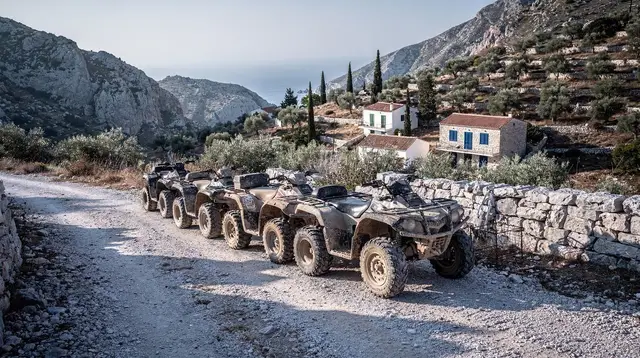
For travellers who want the wider mountain context rather than a single village, a 4x4 route through several Psiloritis villages that also calls at the cave covers more ground than a self-drive day comfortably allows, including tracks a standard rental car should not attempt.
And if the interior’s underground sites are the main interest, a combined outing to the Melidoni cave with a local honey and olive oil stop sits well either side of a Sfendoni visit, since Melidoni is a short drive away in the same stretch of the Margarites and Melidoni area and carries its own, very different, wartime history rather than a Zeus myth.
If your base is Rethymno rather than Anogia, the loop also works from the coast: the Arkadi monastery and the pottery village of Margarites both sit on a plausible route inland, and cheese and dairy specialities from this part of the mountains — the mizithra, graviera and staka you will see on tavern menus across Crete — are made in villages very like Zoniana, which gives the cave stop a clear place in a food-and-landscape day rather than a lone tick on a list.
Planning Notes
Sfendoni works best folded into a spring or early-summer visit, when Psiloritis still carries snow on its upper slopes and the drive up from the coast feels like a real change of altitude; see the month-by-month notes in the guide to the best time to visit Crete for how the interior’s climate differs from the beaches below it. Outside the main season, rural sites like this one can reduce their hours or close for stretches, so building in flexibility — and a fallback plan such as the things to do around caves and underground sites category page — is worth more than a fixed schedule here.
| Planning point | What to know |
|---|---|
| How to get there | Self-drive only; no realistic KTEL or public transport option |
| Best paired with | Anogia, Zoniana cheese-making, Melidoni cave |
| Season to favour | Spring to early summer, when Psiloritis still holds snow above |
| Wildlife concerns | None — no dangerous snakes anywhere on Crete |
| Road conditions | Narrow mountain roads; allow more time than the map suggests |
Treat Sfendoni for what it is: a genuine, staffed cave in a quiet corner of the Psiloritis foothills, worth a stop if you are already in Anogia or Zoniana, and best judged on its setting and its village rather than on a comparison to Psychro’s mythology that no honest guide can settle for you in advance.
Cave Tours in Crete on GetYourGuide
Verified deep-linked GetYourGuide tours. Book through these links and we earn a small commission at no cost to you.
GetYourGuide does not provide a product photo for this activity — the image shows the meeting point, photographed by us.