5-Day Crete Archaeology Itinerary: Knossos to Zakros
Five days, four Minoan sites, one museum that matters as much as any of them
Crete’s archaeological record does not sit in one place. It runs the length of the island, from the reconstructed courts of Knossos just outside Heraklion to the far-eastern palace of Zakros, with the originals of what you see at the sites themselves often kept somewhere else entirely. Five days is enough to link the major stops without turning every day into a transfer, provided you accept two things from the start: Heraklion, not one single site, is your real base for the first three days, and the run out to Sitia and Vai on day five is a genuine journey, not an afternoon detour.
This itinerary moves broadly west to east — Knossos and Heraklion, then Phaistos on the Messara plain, then east along the coast to Sitia and Vai. A car is close to essential; the KTEL coach network covers the north-coast towns reasonably well but does not serve Knossos, Phaistos or Vai on a timetable that suits a five-day trip. See renting a car in Crete before you land.
Day 1: Knossos, and why the frescoes you see there are not the ones that matter
Start early. Knossos sits about 5 km south of central Heraklion, and it has almost no shade — arriving at opening time is the difference between a comfortable morning and a hot, crowded one by 11am. Walk the reconstructed staircases, the throne room and the storage magazines with their giant pithoi jars, and you will see painted frescoes on several walls: the Bull-Leaper, the Prince of the Lilies, the griffins of the throne room.
Say it plainly, because guides and brochures often do not: those frescoes are replicas. The originals, excavated and restored in the early twentieth century, are held 5 km away in the Heraklion Archaeological Museum, and they are considerably more vivid and more fragile than anything reproduced on site at Knossos.
A combined ticket covering both Knossos and the museum exists and is worth buying on day one, even if you save the museum itself for tomorrow — see Knossos and the Heraklion Museum for how the two sites relate. If you have the stamina, the museum’s air-conditioned galleries make a good, cooler second stop on the same afternoon; otherwise day 2 covers it properly. A guided visit that pairs Knossos with Heraklion’s old town and market is a reasonable way to do day one without self-navigating the site notes yourself.
a guided morning at Knossos combined with Heraklion’s old town and marketOvernight in Heraklion. For the full site background before you go, see the Knossos Palace visitors’ guide.
Day 2: The Heraklion Archaeological Museum
Give this a full morning, not the hour most itineraries allow it. The Heraklion Archaeological Museum holds the material that makes sense of everything you will see on the rest of this trip: the original Knossos frescoes, gold jewellery from Minoan tombs, the Phaistos Disc — a clay disc stamped with an undeciphered script, found at the palace you visit on day 3 — and finds that stretch from early Minoan pottery through to Roman-era Crete. It is one of the most important museums in Greece for this period, and rushing it undercuts the rest of the itinerary rather than saving you time.
Spend the afternoon in Heraklion itself: the Venetian harbour and its fort, the market streets, and the city walls where the writer Nikos Kazantzakis is buried. None of this is Minoan, but it fills out the picture of an island whose archaeology spans Bronze Age palaces, Roman Gortyna, Venetian fortifications and Ottoman-era streets layered on top of each other. A walking-focused tour is a low-effort way to cover the old town without planning your own route.
a guided walking tour through Heraklion’s old townDay 3: Phaistos and the Messara plain — and the capital that was not Knossos
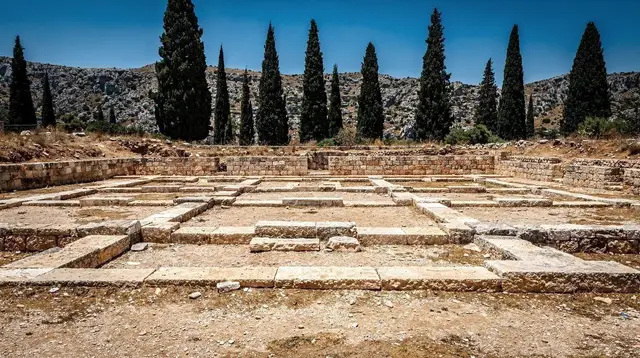
Drive south-west, about an hour from Heraklion, onto the Messara plain to Phaistos, Crete’s second Minoan palace and, in the view of many visitors who prefer their ruins unreconstructed, the more atmospheric of the two. Where Knossos was heavily rebuilt by Arthur Evans in the early twentieth century, Phaistos was left largely as excavated: bare stone courts, storage rooms and a wide ceremonial staircase, set on a low hill with the Messara plain and the Psiloritis range behind it. This is also where the Phaistos Disc, now in the Heraklion museum you saw yesterday, was found in 1908.
One correction worth carrying with you for the rest of the trip: Crete’s Roman-era capital was Gortyna, not Knossos. Gortyna sits a short drive from Phaistos and preserves a Roman odeon, an early Christian basilica and the Law Code of Gortyn, one of the oldest substantial bodies of written Greek law. Knossos had already been abandoned as a major settlement long before Rome absorbed Crete in 67 BC; treating it as the island’s ancient capital is one of the most common factual mix-ups in Crete’s archaeological story. For the fuller picture of how the two sites and periods relate, see Phaistos and Gortyna, and for the wider Minoan chronology, the Minoans in one hour.
A private tour covering Knossos, Phaistos and the surrounding Minoan sites in one guided itinerary is worth considering if you would rather not self-drive the Messara detour.
a private tour linking Knossos and Phaistos with the wider Minoan sitesReturn to Heraklion, or push on partway toward the east coast if you want to shorten day 4.
Day 4: East along the coast, through Stalida and Malia
Day 4 is a transit day, and it is worth planning it as one rather than expecting a destination. The drive east from Heraklion follows the north coast, passing through Gouves and Hersonissos before reaching Stalida and Malia — the organised resort strip that runs for roughly 20 km of Crete’s 260 km length. On an archaeology-focused trip, this stretch is a stop for fuel, food or a swim break rather than a reason to linger; the beach-club density here is a different holiday to the one this itinerary is built around.
The one genuine archaeological stop on this stretch is worth the short detour off the main road: the Minoan palace at Malia, third in scale after Knossos and Phaistos, with a large central court, storage rooms and a distinctive kernos stone thought to have been used in ritual offerings. It rarely draws the crowds the two bigger palaces do. See the Malia Palace guide before you stop.
Continue east and overnight around Agios Nikolaos or push on to Sitia itself — either shortens tomorrow’s drive meaningfully, and neither costs you much given how the rest of this itinerary is paced.
Day 5: Sitia, then Vai — a real distance, not a side trip
Be clear-eyed about this day before you plan it: Sitia is roughly 135 km from Heraklion, and Vai lies a further 25 km beyond that, on mostly two-lane roads through the Lasithi region’s eastern hills. This is not a loop you can do comfortably from a Heraklion base in a single day — treat any itinerary or tour that promises it with suspicion, or plan to stay overnight near Sitia to make the numbers work without a long night drive back. Breaking the journey the evening before, as suggested on day 4, is what makes day 5 realistic rather than exhausting.
Sitia itself is a low-key harbour town, worth an hour’s walk before you continue — see the Sitia town guide. From there, the short drive to Vai reaches the largest natural palm forest in Europe: thousands of Phoenix theophrasti, a palm species endemic to Crete found in only a handful of places on the island, the other well-known stand being at Preveli on the south coast. The Vai grove is fenced, camping is banned, and it gets genuinely busy at midday in summer — an early or late visit is worth the effort. Details on access and timing are in the Vai palm beach guide.
If your schedule and energy allow it, the Minoan palace at Zakros lies a further drive east of Vai — the easternmost of Crete’s four major palaces, smaller and far less visited than Knossos or Phaistos, set in a quiet valley near the coast. It is a genuine add-on rather than part of the core plan, worth it only if you are not racing the clock back toward Heraklion or your onward flight. See Zakros and the Minoan east for what to expect. A tour built around the wider eastern Messara sites, including Gortyna and Matala, is a useful alternative structure for travellers who would rather not drive the full east-coast distance themselves.
a guided day trip covering Gortyna, Phaistos and MatalaPlanning notes for this route
| Day | Stop | Approx. drive from previous base |
|---|---|---|
| 1 | Knossos | 5 km from Heraklion |
| 2 | Heraklion Archaeological Museum | in Heraklion |
| 3 | Phaistos and Gortyna | about 60 km from Heraklion |
| 4 | Stalida and Malia, toward Agios Nikolaos or Sitia | about 60-100 km east |
| 5 | Sitia, then Vai | about 135 km from Heraklion, plus 25 km to Vai |
Frequently asked questions about a Crete archaeology itinerary
How many days do you need for Crete’s archaeological highlights?
Five days covers the core route comfortably: Knossos and the Heraklion museum on days 1-2, Phaistos and Gortyna on day 3, and Sitia and Vai on day 5, with day 4 as a transit day east along the coast. Fewer than five days usually means dropping either the museum or the Sitia-Vai leg, both of which are worth keeping.
Are the frescoes at Knossos original?
No. The frescoes visible at the Knossos site are reproductions. The originals were excavated and restored in the early twentieth century and are displayed in the Heraklion Archaeological Museum, about 5 km from the site. A combined ticket for both is available.
Was Knossos the Roman capital of Crete?
No. Crete’s Roman-era capital was Gortyna, on the Messara plain near Phaistos, not Knossos. Knossos had already declined as a major settlement long before the Roman period; Gortyna preserves a Roman odeon, an early basilica and the Law Code of Gortyn.
Can you visit Sitia and Vai as a day trip from Heraklion?
Technically yes, but it makes for a very long day: Sitia is roughly 135 km from Heraklion and Vai a further 25 km beyond it. This itinerary treats it as day 5 after an overnight closer to the east coast, which is the more realistic way to do it.
Do you need a car for this itinerary?
Yes. Knossos, Phaistos and Vai are not well served by the KTEL coach network, which runs strongest along the direct north-coast route between the main towns. A rental car is the practical default for this route.
What is the largest natural palm forest in Europe?
The palm forest at Vai, on Crete’s east coast, made up of Phoenix theophrasti, a palm species endemic to the island. A second, smaller stand of the same species grows at Preveli on the south coast.
Should you visit Knossos or the Heraklion Archaeological Museum first?
Either order works, but seeing Knossos first and the museum the same afternoon or the next morning makes the most sense of both: the site gives you the scale and layout, and the museum holds the original frescoes and finds that the site itself only reproduces.
Is the palace at Malia worth stopping for on day 4?
If you are already driving through Stalida and Malia, yes — it is Crete’s third Minoan palace, quieter than Knossos or Phaistos, and only a short detour off the main coast road.
tours.5 days
Verified deep-linked GetYourGuide tours. Book through these links and we earn a small commission at no cost to you.
GetYourGuide does not provide a product photo for this activity — the image shows the meeting point, photographed by us.