Gouves and Hersonissos for Families
Is Gouves and Hersonissos a good family base in Crete?
Gouves and Hersonissos work well for families who want an easy, resort-style stay with organised beaches and short transfers, but this package coast is only about 20 km of Crete's 260 km length, so treat it as one convenient base, not a sample of the whole island.
The question worth asking before you book
Search for family holidays in Crete and the algorithm points most people at the same stretch of coast: Gouves and Hersonissos, running east into Stalida and Malia. It is easy to land here, easy to find a pool, a water park and an English-language menu, and easy to assume this is simply what Crete looks like. It isn’t. This whole package strip is about 20 km long, on an island that runs roughly 260 km from Chania in the west to Sitia in the east. What follows is an honest look at what this coast actually offers a family, what it costs, where it falls short, and where to look instead if a flatter, gentler version of Crete is what you are hoping for.
What Gouves and Hersonissos actually are
Gouves and Hersonissos sit on the north coast of the Heraklion regional unit, strung along the VOAK highway between the city of Heraklion and the resort towns of Stalida and Malia. Gouves is the smaller, quieter of the two: a scatter of hotels and apartment blocks around a modest beach, without much of a historic centre to speak of. Hersonissos, a little further east, has an actual old harbour and fishing quarter behind the modern hotel strip, plus the bulk of the area’s shops, restaurants and organised beach clubs.
Both towns were built, almost entirely, for package tourism from the 1970s onward. That is their honest identity: not a Venetian old town like Chania or Rethymno, not a Minoan site like nearby Knossos, but a working holiday machine of hotels, water parks, go-kart tracks, mini-golf and all-day beach bars, aimed squarely at families and groups who want convenience over character. There is nothing wrong with wanting that. The point is to choose it knowingly, not by accident.
Getting here, and getting around once you land
Heraklion airport is the nearest airport to both towns, generally 15-25 minutes by transfer depending on traffic on the VOAK highway and exactly where along the strip a hotel sits; Chania airport, on the far side of the island, is not a realistic option for this base. Most package holidays here come with a coach transfer built in, and for a family arriving independently a private or shared airport transfer booked in advance avoids haggling with taxi ranks after a late flight.
Once settled, a car is optional rather than essential in a way it rarely is elsewhere on the island. Hotels, beaches, water parks and restaurants along this stretch sit close enough together to walk or take a short, cheap taxi, and local buses run along the coast road. Renting a car still pays off for families planning day trips to Knossos or the Lasithi plateau, since public transport thins out fast once you leave the VOAK corridor, but a family staying put for the whole trip can genuinely manage without one.
The 20 km that is not all of Crete
It bears repeating in plain numbers: the developed strip from Hersonissos through Stalida to Malia covers roughly 20 km of coastline. Crete’s south-west has the wild, boat-only villages of Loutro; the far west has the lagoon at Balos; the interior has the Lasithi plateau at nearly 850 metres. None of that resembles Gouves or Hersonissos, and none of it is more than an hour or two away by car.
Families who stay only on this strip for a full week see a real slice of Crete, but a narrow one — closer in feel to a purpose-built resort town anywhere in the Mediterranean than to the island as a whole. If the goal is a single easy base with day trips layered on top, that is a reasonable trade. If the goal is to “see Crete,” this coast alone will not deliver it, and a broader itinerary is worth planning around it.
Beaches, sunbeds, and what the law actually guarantees
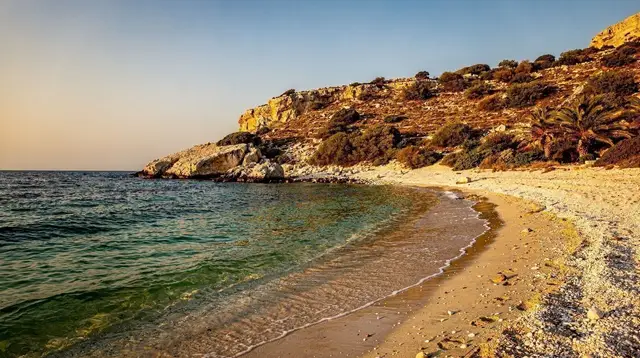
The beaches themselves are the coast’s real strength: long, sandy, shallow-shelving and generally safe for younger swimmers, many holding EU Blue Flag status. Most are organised, meaning a beach bar or hotel rents sunbeds and umbrellas along the sand. A typical set of two sunbeds and an umbrella runs about 10-20 euros a day, VAT included — Greece’s standard VAT rate is 24 percent, and unlike some Aegean islands, Crete has never qualified for a reduced island rate, so that tax is baked into every price you see on this coast.
What is easy to miss is that paying is optional. Greek law requires every beach, organised or not, to keep a free public strip and an unobstructed corridor down to the water, and it regulates how much of a beach a concession can cover with sunbeds in the first place. Families on a budget can bring a towel, spread it on the free stretch, and swim in exactly the same sea for nothing. For the full detail on the rules and how they are actually enforced, see the sunbeds and beach rights guide.
Water parks, without the specifics
This stretch of coast is home to more than one large water park, the reason “water parks and family attractions” leads most searches for the area. Rather than naming a park or quoting a gate price here — both change year to year, and a wrong number is worse than none — the practical advice is this: check the operator’s own current pricing and hours before you go, budget for a full day once you include lunch and lockers, and expect July and August to mean real queues by mid-morning. Outside peak season, several parks reduce hours or close for maintenance, so a spring or autumn trip should be confirmed in advance rather than assumed.
Beyond the water parks, the strip is dense with smaller family draws: go-kart tracks, mini-golf, aquariums and indoor play centres clustered mainly around central Hersonissos and along the Stalida-Malia road, most walkable or a short taxi from the main hotel zones.
Water park or beach: choosing for a single free day
Families with only one spare day, and a choice between the beach and a water park, tend to regret picking the water park on a calm, sunny morning and the beach on a windy or overcast one. A water park makes the most sense on a day when the sea itself is uninviting — choppy from the meltemi, or simply too hot at midday for small children to want to sit still on sand — since the pools, slides and shaded queuing areas absorb a few blustery hours that a beach cannot. On a genuinely calm, clear morning, the free public stretch of an organised beach, plus a sunbed if wanted, delivers the same holiday for a fraction of the cost and with far less standing in line.
The honest middle path many local families use is a half-day each: mornings at the water park before the queues build, afternoons cooling off in the sea once the sun has softened.
When the meltemi gets in the way
July and August bring Crete’s meltemi, a strong, dry wind out of the north that can turn a calm morning sea into a choppy one by afternoon — and this north-facing coast, Gouves and Hersonissos included, feels it more than the sheltered south. On a strong meltemi day, jet skis, banana boats, parasailing and some boat excursions can be suspended for safety, and the open sea beyond the organised swim zones gets genuinely rough.
It rarely lasts more than a day or two at a stretch, and it has no effect on water parks, pools or beach time on the sand itself, but it is worth building a spare day into a July or August itinerary rather than pinning every water-based activity to one afternoon. The meltemi guide covers what else it affects island-wide.
Making the most of a short boat trip
One of the better family excursions from this exact base is the short hop out to a catamaran sail and swim stop at Dia island, the uninhabited islet visible from the coast here. It is calm, shallow in its coves, and short enough — usually a half-day — not to tire out younger children.
Families wanting a fuller day with lunch built in can look at the full-day Dia island sailing trip with lunch and hotel transfer, which removes the need to arrange a car for the day. Either way, Dia island gives families a sea day that does not depend on a single beach being calm, since a shift in wind simply moves the boat to a sheltered cove. More on the crossing itself is in the Dia island boat trips guide.
Day trips that actually justify this base
The strongest case for staying in Gouves or Hersonissos is not the strip itself but what sits within easy reach of it.
Knossos, Crete’s best-known Minoan site, is roughly 20-25 minutes away by car, and a guided visit to the Knossos excavation site is a manageable half-day for most families, ideally done at opening time in summer since the ruins offer almost no shade — and worth pairing, on the same trip, with the Heraklion Archaeological Museum, which holds the original frescoes; what stands at the palace itself are reconstructions. The full context is in the Knossos visitor’s guide.
Inland and upward, the Lasithi plateau makes a scenic loop drive, its famous white-sailed windmills now mostly rusted frames rather than the working fields of old photographs — still worth the trip for the drive and the Dikteon cave, just not for that particular postcard image.
For families who want a change of pace that is less about sightseeing and more about a slower morning, a 4x4 off-road experience through the Cretan countryside gets children off the beach and into olive groves and hill villages for a few hours, and a day at Voulisma beach on the Gulf of Mirabello swaps this coast’s beach for a quieter, east-Crete alternative near Agios Nikolaos for those staying long enough to make the drive worthwhile.
Hersonissos, Malia, Stalida: not interchangeable
Families comparing hotels along this coast often assume Hersonissos, Stalida and Malia are the same place with different names. They are not. Hersonissos has the most infrastructure and the busiest centre; Stalida is the smallest and calmest, mostly low-rise and family-run; Malia has the reputation for nightlife, but that reputation belongs to a specific bar strip active after dark, while its old town and family beach areas are unrelated to it by day.
Gouves, to the west, is quieter again, closer to Heraklion and Knossos, and light on its own entertainment beyond the hotels themselves. A side-by-side read of the differences is in Hersonissos versus Malia versus Stalida, and a wider first-person take on whether the area earns its popularity is in is Hersonissos worth it.
What tends to disappoint
The gap between the marketing photos and the reality is mostly about density, not quality. In August, the busiest stretches of Hersonissos can feel more like a crowded high street than a beach holiday: queues at popular restaurants, a wait for a sunbed on the best-placed rows, and construction noise from the steady churn of hotel renovations that never quite stops in a resort this size. Restaurant quality varies sharply within a few hundred metres — a genuinely good taverna can sit next to a picture-menu tourist trap charging similar prices, and it is worth asking a hotel concierge or reading recent reviews rather than judging by a restaurant’s terrace alone.
The other common disappointment is less about the towns than about expectations: visitors who arrive picturing the whitewashed alleys of Chania or the ruins of Knossos find little of that character here, since this strip was built for beach holidays, not history. The mistakes to avoid in Crete guide covers this expectation gap and others that trip up first-time visitors island-wide.
Who this coast actually suits
| Family profile | Good fit here? | Why |
|---|---|---|
| Toddlers and young children, short trip | Yes | Shallow beaches, short transfers, water park close by |
| Teenagers wanting more independence | Mixed | Plenty to do, but nightlife areas need avoiding after dark |
| Families wanting culture and history daily | No | Better based nearer Heraklion, Chania or Rethymno |
| Budget-focused, long stay | Mixed | Free beach access helps, but package prices add up over two weeks |
| First trip to Crete, one base only | Mixed | Convenient, but misses the west, south coast and mountains entirely |
Two more questions worth answering
Is there an airport near Gouves and Hersonissos, and how far is the transfer?
Heraklion airport is the nearest, and for most hotels along this coast the transfer runs 15 to 25 minutes depending on traffic and exact location. Chania airport, on the other side of Crete, is not a practical choice for a stay based here. See the Heraklion airport guide for arrival and transfer details.
What do families most often say disappoints them about this coast?
Crowding and noise in peak August, inconsistent restaurant quality within a short walk of each other, and ongoing hotel construction are the most common complaints, rather than anything about the beaches or water parks themselves. Visitors expecting the historic character of Chania or Rethymno are usually the most disappointed, simply because this coast was never built for that.
The honest verdict
Gouves and Hersonissos do what they were built to do: deliver an easy, low-friction family beach holiday with a water park, organised sand and a short flight or ferry connection behind it. Prices are transparent and VAT-inclusive, the law protects a free stretch of every beach, and Knossos, Dia island and the Lasithi plateau are all close enough to add real variety without long drives.
What this coast is not is a stand-in for Crete as a whole — it is one developed strip on a very large island, and families who want to say they have seen Crete, not just a resort on it, should treat this base as a comfortable starting point for day trips rather than the whole story. For a broader look at basing a family trip elsewhere on the island, the Crete with kids guide covers the alternatives directly.
Family-Friendly Tours in Crete on GetYourGuide
Verified deep-linked GetYourGuide tours. Book through these links and we earn a small commission at no cost to you.
GetYourGuide does not provide a product photo for this activity — the image shows the meeting point, photographed by us.