The Bearded Vultures of the White Mountains
I had driven up from Chania with a pair of binoculars I’d owned for exactly one afternoon, convinced that somewhere above the Omalos plateau I would find a bearded vulture waiting for me. I did not. What I found instead was wind, a lot of grey limestone, and a slow understanding of why this bird is worth looking for in the first place.
A mountain range, not a backdrop
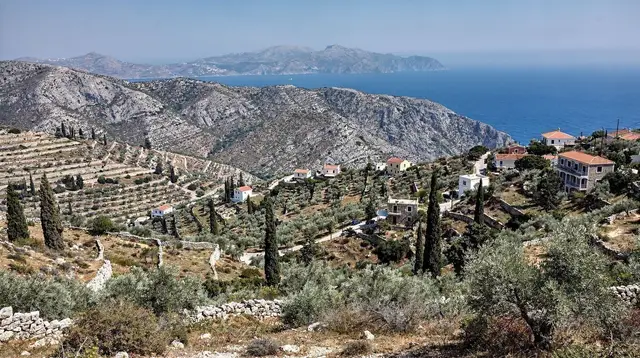
It’s easy, from a beach on the north coast, to think of Crete’s mountains as scenery — a grey line behind the postcard. The Lefka Ori, the White Mountains, are not that. They are a genuine massif, folded and cut by gorges, topped by Pachnes at 2,453 m, and rough enough that even the roads around them defer to the terrain rather than the other way round. Snow sits on the highest ridges into May or June in an ordinary year, and the range still holds pockets of true wilderness that the rest of the island has mostly lost.
That terrain is exactly what the bearded vulture needs: high cliff faces, deep gorge systems, thermals rising off bare rock, and almost no human presence at altitude. This is one of the last strongholds in Greece for a bird that has vanished from most of the ranges it once occupied across Europe. It survives here because the White Mountains are still hard country, not despite it.
I mention this because I think most visitors, myself included on that first attempt, come looking for the bird before they’ve really registered the mountain. You cannot separate the two. A bearded vulture sighting in Crete is really a Lefka Ori sighting — it belongs to this one range, defined by the gorge country around Samaria and the ridgelines above Frangokastello and Chora Sfakion, and nowhere else on the island.
Anogia sits under a different massif, Psiloritis, with its own raptors and its own character; the two ranges are not interchangeable, and neither is what you might see in each.
Why I stopped expecting to see one
The second time I went looking, I’d read enough to lower my expectations properly, and that turned out to be the useful part. The bearded vulture is one of Europe’s rarest large raptors, and the population holding on in the Lefka Ori is small — a handful of pairs, ranging over a huge stretch of cliff and canyon that they know intimately and that I, standing on one ridge for an afternoon, barely sample. A pair here can cover an enormous territory in a single day of thermalling, which means the odds of your patch of sky and their patch of sky coinciding are genuinely modest, however good the weather.
I’d also read enough to feel a bit embarrassed about my first outing. Scrambling along a goat path toward what I thought was a distant shape on a crag is precisely the kind of active pursuit that stresses a bird this sensitive, and it is also, almost always, a waste of a morning: bearded vultures range far too widely to be tracked down on foot. Nest sites in particular need to be left alone entirely — approaching one, even out of curiosity, can cause adults to abandon a breeding attempt for the season. None of that is a hypothetical rule. It’s the actual reason the population here is still hanging on at all.
What worked, eventually
What worked, on the third try, was doing almost nothing. I picked a fixed spot on the rim above one of the western gorges — high enough to have an open sweep of sky and cliff below me, low enough that I hadn’t spent the whole morning climbing — and I sat down with a flask of coffee and the same pair of binoculars. I stayed for most of an hour before anything happened, and for most of that hour nothing did: just griffon vultures circling in loose, easy groups on the thermals, unmistakable and, if I’m honest, a decent consolation prize on their own.
Then, low along the cliff line rather than up with the griffons, one bird came past on a long, flat glide — rust-tinted underneath, a wedge of a tail instead of the fan the griffons carried, moving with far less circling and far more direct intent. It didn’t linger, and I didn’t try to follow it. I watched it disappear round a spur of rock and that was, entirely, the sighting. It lasted perhaps forty seconds.
I’ve come to think that’s the honest shape of this kind of watching. You are not tracking the animal down; you are giving it a wide, quiet, elevated window to pass through, and waiting to see if it does. Bring good binoculars, dress for wind that will be sharper than the coast led you to expect, and treat the outing as time spent inside a genuinely wild mountain range rather than as a wildlife-park visit with a guaranteed exhibit. If the bird appears, you’ll know it from the griffons at a glance. If it doesn’t, you’ve still spent an hour on a ridge above one of the more serious landscapes in Greece, which on my second and least successful attempt was still, on balance, the better part of the day.
Getting into the range properly
None of this is a solo pursuit if you’d rather have local eyes doing the spotting. I went back a third time with a private guide who works the White Mountains and the country above Samaria, and the difference was less about vulture odds than about knowing which ridgelines are worth the wait in the first place — that kind of local reading of the terrain took me two failed mornings to begin to develop on my own.
If your priority is the gorge itself rather than the bird, a professional guide leading the walk down through Samaria still puts you inside the same territory, on the rim trail above the gorge, for most of a day. And for a gentler introduction to the foothills on the Chania side, without committing to a full mountain day, a scooter run up through the villages of the Therisso gorge gets you into the lower folds of the same range in an afternoon.
Whichever way you approach it, the Imbros gorge and the trails feeding the long-distance E4 route both sit well inside bearded vulture territory and require far less effort than a push toward the summit of Pachnes. Spring brings the best wildflowers on the range as a bonus, and if you’re building out a wider wildlife day, the kri-kri sharing these same slopes is a far more reliable sighting than the vulture will ever be.
For a longer stay in the range itself, a three-day loop through the White Mountains and Sfakia gives you several mornings on the ridgelines rather than one, which is honestly the only real way to improve your odds.
You can also browse wildlife and nature activities across the island if you’d rather build the day around more than one species — and if you’re curious where else in Crete people actually run into the island’s wilder residents, this piece on where the kri-kri are really seen is a fair companion read, as is what actually happens to these mountains under snow for anyone planning a shoulder-season trip.
Bearded vulture watching in the Lefka Ori: common questions
Where exactly do bearded vultures live in Crete?
In the Lefka Ori, the White Mountains of western Crete, whose highest point is Pachnes at 2,453 m. They are not found across the whole island, and Psiloritis to the east holds a different set of raptors.
Is a sighting guaranteed on a hike or drive through the White Mountains?
No. The bearded vulture is one of Europe’s rarest large raptors, and Crete’s remaining pairs range over a huge territory of cliff and gorge. Most visits, even good ones, end without a sighting.
What is the best way to try to see one without disturbing it?
Find a fixed, elevated vantage point with a wide view over the gorges below the ridgeline, sit down, and scan slowly with binoculars for at least thirty minutes. Moving toward a distant bird, or toward a nest site, is the one thing that reliably fails and the one thing that can genuinely harm the population.
When is the best season to look?
Spring through early autumn, when thermals rise off the gorge walls and the bird uses them to glide for long stretches without flapping. Snow still caps Pachnes into May or June, which keeps the highest ridges quiet later than the coast suggests.
Do I need to hike to altitude to have a chance?
Not necessarily. The rim trails above the Samaria and Imbros gorges, well below the summits, sit inside the same territory and are far more walkable than a push toward Pachnes.
Are there other large raptors in the same mountains?
Griffon vultures are more numerous and easier to see, often in loose groups riding the same thermals. The bearded vulture is usually alone, flies lower along the cliff line, and is told apart by its wedge-shaped tail and rust-tinted underside.
Is it true they eat bone marrow?
Yes, the bearded vulture specializes in bone, sometimes dropping large ones from height onto rock to split them, which is part of why it needs open cliff and gorge country rather than forest.
tours.Wildlife
Verified deep-linked GetYourGuide tours. Book through these links and we earn a small commission at no cost to you.
GetYourGuide does not provide a product photo for this activity — the image shows the meeting point, photographed by us.