A fort at the end of the road, and a gorge that lets you walk back out
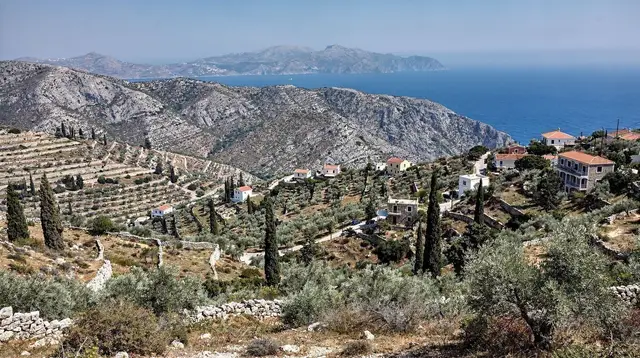
Frangokastello sits at the point where the coast road along the south-west simply stops being a through route. There is no old town here, no harbour promenade, no museum. There is a squat Venetian fort facing a long sandy beach, a scattering of rooms and tavernas strung along the shore road, and the mountains rising steeply behind. For a traveller who has already seen Chania’s Venetian harbour or walked the walls at Rethymno, Frangokastello reads almost as an afterthought — until the history and the geography are taken together with the Imbros gorge a short drive inland, which gives this stretch of the south-west a reason to appear on an itinerary beyond a photograph of a fort.
The honest framing matters here more than at most destinations on this island. Frangokastello is not going to compete with Knossos or the Heraklion Archaeological Museum for archaeological weight, and it has nothing like the nightlife of Malia or Hersonissos. What it offers is isolation, a specific and well-documented piece of nineteenth-century history, and a genuinely good hiking alternative for travellers who cannot fit the Samaria gorge’s one-way, boat-exit logistics into their schedule, or who have already walked Samaria and want a shorter second gorge on the same trip.
The fort: Venetian walls, an 1828 battle, and a local legend
The fort at Frangokastello was built by the Venetians in the 1370s, a low, square structure with a corner tower at each angle, set almost at the waterline rather than on a defensible height — an unusual choice that reflects its purpose as much as anything: watching the coast and, at times, containing the notoriously independent Sfakiot villages inland rather than repelling a naval assault. It changed hands with the rest of Crete when Ottoman rule replaced Venetian rule across the island, and it is that later, Ottoman-era chapter that gives Frangokastello its place in Cretan memory.
In May 1828, during the long Greek uprising against Ottoman rule, several hundred Cretan and mainland Greek fighters under Hatzimichalis Dalianis took up position at the fort and were overwhelmed by a much larger Ottoman force. Most of the defenders were killed. The episode sits in the same tradition of doomed last stands as the powder-magazine explosion at Arkadi monastery less than forty years later, and it is remembered locally with the same weight — not as a footnote, but as part of how this end of the island tells its own history. A visit to the fort gains from knowing this before arriving, since the walls themselves say relatively little on their own.
What has attached itself to the story since is the Drosoulites: local tradition holds that in the very early morning, in a narrow window around late May, shadow-like figures resembling marching soldiers are occasionally reported near the fort and are popularly linked to the men killed there in 1828. The more grounded explanation offered locally is a Fata Morgana mirage, a rare atmospheric effect off the Libyan Sea that can project distant shapes onto low cloud or haze. It is worth knowing the story exists — it comes up in any conversation about Frangokastello — but it is not something a visit can be planned around with any reliability, and no legitimate operator will promise a sighting.
Beyond the walls, the fort’s setting is the real draw for a short stop: a long, shallow, sandy beach runs along the shore directly below it, with a few tavernas and small rooms for rent nearby and none of the beach-bar scene found further along the coast at Plakias. Twenty to thirty minutes covers the fort and a walk along the sand; a swim afterward is the natural next step, particularly in the shoulder months when the beach is close to empty.
Why pair it with the Imbros gorge
The practical reason travellers combine Frangokastello with a walk down the Imbros gorge is geography: the gorge exits near Komitades, a small village on the road into Chora Sfakion, a short drive from Frangokastello along the same stretch of coast road. The more interesting reason is what the Imbros gorge offers that the island’s most famous gorge does not.
The Samaria gorge is the benchmark most visitors compare against, and for good reason — it is longer, deeper and more dramatic, cut through the White Mountains down to Agia Roumeli, a village that has no road at all.
That last detail is the catch: Samaria is a one-way walk, and the only way out of Agia Roumeli is by ferry along the coast to Chora Sfakion, Sougia or Palaiochora, followed by a coach back to wherever the day began. It is a full-day commitment built around a fixed departure window, an early start, and a schedule set by the boat rather than the walker. Full details on that logistics chain are covered separately in the Samaria gorge guide from Chania.
The Imbros gorge removes that constraint. At roughly 8 km, it is shorter than Samaria’s 16 km descent, generally taken in two and a half to three and a half hours depending on pace, and it drops far more gently — this was a mule track and, briefly, a road used during the Battle of Crete, rather than a wilderness trail. It narrows in places to a genuinely tight passage, around a metre and a half across between rock walls at its tightest point, without needing the same early start or the same all-day window that Samaria demands.
Because it exits onto the ordinary road network at Komitades rather than at a boatless village, the way back to a starting point in Chania, Rethymno or Plakias is a car shuttle, a pre-arranged taxi, or a tour that handles the return leg — not a ferry timetable. For travellers who want the experience of a Cretan gorge walk without committing a full day and a boat crossing to it, or who have already done Samaria and want a second, shorter walk, Imbros is the straightforward answer.
Both gorges answer to the same seasonal rule, worth stating plainly: Crete’s gorges are walkable roughly May to October and close over winter, when rain and rockfall risk make them unsafe. Outside that window, a trip built around Frangokastello and Imbros should be replaced with a coastal walk or a drive along the shore instead — the gorge itself will simply be closed.
a guided walk down the Imbros gorge that finishes with a swim at Frangokastello beach covers exactly this pairing in a single organised day, with transport handled at both ends — useful given how thin public transport is on this stretch of coast.
A quiet corner of the Libyan Sea coast
Frangokastello and the Imbros gorge both sit on Crete’s south coast, facing the Libyan Sea rather than the Aegean. That distinction matters in July and August, when the meltemi, a strong north wind, regularly disrupts sailings on the north and west coasts — cancelling the boat trips to Balos and Gramvousa, for instance — while the south coast, sheltered behind the White Mountains, typically stays calmer.
It is one of the more useful pieces of local knowledge for anyone building a July or August itinerary around Chania: when the north coast turns blustery, this stretch of the south-west, running from Palaiochora and Sougia through Frangokastello to Loutro and Chora Sfakion, is worth shifting a day toward. It is covered together with the rest of the meltemi pattern in the guide to Crete in July and the meltemi.
That said, this remains a genuinely under-served corner of the island in terms of transport, and it is worth being direct about it. The KTEL coach network, which runs a workable schedule along the north coast between Chania, Rethymno, Heraklion and Agios Nikolaos, thins to a handful of seasonal runs once it crosses into Sfakia; details are in the KTEL buses guide.
Reaching Frangokastello or the Imbros gorge trailhead without a car generally means booking an organised tour or a private transfer rather than relying on public transport, and self-driving remains the default recommendation, covered in the guide to renting a car in Crete — worth reading alongside general notes in the driving in Crete guide, since the road down from the Imbros pass is narrow, with tight bends and occasional livestock on the tarmac.
What Frangokastello is, and what it is not
It is worth being explicit about scope, because this stretch of coast gets oversold in some itineraries built for social media rather than for a realistic day. Frangokastello has no old town to wander and no restaurant scene to speak of — a few tavernas along the beach road cover meals, and that is the extent of it. Accommodation is limited to a small number of rooms and studios, mostly open only in the warmer months, which is why most visitors base themselves elsewhere — in Chania, Rethymno, Plakias or Chora Sfakion — and treat this as a half-day or full-day excursion rather than a stop with its own hotel booking.
There is no significant archaeological site here, and nothing resembling nightlife; the fort itself, while genuine and historically documented, is modest in scale next to the island’s larger Venetian monuments in Chania and Rethymno. None of that makes it a poor destination — it makes it a specific one, suited to travellers who want a quiet coastal fort, a manageable gorge walk, and a beach without a sunbed operation, rather than a full day of sights.
For travellers weighing this area against the rest of Sfakia, the Loutro, the village with no road guide and the Glyka Nera and the Sfakia beaches guide cover the boat-only villages a little further along the coast, reachable from Chora Sfakion, and the dedicated white mountains and Sfakia three-day itinerary sets Frangokastello inside a wider loop through this quieter half of the south-west rather than as a single stand-alone stop.
A broader roundup of things that trip visitors up across the island, including gorge logistics and south-coast transport, sits in the mistakes to avoid in Crete guide, and category browsing for gorge walks generally is at gorge hikes.
a Rethymno-based hiking tour that combines the Imbros gorge with time on Frangokastello beach and a day trip pairing Loutro and Frangokastello beach both solve the transport problem for visitors without a rental car, which, given how limited the coach service is south of the mountains, is the main obstacle to reaching this part of the coast independently.
Travellers who want the gorge walk on its own, without the beach add-on, can book a guided Imbros gorge walk with a small group, and those based further along the coast toward Chora Sfakion have a Rethymno-departure day trip covering Glyka Nera, Loutro and Sfakia as an alternative for seeing the wider stretch of coastline in a single day.
Questions about Frangokastello and the Imbros gorge
Is Frangokastello fort worth visiting?
It is a modest, low, square Venetian fort with four corner towers, not a major monument like Knossos or the Fortezza in Rethymno. It is worth the stop for its isolation and its history rather than for scale: a 20-30 minute walk around the walls and along the beach beside it is enough for most visitors.
How long is the Imbros gorge walk?
Roughly 8 km one-way, generally taken from Imbros village down to Komitades near Chora Sfakion, in about 2.5 to 3.5 hours at a walking pace. It descends gently rather than dropping steeply, and its narrowest point pinches to around 1.5 metres between the rock walls.
Do you need a boat to finish the Imbros gorge, like Samaria?
No. The Imbros gorge ends on the road network near Chora Sfakion, so a car shuttle, a pre-booked taxi, or an organised tour that returns you to your start point covers the logistics. That is the main practical difference from the Samaria gorge, which ends at Agia Roumeli, a village with no road, and can only be left by ferry.
What is the Drosoulites phenomenon at Frangokastello?
Local tradition holds that in late May, around dawn, shadowy figures resembling marching soldiers are sometimes seen near the fort, linked to the defenders killed at the 1828 battle nearby. It is generally explained as a Fata Morgana mirage off the Libyan Sea rather than treated as a scheduled event, and it is not something a visit can be timed around with any certainty.
Can you get to Frangokastello by bus?
Barely. The KTEL coach network is reliable along the north coast between Chania, Rethymno, Heraklion and Agios Nikolaos, but service south of the mountains into Sfakia is thin and seasonal. A rental car is the practical way to reach Frangokastello and the Imbros gorge trailhead.
Is the beach at Frangokastello good for swimming?
Yes. It is a long, shallow, sandy beach directly below the fort walls, generally quiet outside the middle of summer, with no sunbed rows to speak of and only a handful of tavernas nearby. It suits a swim after the gorge rather than a full beach day with facilities.
When should you avoid the south coast because of the meltemi?
The meltemi, a strong north wind, blows mainly in July and August and disrupts boats on the north and west coasts, including the crossings to Balos and Gramvousa. The south coast, on the Libyan Sea, is sheltered by the White Mountains and generally stays calmer, which is one reason Frangokastello and the Sfakia coast are a sound plan B when the north coast is blustery.
Is there anywhere to stay overnight in Frangokastello?
A handful of small rooms and studios exist along the beach road, but the choice is limited and the season short. Most visitors base themselves in Chania, Rethymno, Plakias or Chora Sfakion and treat Frangokastello and the Imbros gorge as a day trip rather than a stop on the itinerary.