A Quiet Stop on the Libyan Sea
Most people first hear the name Sougia because of a map, not a photograph. It appears as one of three possible boat exits after walking down the Samaria gorge, alongside Loutro and Chora Sfakion further east and Palaiochora to the west. That role is real, and it matters for planning, but it also undersells the place.
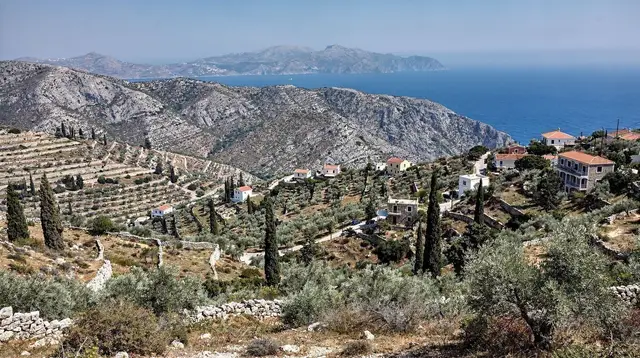
Sougia is a village worth arriving at on its own terms: a long grey-pebble beach on the Libyan Sea, a scatter of tamarisk trees along the shore, a handful of tavernas that do not change their menu to chase trends, and, a short walk inland, the quiet remains of ancient Lissos. There is no marina, no strip of bars, and nothing built in the last decade that tries very hard to impress. That is the point.
Sitting on Crete’s south-west coast in the Chania regional unit, Sougia belongs to the same stretch of coastline covered in our south-west guide to Sfakia, Loutro and the Samaria gorge, sandwiched between the mountains of the Lefka Ori and the open sea. It is reachable by road, but the road is slow, and that slowness is the main reason it has stayed the way it is.
Beyond the Third Exit from Samaria
The Samaria gorge is a one-way walk: down from Xyloskalo at Omalos to Agia Roumeli, a village with no road, so every hiker leaves by boat. From Agia Roumeli, the small south-west ferries fan out in both directions along the coast. Most hikers take the short hop east to Chora Sfakion, where the coach connection back to Chania is most direct. A smaller number continue west, past Sougia, to Palaiochora. Sougia itself sits in between as a genuine third option: a boat stop where a hiker can simply get off, rather than change boats again.
Choosing Sougia as an exit changes the day. Instead of a bus queue and a fast return to Chania, a hiker steps off the boat into a village with a beach right there, a shower of sea water instead of gorge dust, and an evening that does not need to go anywhere else. It suits travellers who would rather absorb the walk than rush from it, and who are comfortable planning their own road connection onward the next day rather than folding straight back into an organised coach transfer.
For a structured look at the walk itself before deciding where to get off the boat, see our guide to the Samaria gorge from Chania, and for hikers who only want a taste of the gorge without the full descent, the easy Samaria walk from Agia Roumeli is a different, shorter route worth knowing about, since it is often confused with the full gorge.
Travellers who prefer the boat option guided rather than self-arranged can also look at organised routes along this stretch of coast, such as a day trip along the Sfakia coast that takes in Loutro and the Glyka Nera beaches, which covers the eastern half of the same south-west shoreline that Sougia sits on the western edge of.
Ancient Lissos, a Short Walk from the Village
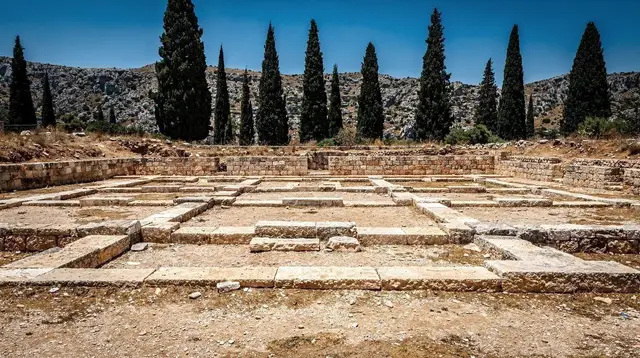
The detail that separates Sougia from a simple transit point is Lissos, a small ancient city set in a quiet valley behind the modern village. Lissos was a Dorian settlement and later flourished under Roman rule, known in antiquity for a sanctuary to Asklepios, the god of healing, where the sick would come to be treated by priest-physicians. What remains today is modest by the standards of Knossos or Phaistos: mosaic floor fragments, the outline of the Asklepion, scattered column bases and a small early Christian basilica built later on the same ground. There is no ticket booth crowd and no coach park. Most days, a visitor has the site largely to themselves.
The walk to Lissos from Sougia takes roughly 40 minutes to an hour each way, following a path that climbs gently along the coast and then drops into the valley where the ruins sit. There is no road, which is part of why the site has stayed so undisturbed, and also why it rewards an unhurried morning rather than a quick stop. Comfortable shoes and water matter here more than they would on a paved town walk, since there is no shade for long stretches and no kiosk once you leave the village.
Travellers building a themed south-west itinerary around lesser-known ancient sites and gorge walks can pair this with the guided route through the Agia Irini gorge that finishes near Sougia, which approaches the same corner of the coast from a different direction, through a gorge that is far quieter than Samaria.
Getting to Sougia, and Why the Journey Matters
There is no way around it: Sougia is not convenient to reach, and that inconvenience is exactly what has kept it from becoming another version of the north coast. By road from Chania, the drive takes roughly 1.5 to 2 hours, climbing over the mountains before descending in tight switchbacks to the coast. The road is narrow in places, and the usual etiquette on Cretan mountain roads applies: a slower car pulling briefly onto the hard shoulder to let a faster one pass is a courtesy, not an invitation to overtake blind on a bend.
Public transport exists but is thin. A KTEL bus service runs to Sougia, timed loosely around the hiking season and Samaria gorge traffic, rather than as a frequent daily service the way north-coast routes between Chania, Rethymno and Heraklion are. For background on how the island’s bus network works, and where it thins out south of the mountains, our guide to KTEL buses in Crete is a useful companion.
The boats along the coast fill some of the gap in season, connecting Sougia to Agia Roumeli, Loutro, Chora Sfakion and Palaiochora, but sailings are seasonal and can be cancelled in poor weather, so they should be treated as a plan, not a guarantee. For travellers weighing whether to self-drive this stretch or rely on transfers and boats, see renting a car in Crete and driving in Crete for the practical basics before committing to a route.
The honest summary for anyone planning around Sougia: budget real time for getting there and away, do not expect to bolt it onto a day already built around somewhere else on the island, and treat the limited connections as a reason to stay a night rather than rush through.
When to Go: Walking and Sailing Season
Sougia’s rhythm follows the same calendar as the rest of the south-west coast. The practical season runs roughly May to October, when the Samaria gorge is open, the coastal boats are running, and the village’s tavernas and rooms are operating. Outside that window, from November to March, this stretch of coast quiets down considerably: the gorge closes, boat schedules thin to almost nothing, and several businesses close for the winter. Anyone drawn here by the walk to Lissos or a Samaria exit should plan within the May to October window.
Within that season, late spring, from May into June, and early autumn, from mid-September into October, offer the most comfortable balance: the gorge is open, the sea is warming or still warm, and the village has not reached its August peak, such as it is. July and August bring the heat and the meltemi wind, which is where Sougia’s other advantage comes in.
Calmer Water When the Meltemi Blows
The meltemi, the strong north wind that picks up across Crete in July and August, is mainly a north-coast problem. It is the wind that cancels boat trips to Balos, Gramvousa and Chrissi and stirs up the sea along Chania, Rethymno and Heraklion’s beaches. The Libyan Sea coast, on Crete’s southern side and shielded by the White Mountains, is generally calmer during those same weeks. Sougia benefits from that geography: while the north coast is dealing with wind-whipped water, the swimming here is often noticeably more comfortable.
That said, “generally calmer” is not “immune.” South-west boat connections, including the ones linking Sougia to Agia Roumeli, Loutro and Palaiochora, can still be suspended in genuinely poor weather, and the meltemi can occasionally push conditions even on this side of the island. For more detail on how this wind pattern behaves and what it does to travel plans across the whole island, see Crete in July and the meltemi and the wider look at best time to visit Crete.
What Sougia Actually Offers
It is worth being direct about what a visitor will and will not find here. Sougia has a long beach of grey pebble and sand, generally uncrowded even in August by the standards of Crete’s more developed coast, with tamarisk trees offering natural shade along parts of it. It has a small, genuine village centre: a few family-run tavernas serving straightforward Cretan food, a couple of small hotels and studio rooms, a minimarket or two, and very little else in the way of built tourist infrastructure.
There is no significant nightlife, no beach clubs, no water park, and no strip of souvenir shops. Anyone picturing the atmosphere of Hersonissos, Malia or Stalida on the north coast should recalibrate: Sougia is closer in spirit to Loutro or Palaiochora than to anything on the resort coast.
Beyond the beach and Lissos, walkers use Sougia as a base for exploring nearby gorges and coastal paths, including routes toward the Agia Irini gorge inland and coastal trails along the E4 European long-distance path, which threads through this part of the south-west coast. Divers and snorkellers also find clear water here, away from the boat traffic of busier harbours. For visitors who want a guided nature walk that takes in this stretch of coastline with a swimming stop included, a guided nature walk along the south coast with a swim break in the Libyan Sea covers similar ground without requiring your own transport or route planning.
Where Sougia Fits in a South-West Itinerary
Sougia rarely works as a sole base for an entire trip, given the slow road connections beyond it, but it fits naturally into a wider loop of this coast. A common pattern pairs a Samaria gorge walk that exits at Sougia rather than Chora Sfakion, a night in the village, the walk to Lissos the next morning, and then a drive or boat onward toward Palaiochora or back north to Chania.
Travellers building a multi-day south-west route can look at our white mountains and Sfakia three-day itinerary or the broader Crete south coast six-day itinerary for how Sougia can sit alongside Frangokastello and the villages further east.
Visitors who want the broader south-coast boat network explained in one place, including which villages connect to which by sea and how reliable those links are outside peak season, will find our piece on the south coast boat network useful background before booking anything. For those weighing whether to break up the drive with an organised excursion that takes in the wilder stretches of this coast rather than self-driving every leg, a small-group tour covering the wilder parts of Crete’s south coast is worth considering.
Practical Notes
Sougia has no ATM guarantee at all times of year, so carrying enough cash from Chania or a larger town is sensible, especially outside peak season. Mobile coverage along parts of the mountain road in and out can be patchy. The beach has no organised sunbed operation on the scale of the north coast, and Greek law guarantees a free stretch and a clear corridor to the water regardless.
Tap water in the village should be treated the way it is across most of rural Crete: fine for main towns, but check locally, and bottled water is cheap and widely sold. For a general orientation to money, tipping and typical prices before a visit, see tipping, money and prices in Crete, and for a general list of what to pack for a trip that mixes gorge walking, ancient sites and swimming, see what to pack for Crete.
Anyone planning to combine Sougia with the full Samaria descent should also look at the guided Samaria gorge hiking option, which covers transport to Omalos and back from the coast, useful for travellers who do not want to arrange their own return leg after a long day’s walk.
Questions About Visiting Sougia and Lissos
Is Sougia just an exit point for the Samaria gorge?
No. Sougia does receive hikers who choose it as a boat exit instead of Chora Sfakion or Palaiochora, but it is also a destination in its own right: a quiet village with its own beach, a short walk to the ancient site of Lissos, and a genuinely relaxed pace that many visitors come back for.
How do I get to Sougia?
By road from Chania it takes roughly 1.5 to 2 hours on a winding mountain route. Sougia also has seasonal boat connections to Agia Roumeli, Loutro, Chora Sfakion and Palaiochora along the south-west coast.
Is there a bus to Sougia?
A limited KTEL service runs to Sougia, mainly in the hiking season, timed loosely around Samaria gorge traffic. It is not a frequent, all-day service like the north-coast routes, so check current timetables locally rather than assuming several buses a day.
What is ancient Lissos and how do I reach it?
Lissos was a small Dorian and later Roman-era city with a sanctuary to the healing god Asklepios. It sits in a valley behind Sougia and is reached on foot, a walk of roughly 40 minutes to an hour each way, with no road access.
Does Sougia have nightlife or big hotels?
No. Sougia is deliberately low-key: a handful of tavernas, rooms and small hotels, and no clubs or organised beach parties. Visitors looking for the resort strip of Hersonissos or Malia should look at the north coast instead.
Is Sougia calmer than the north coast in summer?
Generally yes. When the meltemi wind blows across the north coast in July and August, the Libyan Sea side of Crete, including Sougia, is usually more sheltered, though boat trips can still be cancelled if conditions turn.
How many days should I spend in Sougia?
One to two days covers the village, the beach and the walk to Lissos comfortably. Most visitors combine it with a wider south-west itinerary rather than basing an entire trip here, since the road connections beyond the immediate area are slow.
Can I visit Sougia without a rental car?
It is possible using the seasonal boats along the south-west coast and the limited KTEL bus, but options are thin outside the main hiking season. A rental car gives far more flexibility for reaching Sougia and moving on from it.