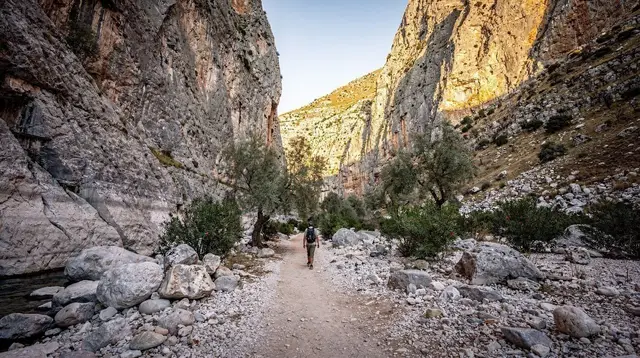
Sarakina Gorge in a Day: Is It Worth the Detour?
Is a day trip to Sarakina Gorge near Ierapetra worth it?
Yes for travellers who are already based in the south-east and want a quieter alternative to Samaria or Imbros. It sits close to Ierapetra on the Libyan Sea coast, is far less crowded than the west-side gorges, and works well paired with a town visit or a boat trip to Chrissi. A rental car is the realistic way to reach it, since the KTEL coach network thins out fast once you leave the north-coast highway.
A Quieter Walk in Crete’s Forgotten South-East
Ask most first-time visitors to name a Cretan gorge and they will say Samaria, the 16-kilometre descent from Omalos that ends with a boat because Agia Roumeli, the village at the bottom, has no road out. Some will mention Imbros, the shorter and busier alternative near Chora Sfakion. Almost none will say Sarakina, a gorge near Ierapetra on the island’s south-east coast, in the region that this guide, and the wider /things-to-do/gorge-hikes/ category, treats as genuinely under-visited compared with the west.
That obscurity is not a flaw. Crete is not a small island — the drive from Chania to Sitia alone runs to roughly 270 km and more than four hours — and no single base, however well known, covers all of it. If your trip is centred on Ierapetra, on the south-east coast, or on a longer loop through east Crete, a walk like Sarakina is worth weighing on its own terms rather than against Samaria’s reputation. This page sets out what we can say responsibly about the gorge, where it sits geographically, how to reach it safely, and where it fits alongside better-known days out from Ierapetra.
Where Sarakina Fits on the Map
Sarakina Gorge lies inland of Ierapetra, in the Lasithi regional unit that anchors Crete’s eastern end. This is the part of the island where the Lasithi plateau gives way to a drier, more open south coast, and where Ierapetra itself sits on the Libyan Sea rather than the busier north coast that runs from Chania through Rethymno to Heraklion. That distinction matters for planning a visit: the Libyan Sea side of Crete behaves differently from the north, especially in high summer.
For travellers building a longer stay in the south-east, Sarakina sits within reach of Ierapetra itself and of the excursion boats that leave for Chrissi island, the protected, uninhabited islet about 15 km offshore. It is not, however, within easy reach of the island’s other well-known gorges — Samaria and Imbros are both in the far south-west, a multi-hour drive away — so this is a walk to plan around an east-Crete stay, not to bolt onto a west-coast itinerary.
Why a Rental Car Is the Realistic Option
Crete’s coach network, run by KTEL, is genuinely usable along the north coast, where buses link Chania, Rethymno, Heraklion and Agios Nikolaos on the VOAK highway at a steady frequency. That reliability does not extend south of the mountains. Once a route leaves the VOAK and climbs into the hills — which is exactly the kind of drive that reaches a gorge like Sarakina — services thin to a handful of runs a day, sometimes none at all outside the school term or the height of summer. Details of what does and does not run are set out in /guides/ktel-buses-in-crete/.
In practice, that leaves two realistic ways to reach Sarakina: a self-drive rental car, covered in /guides/renting-a-car-in-crete/ and /guides/driving-in-crete/, or an organised excursion that includes transport from Ierapetra. A private tour such as a villages-and-gorge day out from Ierapetra solves the access problem entirely, since the operator handles the driving on roads that are narrow, occasionally unpaved, and unfamiliar to most visitors on a first trip.
For walkers who want the gorge itself to be the focus rather than one stop among several, a private trekking day that pairs Sarakina with Myrtos beach is built specifically around the walk and a coastal finish.
Mountain Driving: What Local Courtesy Actually Means
If you do rent a car for this route, the driving itself deserves a paragraph on its own. Roads into the hills behind Ierapetra, like most secondary mountain roads on Crete, are narrow, with blind bends and no real shoulder in places. Local drivers have a habit that surprises visitors: when a faster car comes up behind them, they pull partly onto the hard shoulder or verge to let it pass. It is a genuine courtesy, and returning it — moving over when it is safe and someone wants to pass — is good manners on these roads.
What it is not is an invitation to overtake blind. A car easing onto the shoulder ahead of you does not mean the road ahead is clear, and treating it as a green light on a blind bend is exactly how head-on incidents happen on roads like this. Overtake only where you can actually see the road is empty, keep your speed down on unfamiliar bends, and remember that rental insurance in Crete routinely excludes unpaved sections — worth confirming before any drive that might include a dirt track, a caution covered in more depth in /guides/mistakes-to-avoid-in-crete/.
What to Expect on the Walk
Here we want to be straightforward about the limits of what we can confirm. Crete’s major gorges — Samaria above all — have published statistics: a fixed length, a marked route, a defined hiking season set by a park authority, and a known exit. Sarakina does not have that same level of independently verified public documentation available to us, and rather than print an invented length, a made-up difficulty grade, or a specific opening season, we would rather say so plainly and point you to the people who do know the ground: a local operator, your accommodation host in Ierapetra, or a guided walk that already accounts for current trail conditions.
What we can say with confidence, because it holds across Crete’s inland gorges generally, is this: go with proper walking shoes rather than sandals, carry water, start earlier rather than later in summer heat, and treat any duration you are quoted locally as an estimate rather than a guarantee. Mountain weather and trail conditions on Crete can change a walk’s difficulty from one week to the next, particularly after rain, which is exactly why gorges with a formal season — like Samaria, which typically runs from roughly May to October and closes for flood or fire risk — publish that season rather than leaving it fixed year to year.
No Snakes to Worry About
One reassurance we can give without qualification: Crete has no dangerous snakes. The island is home to four snake species, and none of them are vipers. That holds in Sarakina Gorge as much as anywhere else on the island. It is a genuinely different situation from many Mediterranean hiking destinations, and walkers who have hesitated over gorge trails elsewhere in Europe because of snake concerns can set that worry aside here. Ordinary care on loose stone and uneven ground remains sensible, simply because any rocky trail rewards good footwear and attention underfoot, not because of what might be sharing the path with you.
When to Go: The Libyan Sea Advantage
Timing a visit to Sarakina is really a question of timing a stay in the south-east generally, and the Libyan Sea gives the south coast a real advantage over the north in the hottest months. The meltemi, the strong north wind that blows through July and August, batters the north coast and regularly cancels boat trips to west-coast destinations like Balos and Gramvousa. The south coast, sheltered from that wind by the island’s mountain spine, typically stays calmer, and the sea here runs warmer through the same period — one reason excursions to Chrissi island from Ierapetra keep running through summer even when north-coast operators are watching the forecast nervously.
For a gorge walk itself, though, warmer is not necessarily better: high summer heat makes any inland walk harder work, and an early start matters more than the calendar month. Late spring (May–June) and early autumn (September–early October) offer the general Crete-wide balance of milder temperatures, without the same north-coast wind disruption that defines a west-coast itinerary in July and August. Whichever month you choose, plan the walk for morning or late afternoon rather than the middle of a summer day.
Building a Day Around Sarakina
Because Sarakina sits close to Ierapetra rather than in one of the island’s more built-up resort areas, most visitors pair it with something else rather than devoting a full day to the gorge alone. A few practical combinations:
| Pairing | What it adds | Best for |
|---|---|---|
| Ierapetra town + Sarakina | A short town walk and a taverna lunch either side of the drive | Travellers based in Ierapetra without a fixed itinerary |
| Sarakina + Myrtos beach | Trekking finishes at the coast rather than back at the car | Walkers who want a swim to end the day |
| Sarakina as part of a villages tour | Several inland villages plus the gorge, guided, no driving required | Visitors without a rental car |
| History-and-sea day from Ierapetra | Combines inland sites with the coastline in one guided loop | A broader south-east introduction beyond one gorge |
For the villages-and-gorge pairing, a guided private day through the villages around Sarakina Gorge removes the need to plan the driving yourself, while a south Crete day mixing history and coastline works well for visitors who want the region’s broader character rather than the gorge alone.
On a day you would rather spend on the water, a Chrissi island cruise with lunch from Ierapetra is the better use of the day — Chrissi and Sarakina do not combine comfortably into one itinerary, so most visitors treat them as separate days of the same stay. Travellers who prefer an evening built around food after an active day inland sometimes choose a Cretan farm visit with a traditional dinner near Ierapetra instead.
How Sarakina Compares With Crete’s Better-Known Gorges
| Gorge | Region | What is well documented |
|---|---|---|
| Samaria | South-west, near Omalos | 16 km one-way, fixed season (roughly May–October), marked exit by boat only |
| Imbros | South-west, near Chora Sfakion | Shorter and busier than Samaria, well-marked route |
| Richtis | East Crete | A shorter waterfall hike, popular but manageable in a morning |
| Agia Irini | South-west | A gentler, well-marked alternative to Samaria |
| Sarakina | South-east, near Ierapetra | Location and access are established; length, marking and season are not independently confirmed here |
That table is deliberately honest about the gap in what we can verify for Sarakina next to the island’s headline gorges. It is not a reason to skip the walk — plenty of worthwhile trails on Crete are simply less written about than Samaria — but it is a reason to lean on local, current information (an operator, a host, a recent visitor) for the specifics of length, waymarking and season rather than trusting a fixed figure printed somewhere online.
Practical Notes for an Ierapetra-Based Visit
A few points worth keeping in mind if Sarakina is part of a wider stay in the south-east:
- Base yourself in or near Ierapetra. It puts you closest to the gorge, to the Chrissi boats, and to the region generally, rather than commuting in from the north coast.
- Confirm access and conditions locally before you go, especially outside the main summer season, since we cannot verify a fixed opening calendar for this specific gorge.
- Bring proper shoes and water, as for any Cretan gorge walk, and start earlier rather than later in the day during summer heat.
- Respect the shoulder-pulling courtesy on the drive in, but never treat it as clearance to overtake blind — confirm the road ahead is genuinely clear before you pass.
- Do not expect a KTEL bus to get you there. Outside the VOAK corridor along the north coast, the coach network is too thin to rely on for a route like this; see /guides/ktel-buses-in-crete/ for what does run.
- Pair the walk with one other activity rather than building a whole day around it alone, given how close Ierapetra, its town centre and the Chrissi boats all sit to the gorge.
Sarakina will not replace Samaria on anyone’s list of essential Crete experiences, and this page has tried not to oversell it. What it offers instead is a legitimate, quieter reason to get off the VOAK and into the hills behind Ierapetra, in a part of the island — the south-east, on the calmer Libyan Sea — that rewards a rental car, a bit of caution on the road, and realistic expectations about what is and is not documented.
Gorge Hikes in Crete on GetYourGuide
Verified deep-linked GetYourGuide tours. Book through these links and we earn a small commission at no cost to you.
GetYourGuide does not provide a product photo for this activity — the image shows the meeting point, photographed by us.