Glyka Nera and the Sfakia Beaches
How do you get to Glyka Nera beach in Sfakia?
Glyka Nera has no road. It is reached by a small boat from Chora Sfakion or Loutro, or on foot along the coastal path between the two villages. Boats run mainly from around May to October and thin out sharply outside that window.
A beach with no road, on the Libyan Sea
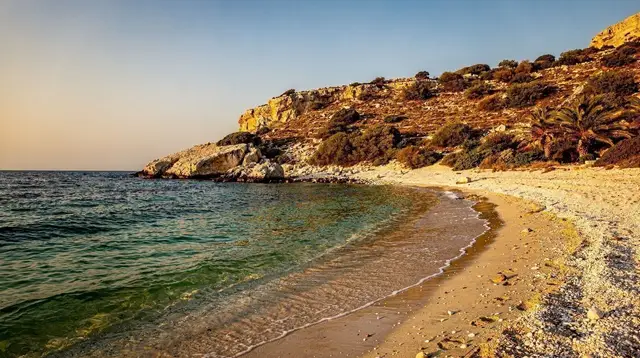
Glyka Nera, the name means sweet or fresh water, sits on the south coast of Crete between Chania Sfakion and Loutro, in the region known as Sfakia. There is no road to it, none is planned, and none has ever existed. The only ways in are a short boat ride or a coastal walk over rocky, sun-exposed ground. That single fact shapes everything about visiting this stretch of coast, more than the scenery does. This is not a first stop for a traveller building an initial itinerary around Crete’s better-known names; Crete for first-timers covers the sights most visitors prioritise before a detour this specific enters the plan.
The beach faces the Libyan Sea, the stretch of Mediterranean south of Crete that runs, with nothing but open water, toward North Africa. This matters for one practical reason: when the meltemi, a strong seasonal wind from the north, disrupts ferries and boat trips on Crete’s north coast and around islets like Balos and Gramvousa, the south coast around Sfakia is usually calmer. The meltemi peaks mainly in July and August. It is not a guarantee of calm water here, since strong wind from the south or west can still cancel a crossing, but the geography works in this coast’s favour more often than not.
Glyka Nera’s name comes from small freshwater springs that seep through the shoreline rock, noticeably cooler than the surrounding sea. Divers and swimmers who know where to look find pockets of cold, fresh water mixing with the salt water close to shore. It is a quiet detail, not a spa attraction, and most visitors come for the pebble-and-sand beach, the clear water, and the isolation rather than the springs themselves. Crete has other freshwater features worth knowing about too, inland rather than at the shore, and a guide to Lake Kournas and the Argyroupoli springs covers the island’s other notable freshwater sites for a traveller curious about the theme beyond this one stretch of coast.
Swimmers who come specifically for the freshwater pockets do better with a mask than bare eyes, since the boundary between cold fresh water and the surrounding sea is usually seen rather than felt from a distance. A broader guide to snorkelling spots in Crete covers where visibility and easy entry both work in a visitor’s favour, and for anyone tempted to go further than a mask and fins, diving in Crete lays out where dive centres actually operate, which is mostly out of Chania, Rethymno, and the north coast rather than this remote stretch of the south.
Getting there: boat, on foot, or not at all
There are exactly three ways to reach this coast, and none of them is a rental car pulling up to a beach car park.
By boat from Chora Sfakion or Loutro. Small boats run along this coast in season, connecting Chora Sfakion, Glyka Nera, and Loutro, sometimes continuing to Frangokastello. Some operate as scheduled hop-on services during the tourist season, others as organised day trips with a fixed itinerary. A boat trip is the standard way most visitors see Glyka Nera, often paired with time in Loutro.
Travellers who want a slower, more active way onto the water rather than a scheduled hop-on boat can look at sea kayaking in Crete or, for a full day afloat rather than a series of short stops, a catamaran sailing day in Crete, though neither is set up specifically for this exact stretch of coast.
a day trip from Rethymno that combines Glyka Nera beach with time in Loutro covers this exact route in one outing, useful for a traveller based in Rethymno rather than Chania.
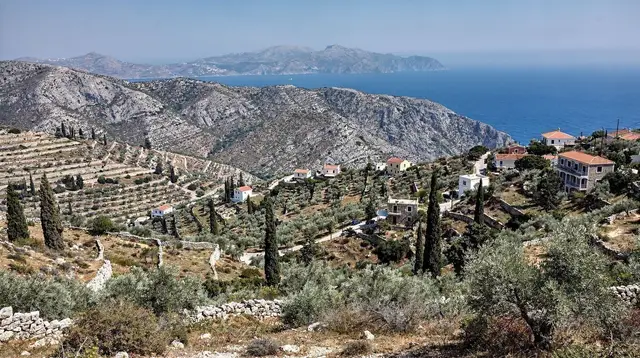
On foot along the coastal path. A trail connects Chora Sfakion, Glyka Nera, and Loutro, part of the wider E4 European long-distance path that crosses this section of the south coast. Walking Chora Sfakion to Loutro, passing Glyka Nera along the way, takes a few hours each direction over rocky, largely shadeless ground. It suits a traveller with sturdy shoes, real water supplies, and no plan to rush, not a casual beach walk in sandals. Walkers who time the trip for April or May often find the slopes above the path in bloom, a seasonal detail covered in the wider guide to wildflowers and herbs of Crete.
Not by road, and not by rental car insurance. No paved or unpaved road reaches Glyka Nera. A traveller expecting to drive down for an afternoon, the way they might reach Plakias or Damnoni further along the south coast, will not find that option here. This is the point of the place, not a gap in the infrastructure.
This coastal stretch is just one segment of a much longer network. The E4 trail across Crete continues well beyond Chania Sfakion and Loutro in both directions, and travellers who enjoy this short walk sometimes come back for a longer chunk of it another year, rather than treating it as a one-off detour. The Lefka Ori, the White Mountains that rise directly above this coast, are a different kind of walking altogether, and travellers drawn upward rather than along the shore can read about the range’s high point in Pachnes and the White Mountains.
Travellers who enjoy this kind of walking enough to want more of it can build a trip around it: the week-long Crete hiking itinerary strings together gorges and coastal paths like this one, while climbing and canyoning in Crete covers where more technical routes are actually organised, mostly away from this specific stretch of coast.
Chora Sfakion: the gateway, and Samaria’s other end
Chora Sfakion, sometimes written Hora Sfakion, is the largest village in the Sfakia region and the practical base for reaching this coast. It has a genuine road connection, over the mountains from Vrysses on the north coast, a small harbour, a handful of tavernas and rooms, and boats to Loutro, Glyka Nera, and Frangokastello.
Chora Sfakion carries a second role that surprises visitors who arrive only for the beaches. It is one of the boat destinations for walkers finishing the Samaria gorge, the 16 kilometre trail that runs one-way from the Omalos plateau down to Agia Roumeli, a village with no road of its own. Walkers cannot drive back out of Agia Roumeli.
Most take a boat, and Chora Sfakion, along with Sougia and Palaiochora, is one of the standard onward destinations, followed by a coach back over the mountains to Chania. A traveller planning a Samaria hike should read a complete Samaria gorge guide or a Samaria from Chania planning guide before assuming any particular exit point, since the boat schedule and the walker’s pace both decide it on the day.
This overlap means Chora Sfakion, in season, sees two different kinds of traveller at once: day-trippers heading out to Glyka Nera and Loutro by boat, and Samaria walkers arriving tired, sunburnt, and looking for a coach connection home. The village handles both without much fuss, but it is worth knowing which one applies to you when you plan a day here.
A traveller with a full day and a rental car, rather than a boat ticket, has another option: Frangokastello, reachable by road east of Chora Sfakion, with its own beach and a Venetian fortress, or the Imbros gorge, a shorter and gentler walk than Samaria that also ends near this coast.
Further west toward Sougia, the Agia Irini gorge hike offers a second, quieter alternative to Samaria for a traveller who has already done one gorge and wants another without the same crowds. Neither substitutes for Glyka Nera’s isolation, since both keep a road within reach, but either fills a day for someone who has already done the boat trip once and wants a different angle on Sfakia.
Loutro: the car-free village next door
Loutro sits a short boat ride or walk west of Glyka Nera, in a sheltered bay with no road access of its own, a detail covered in full in the guide to Loutro, the village with no road. Whitewashed houses run down to a calm, boat-filled harbour, and the absence of cars is not a marketing line, it is a description of daily life there. Evenings here are quiet tavernas rather than bars, and travellers expecting the busier scene covered in nightlife in Crete should look to the north coast instead.
Several boat trips pair Glyka Nera with a stop in Loutro, since the two sit close together on the same stretch of coast. Options include a Loutro and Sfakia beach tour departing from Chania, a combined day trip taking in Loutro and Frangokastello beach, and a gentler option, a relaxed tour built around time in Loutro village itself, for a traveller who wants the boat ride and the village more than an active beach day.
For a walker rather than a boat passenger, the Aradena gorge walk down to Loutro, with an optional pickup links a mountain gorge to this coast on foot, ending at sea level rather than starting there.
For a traveller with only half a day free, the choice is straightforward: take the boat. A round trip from Chora Sfakion to Glyka Nera and back covers the swim and the isolation in an afternoon. Walking the coastal path in both directions, by contrast, is closer to a full day once water breaks and photo stops are counted in, and it suits someone who wants the hike itself, not just the beach at the end of it.
A traveller weighing the two against a night in Loutro instead should also glance at the Loutro and Chora Sfakion destination overview, which lays out how the villages and the coast between them fit together as a base. Cruise passengers with a single day ashore should set expectations accordingly: one day in Crete from a cruise ship explains why standard port-day itineraries stay closer to Heraklion or Chania rather than reaching this far down the south coast.
The relative emptiness of this coast, outside the busiest hop-on boat hours, also makes it one of the more rewarding stretches on the island for landscape shots without other visitors in frame. The wider guide to photography spots in Crete touches on this same quality across other parts of the island.
Boat routes on this coast: what to expect
| Route | Typical duration | Season | Notes |
|---|---|---|---|
| Chora Sfakion to Loutro | 15-20 minutes | Roughly May to October | Also a hop-on stop near Glyka Nera |
| Chora Sfakion to Glyka Nera | 10-15 minutes | Roughly May to October | Short crossing, weather-dependent |
| Chora Sfakion to Agia Roumeli | Around 1 hour | Roughly May to October | Main exit route for Samaria walkers |
| Loutro to Agia Roumeli | 30-45 minutes | Roughly May to October | Alternative for walkers and travellers based in Loutro |
| Chania to Sfakia coast (organised day trip) | Full day | Roughly May to October | Combines road transfer and boat legs |
Treat every duration here as approximate. Small boats on open water adjust to conditions, and an operator will delay, reroute, or cancel a crossing rather than run it in unsafe swell.
When to go: the meltemi, and the season that actually operates
Roughly May to October is when this coast functions as most visitors picture it: boats running on a regular schedule, tavernas and rooms open in Chora Sfakion and Loutro, and the coastal path walkable without needing much beyond good shoes and water.
July and August bring the meltemi most strongly, a north wind that can reach a strong, persistent force. Its main damage is done on the north coast and to boat trips toward Balos, Gramvousa, and other northern crossings, covered in a guide to Crete in July and the meltemi. The south coast around Sfakia is comparatively sheltered from a north wind, which is one reason this stretch stays a viable, often calmer, alternative when the north coast churns. It is not immune to bad weather from other directions, so a cancelled or shortened crossing here in peak summer is still possible, just less likely than up north.
November to March is the honest low season for this coast, and the page will not soften that. A large share of the tavernas, rooms, and small shops along the south coast close for winter, boat schedules to Glyka Nera and Loutro reduce sharply or stop running as advertised services, and a traveller arriving expecting a same-day boat trip may simply find none operating. What stays reliably open through winter are the towns with year-round populations and road access, not the boat-only beaches. A trip planned for this period belongs with a realistic read of what actually operates in Crete in winter, not a hope that a summer schedule quietly continues at a smaller scale.
The pattern holds across the wider south coast, not just this one stretch: what actually closes in Crete in winter and how the south coast boat network works both describe the same seasonal contraction, businesses shutting and boats standing down together, that governs Glyka Nera and Loutro from November through March.
Shoulder months, roughly late April into June and September into mid-October, split the difference: most services are running, crowds are thinner, and the sea is comfortable without being at its August warmest.
For the exact weather behind these seasonal shifts, rather than a general impression, Crete weather month by month and the wider guide to the best time to visit Crete break the averages down further.
A traveller narrowing a date range around this specific trip might also check Crete in May or Crete in October directly, since both shoulder months can swing several degrees and several boat departures from one year to the next. The months in between, June and September, sit closer to peak season on this coast, with a fuller boat schedule than either shoulder edge but noticeably thinner crowds than July or August.
What closes and what doesn’t, by season
| Period | Boats to Glyka Nera and Loutro | Tavernas and rooms | Coastal walking path |
|---|---|---|---|
| May-June | Running, building toward full schedule | Mostly open | Open, pleasant temperatures |
| July-August | Running, occasional meltemi disruption elsewhere on the island | Fully open | Open, hot, limited shade |
| September-October | Running, tapering off in October | Open, thinning late in the period | Open, comfortable |
| November-March | Reduced or not operating as scheduled | Largely closed | Technically walkable, but isolated and unsupported |
Getting to Chora Sfakion in the first place
Chora Sfakion itself is reachable by road, and this is where most trips to Glyka Nera actually begin. A rental car is the practical option for most visitors, following the mountain road from Vrysses down to the south coast, a route covered in a general guide to driving in Crete and, for the rental process itself, renting a car in Crete.
For a traveller starting this trip from outside Crete rather than already on the island, getting to Crete by flight or ferry lays out the arrival options, and since Chania is the nearest airport to this side of the island, the Chania airport guide is the more relevant one to check for a Sfakia-bound itinerary.
The KTEL coach network reaches Chora Sfakion too, but this is a case where the north-south divide in Crete’s public transport matters. KTEL coaches run efficiently along the north coast, between Chania, Rethymno, Heraklion, and Agios Nikolaos. South of the mountains, including the road down to Chora Sfakion, the service thins to a small number of seasonal runs rather than a frequent timetable. A traveller relying on buses should check the current schedule directly rather than assume a north-coast frequency applies here, and should build slack into the day rather than plan a tight connection to a specific boat departure.
For a traveller weighing whether to rent a car at all for this side of the island, the comparison in rental car versus organised tours in Crete and the broader north coast versus south coast guide both address the logistics gap this region represents.
Travellers who would rather not navigate the mountain road themselves, particularly after a long day that already includes a boat crossing, can hand the driving to someone else. Private tours and drivers in Crete covers that option, including for a Sfakia day that combines the drive down with time on the water. Where to base for a trip like this is its own question, addressed in where to stay in Crete, since Chania, Rethymno, or a night in Loutro itself each change how early the day has to start. The trade-offs between the three main towns themselves are broken down in Chania versus Rethymno versus Heraklion, useful before settling on a base for a Sfakia-bound day.
Fishing, and other ways to see the coast from the water
Beyond the standard beach-hopping boats, this coast also supports smaller, slower outings. A daytime fishing trip out of Sfakia puts a visitor on the water for a different pace of day, watching the coastline from offshore rather than stepping onto each beach in turn. The wider guide to fishing trips in Crete covers where else on the island this kind of outing runs, since Sfakia is only one small piece of it. For a traveller who wants the crossing itself, not a checklist of stops, an option like a Loutro beach day trip departing from Chania keeps the itinerary simple: a boat out, time on the water and ashore, a boat back.
What to bring, and what not to expect
Facilities along this stretch of coast are minimal outside Chora Sfakion and Loutro. Glyka Nera itself has little to no permanent infrastructure, so a visitor should bring water, sun protection, and cash, and should not expect a sunbed rental, a shop, or a lifeguard at the beach itself. Shade is scarce. The pebble-and-sand mix suits water shoes for some visitors.
The absence of sunbeds here is worth noting precisely because it is the exception on Crete rather than the rule: sunbeds and your rights on Cretan beaches covers the organised beaches where paid loungers and a free access corridor are both standard, which is not the situation at Glyka Nera. Cash matters here specifically because a card reader or an ATM is not something to count on this far from a town, a detail the wider guide to tipping, money, and prices in Crete sets out in more general terms.
None of this makes the coast unsafe for a prepared visitor, but it does make it a poor fit for anyone who cannot manage rocky, uneven ground or a boat that pitches a little on open water. Accessible Crete is honest about which parts of the island suit limited mobility and which do not, and this stretch sits firmly in the harder group. Families with young children face a similar calculation, weighed more specifically in Crete with kids, which points most families toward the organised beaches instead of a boat crossing to an unsupervised cove.
The wider mistakes to avoid in Crete guide covers a related expectation gap, the assumption that a rental car reaches everywhere worth seeing, which this coast disproves directly. Packing for a day here is covered in what to pack for Crete, and anyone concerned about patchy signal or a missed connection should read safety and health in Crete before setting out.
Mobile signal along parts of this coast can be patchy, and a boat schedule is not something to gamble a flight connection against. Building a buffer day, or treating this coast as one component of a longer south-coast trip rather than a tight day-return, suits how the region actually operates. The itinerary planning in a three-day White Mountains and Sfakia itinerary or the wider six-day south coast itinerary both build in that kind of slack. A traveller building a trip mainly around beaches rather than hikes might compare the pace against a Crete beaches week itinerary, which prioritises easier access over this kind of isolation.
For a broader look at activities based around Loutro and Chora Sfakion, including hikes, boat trips, and village time beyond the beaches themselves, the things to do around Loutro and Chora Sfakion hub lists the current options in one place, and the beaches and lagoons category sets Glyka Nera alongside the island’s other boat-only and hard-to-reach stretches of coast, such as Balos and Elafonissi further west. Dia island boat trips cover a different kind of boat-only outing again, a short crossing from Heraklion rather than the longer haul down to Sfakia.
Sfakia is not the only stretch of the south coast that trades a road for a boat or a footpath. Further west, Sougia and Palaiochora sit at the edges of the same kind of coastline, each with its own boat connections and walking trails rather than a direct drive to every beach nearby. Closer to Chania, Seitan Limania and the Akrotiri coves covers a comparable case, a cove reached on foot rather than by a direct beach road, on the opposite side of the island from Sfakia. And for a traveller weighing this coast’s pebbles against the very different sand further west, the comparison in Balos versus Elafonissi makes clear how differently two celebrated Cretan beaches can behave.
Glyka Nera and the Sfakia beaches: your questions answered
Is there a road to Glyka Nera?
No. There is no road to Glyka Nera, Loutro, or most of this stretch of coast. Access is by boat from Chora Sfakion or Loutro, or on foot along the coastal path. Rental cars cannot reach these beaches directly.
Can I drive to Chora Sfakion?
Yes, Chora Sfakion has a road connection over the mountains from Vrysses and the north coast, and a car park at the village. From there onward, toward Loutro and Glyka Nera, it is boat or foot only.
Is Chora Sfakion the same place as the Samaria gorge exit?
Chora Sfakion is one of the boat destinations for walkers finishing the Samaria gorge, alongside Sougia and Palaiochora. Walkers reach Agia Roumeli on foot, since it has no road, then take a boat onward, often to Chora Sfakion, followed by a coach back over the mountains.
Do boats to Glyka Nera and Loutro run all year?
No. The regular tourist boat schedule runs roughly from May to October. From November to March, services are reduced or suspended, weather-dependent, and cannot be counted on for a same-day return.
Is Glyka Nera worth the trip?
For travellers who want a quiet, boat-only beach on the Libyan Sea with clear water and freshwater springs at the shoreline, yes. It is not the place for a traveller who wants guaranteed access, facilities, or a fixed schedule.
What does the meltemi do to boats on this coast?
The meltemi is a north wind, so it mainly disrupts crossings on the north coast and to northern islands such as Balos and Gramvousa. The south coast around Sfakia, on the Libyan Sea, is more sheltered, though strong wind from any direction can still cancel a crossing.
Are there shops or tavernas at Glyka Nera?
Glyka Nera itself has minimal or seasonal facilities at most. Loutro and Chora Sfakion have tavernas, rooms, and small shops, with more open in high season and many closing in winter.
Can I walk from Chora Sfakion to Loutro and Glyka Nera?
Yes, a coastal path connects Chora Sfakion, Glyka Nera, and Loutro, walkable in a few hours in each direction with sturdy shoes and water. It is a real hike over rocky ground, not a promenade.
Beach Tours in Crete on GetYourGuide
Verified deep-linked GetYourGuide tours. Book through these links and we earn a small commission at no cost to you.
GetYourGuide does not provide a product photo for this activity — the image shows the meeting point, photographed by us.