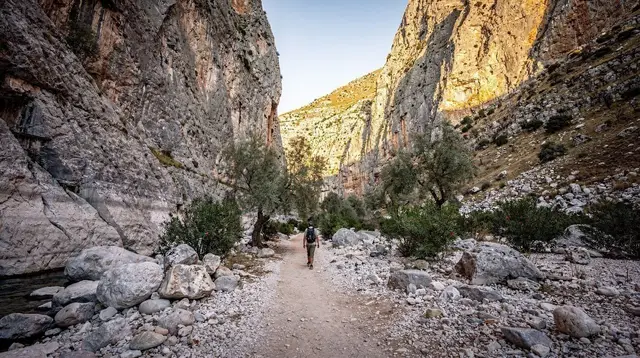
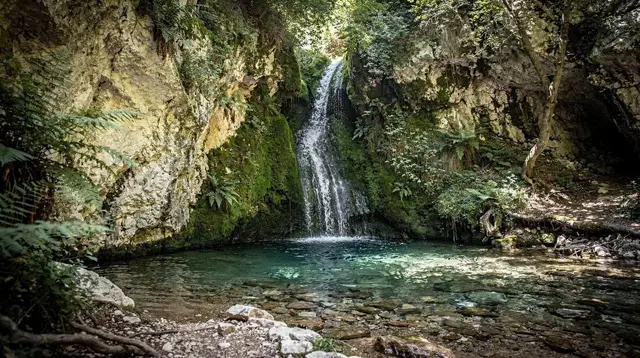
Agia Irini Gorge: A Quiet Alternative Near Sougia
Should I hike Agia Irini gorge instead of Samaria?
Agia Irini, near Sougia in south-west Crete, is a genuine option when Samaria's daily quota is full or the gorge is shut, but it is a different, shorter walk that finishes near a village with normal road access, not a like-for-like swap for Samaria's long one-way descent to a boat. We do not have a verified distance, duration or difficulty rating for Agia Irini to quote here, so treat any figure you see elsewhere with caution and confirm it locally before you set out.
Every May and June, the same message lands in Crete travel forums: the Samaria gorge quota is full for the day you wanted, or the park has closed for a flood or fire-risk alert, and the question becomes “what else is there?” In the south-west of the island, one honest answer sits above the fishing village of Sougia: the Agia Irini gorge. It is worth knowing about, and it is worth using correctly — as its own walk, not a substitute for the one everyone came for.
When Samaria Fills Up, Where Do You Go in the South-West?
The south-west corner of Crete, running from Chania down through the White Mountains to the Libyan Sea, is genuinely rich in gorge walking. Samaria gets the attention because it is the longest, the most famous and the one with a national park around it, but it is not the only cut in this stretch of limestone. Agia Irini, feeding down toward Sougia, is one of several routes locals and repeat visitors reach for when Samaria is booked out, closed for the day, or simply not what someone wants — an all-day, one-way, boat-dependent commitment is not every traveller’s idea of a good morning.
What makes Agia Irini worth naming here is its location. It sits in the same general pocket of the south-west as Sougia, Palaiochora and the boat-only villages further east, so a visitor already based in this part of the island can reach it without the long drive back north over the mountains that a Samaria day otherwise demands.
Agia Irini Gorge: What We Know, and What We Deliberately Don’t Claim
Here is where this guide has to be more careful than most. We can tell you where Agia Irini sits — above Sougia, in the hill country behind the coast — and that it is walked as a hike in its own right, sometimes paired with a visit to ancient Lissos or a swim at a quiet cove. What we will not do is invent a distance in kilometres, a walking time in hours, or a difficulty grade, because we do not have a figure for any of those that we can stand behind as accurate today.
This matters more than it might seem. Crete’s south-west gorges are not uniform, and figures for one get recycled for another across travel sites without anyone checking whether they still apply — trail conditions after a winter of rockfall or a dry summer can change a walk considerably. Rather than repeat a number we cannot verify, we would rather send you to the source that can actually confirm current conditions: a local guide, a taverna in Sougia the morning you arrive, or a guided operator running the route that day. If you see a precise distance or a “moderate, 3 hours” style rating for Agia Irini elsewhere, treat it as someone’s secondhand estimate, not a fact.
a guided walk down the Agia Irini gorge that starts and ends near Sougia is one practical way around this uncertainty: a guide who runs the route regularly knows what the path looks like this week, not what it looked like in an old blog post. There is also a version of the same idea run from Chania, combining the Agia Irini hike with time at a secluded cove afterward, for visitors based further north who want to make a full day of it rather than treat the drive down as a detour.
Sougia, the Village at the Bottom
Sougia itself is worth a few words, because it explains why this gorge sits where it does on most itineraries. It is a small, unpretentious beach village on the Libyan Sea, well off the resort circuit that runs along the north coast between Hersonissos and Malia. It has none of the scale of Chania or Rethymno, and that is more or less the point — people come here for gorge walks, quiet beach time and boat connections, not nightlife.
Sougia is also a stop on the same coastal boat line that links Agia Roumeli (the exit point for Samaria), Loutro and Chora Sfakion, all villages with no direct road access from the north. That makes Sougia genuinely useful as a base for a few days: gorge walking one day, a boat trip to a roadless village the next, and a drive over to Palaiochora or Elafonissi if the schedule allows. It is a slower, more self-directed corner of Crete than the resort towns further east.
Ancient Lissos, a Detour Worth the Extra Effort
A short walk from Sougia, along the coast rather than up into the gorge, sits the ancient site of Lissos — a modest but genuinely old settlement with the remains of a sanctuary to Asklepios, the ancient god of healing, along with a small early Christian basilica. It does not have the scale of Knossos or Phaistos, and it draws a fraction of the visitors, which is part of its appeal: you are likely to have long stretches of it to yourself.
Because Lissos sits close to Sougia rather than up in the mountains, several guided itineraries pair it with a longer day out rather than treating it as a stand-alone stop. a guided group walk out to ancient Lissos from the Sougia area covers the history alongside the walk, and for travellers who would rather set their own pace, a private guided version of the same Lissos walk is also bookable. Either way, if you are already making the trip down to Sougia for Agia Irini, Lissos is close enough to fold into the same day rather than save for a separate visit.
Why the Southwest Gorge Season Matters More Than the Gorge Itself
Whichever south-west gorge you choose — Samaria, Agia Irini, Imbros or another — the calendar matters more than most visitors expect. As a rule across Crete’s gorges, the walking season runs roughly from late April through June, and again from September into mid-October. Outside that window, conditions can turn quickly: heavy winter rain leaves loose rock and swollen streambeds, and several of these routes close outright for stretches of the year.
Late spring and early autumn are, by most measures, the better half of that window rather than the peak. By June the sea along the south coast has typically warmed to somewhere in the 21-25°C range, comfortable enough for a swim after a hot walk, and the crowds that fill the car parks and boat queues in July and August have not yet arrived. September carries the same advantage in reverse: the gorges are still open, the sea holds its warmth, and the summer crush has largely gone home. If your dates are flexible at all, this is the trade worth making — not chasing the single hottest fortnight of the year, but the shoulder weeks around it.
July and August bring their own complication that has nothing to do with the gorges directly: the meltemi, a strong seasonal wind that can cancel boat trips out to Balos, Gramvousa and Chrissi even while leaving south-coast walking largely unaffected. It is one more reason a south-west gorge day can be a sensible fallback plan when a boat-dependent excursion elsewhere on the island falls through.
No Train on This Island: Getting to an Isolated Trailhead
It is worth stating plainly, because visitors from countries with dense rail networks sometimes assume otherwise: there is no train anywhere on Crete, and there never has been. Public transport here means the KTEL coach system, which runs a genuinely useful, frequent service along the north coast highway connecting Chania, Rethymno, Heraklion and Agios Nikolaos. South of the mountains, in exactly the area where Agia Irini and Sougia sit, that network thins to a handful of seasonal, once- or twice-daily runs rather than anything you can build a spontaneous day around.
In practice, this means a rental car is the realistic way to reach an isolated south-west trailhead on your own schedule. See our guides to renting a car in Crete and driving in Crete for the practical details, and our KTEL buses guide for exactly where the coach network does and does not reach. If a rental car is not something you want to arrange, a guided operator who handles the drive as part of the trip — as with the tours already mentioned above — is the sensible alternative rather than trying to improvise with public transport that simply is not built for this corner of the island.
Mountain Roads and Who Gives Way to Whom
The road down toward Sougia, like most mountain roads in this part of Crete, is narrow, twisting and often has no real shoulder to speak of — except where one has been cut into the hillside for exactly this purpose. You will notice local drivers pulling over onto that hard shoulder to let a faster car behind them pass on a straight stretch.
This is a courtesy, a long-standing habit of driving in this terrain, and it is worth reading it correctly: it is not, and should never be treated as, an invitation to overtake blind on the next bend. Visiting drivers who mistake local courtesy for a green light on a blind corner are a recurring cause of near-misses on roads exactly like the one into Sougia. Drive to what you can actually see ahead, and let the road, not the driver in front of you, set your pace.
| Samaria | Agia Irini | |
|---|---|---|
| Where it starts | Xyloskalo, Omalos (1,227 m) | Above Sougia, south-west Crete |
| How you leave | One-way; boat from Agia Roumeli, which has no road | On foot, back toward the Sougia area |
| Supervision | Park-managed, gates and quota | Independent walking or a guided operator |
| Verified distance/duration | 16 km one-way (published park figure) | Not stated here — no verified figure to quote |
| Season | Roughly May to October, weather-dependent | Broadly the same shoulder-season window as other south-west gorges |
Agia Irini Is Not a Substitute for Samaria — Treat It as Its Own Walk
It is tempting to file Agia Irini under “the other one you do if Samaria is full,” and in a practical sense that is often exactly how it gets used. But it is worth being precise about what that means and what it does not. Samaria is a long, one-way, park-managed descent that ends at a village with no road out — Agia Roumeli — where the only way onward is a boat to Chora Sfakion, Sougia or Palaiochora, followed by a coach. It has fixed opening dates, a daily quota, and gates that close in the early afternoon. Nothing about Agia Irini works the same way, and this guide is not going to pretend otherwise by handing you a distance or difficulty figure dressed up to look comparable.
Choose Agia Irini because it suits the day you actually have — because you are already based near Sougia, because you want a shorter walk than Samaria demands, or because you would rather finish near a village with a normal road than plan around a boat schedule. Do not choose it on the assumption that it delivers “the same thing as Samaria, but easier to book.” It doesn’t, and treating two genuinely different walks as interchangeable is how people end up underprepared for whichever one they actually take.
Other Gorges Worth Knowing About in the South-West
Agia Irini is not the only fallback. Further east, near Frangokastello, the Imbros gorge is another walk regularly mentioned in the same breath as Samaria, and travellers building a longer south-west itinerary sometimes string two or three gorge days together rather than picking just one. If you want the structured version of that idea rather than assembling it yourself, a guided Imbros gorge hike combined with beach time at Frangokastello packages the walk with a swim afterward, much as the Agia Irini tours above do.
For a broader view of how these routes connect across the island, our guide to the E4 trail across Crete is a useful reference point, and our full Samaria guide, Samaria from Chania and the shorter “easy Samaria” walk from Agia Roumeli cover that gorge specifically, including the shorter version that starts from the coast rather than the top.
Before you lock in dates, it is worth reading our general notes on the best time to visit Crete and, if June is on the table, what June in particular looks like. And whichever gorge you settle on, our mistakes to avoid in Crete guide covers a handful of south-west-specific pitfalls — from underestimating driving times to assuming public transport reaches further than it does — that are worth ten minutes before you set out.
Agia Irini Gorge and Sougia: Frequently Asked Questions
Is Agia Irini gorge a good replacement for Samaria?
It is a good option, not a replacement. Samaria is a 16 km one-way descent from the Xyloskalo at Omalos to Agia Roumeli, a village with no road, so you leave by boat. Agia Irini is a shorter, more local walk near Sougia that you can reach and leave by car. Choose it because it suits your day, not because it is the same hike as Samaria.
How long is the Agia Irini gorge hike?
We deliberately do not publish a distance, duration or difficulty grade for Agia Irini in this guide, because we do not have a figure we can stand behind. Confirm current conditions locally in Sougia or with a guided operator before you go, and do not rely on secondhand numbers passed around online.
Do I need a guide for Agia Irini gorge?
You do not strictly need one, but a local guide removes the guesswork around timing, water and where the path is currently in good condition, which matters more here than at Samaria, where the route and exits are signed and patrolled.
When is the best time to hike gorges in south-west Crete?
Broadly late April to June and September to mid-October. The gorges are open and in reasonable condition, the sea has warmed to a comfortable 21-25°C by June, and the crowds of July and August have not arrived or have already thinned.
Can I reach the Agia Irini trailhead without a car?
It is difficult. Crete has no train anywhere on the island, and the KTEL coach network thins out south of the mountains to a handful of seasonal runs. A rental car is the practical way to reach an isolated south-west trailhead on your own schedule.
What is Lissos and can I combine it with Agia Irini?
Lissos is an ancient site reachable on foot from the Sougia area, and several guided itineraries pair the two in a single outing. Combining them makes sense if you want a full day out of Sougia rather than two half-hearted stops.
Is Sougia a base for other south-west excursions?
Yes. Sougia sits on the boat line that also serves Agia Roumeli, Loutro and Chora Sfakion, and it is within driving range of Palaiochora, so it works as a low-key base for several days of gorge and coastal exploring without ever setting foot in a resort strip.
Are south-west Crete’s mountain roads dangerous to drive?
They are narrow and require attention rather than speed. Local drivers often pull onto the hard shoulder to let a faster car pass; that is a courtesy, not a signal to overtake blind on a bend. Drive to the road you can see, not the one you assume is coming.
Gorge Hikes in Crete on GetYourGuide
Verified deep-linked GetYourGuide tours. Book through these links and we earn a small commission at no cost to you.
GetYourGuide does not provide a product photo for this activity — the image shows the meeting point, photographed by us.