Crete in June: Weather, Crowds and What to Expect
Is June a good time to visit Crete?
June sits in the best-balanced stretch of the year: the Samaria gorge is open, the sea is warming to around 21-25°C, and the meltemi wind that grounds boats to Balos, Gramvousa and Chrissi has not yet set in. High peaks like Psiloritis and Pachnes can still carry snow into June.
Where June Sits in Crete’s Season
Crete’s calendar has a clear shape, and June sits right at its hinge. The quiet, cool, flower-heavy stretch of April and May is ending; the crowded, hot, meltemi-blown weeks of July and August have not yet started. Most seasoned visitors and most people who live on the island will point to the run from late April to mid-June, and again to September into mid-October, as the two windows where Crete gives the most for the least compromise. June is the back half of the first window, and by its own final days it starts leaning toward summer proper.
That means June rewards a traveller who wants open gorges, a warming but not yet crowded sea, and roads and tavernas that are busy rather than overwhelmed. It also means June is not a guarantee. This guide sets out what tends to be true in June on Crete, region by region, and where the honest uncertainty lies — because no page, including this one, can promise a specific sea temperature or a rain-free week for a date months away.
Sea Temperature: Warming, Not Yet Warm
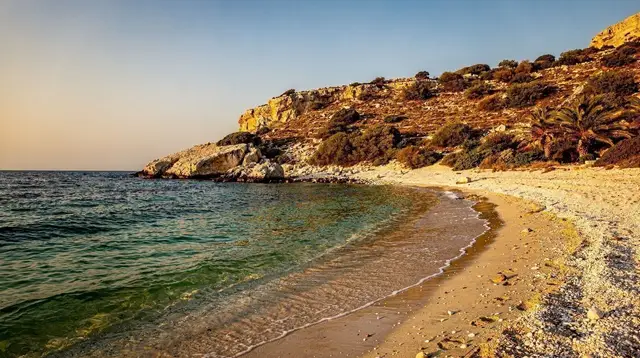
The single most-asked question about June in Crete is whether the sea is swimmable, and the honest answer is: usually, but it is still catching up with the air. Spring sea temperatures around Crete sit at roughly 16-18°C, climbing through May to about 18-21°C, and by June the water is typically in the 21-25°C range — noticeably warmer than May, still short of the 24-27°C that August and September deliver once the sea has had a full summer to absorb heat.
Two things shift that range in practice. First, timing within the month: early June often feels closer to a warm May, while the final week can already feel like July. Second, geography. The Libyan Sea on the south coast and sheltered bays generally warm faster than the open north coast, so a swim at Plakias or Matala in early June can be more comfortable than the same date at an exposed north-coast beach. None of this is a promise for a specific week — treat June as “warming reliably” rather than “guaranteed warm.”
No Meltemi Yet — Boats to Balos, Gramvousa and Chrissi Usually Run
The meltemi is a strong, dry north wind that funnels down the Aegean and, on Crete, regularly cancels the boat trips that depend on calm water: the crossing from Kissamos to the Balos lagoon and Imeri Gramvousa, and the seasonal boats out to Chrissi island off Ierapetra.
That wind is overwhelmingly a July-and-August problem — it is one of the defining features of high summer here, not of June. A full account of what it does to a trip is worth reading before a July visit, but for June the practical upshot is simpler: boats to these islands run on most scheduled days, and cancellations are the exception rather than something to plan around.
That is not the same as a guarantee of flat calm every single day. A stray windy day can still turn up in June, especially toward the Cretan Sea side, and no operator can promise a sailing three weeks out. The sensible approach for a June trip is the one Crete rewards in every season: build in a day or two of slack around a boat-dependent excursion, and confirm with the operator the morning of departure rather than assuming the forecast from a week before.
The Samaria Gorge Is Open
June falls squarely inside the operating season for the Samaria gorge, which typically runs from May to October, subject to closure for flood risk early in spring or fire risk in a dry summer. Nothing about June specifically threatens that window — if anything, June avoids both the early-season chance of a wet, swollen streambed and the late-summer fire-risk closures that can hit August and September without warning.
The mechanics of the walk do not change with the month. It begins at the Xyloskalo at Omalos, 1,227 m up, and runs 16 km one-way, entirely downhill in gradient though not in effort, to Agia Roumeli, a village reachable only by boat or on foot. From there a ferry connects onward to Chora Sfakion, Sougia or Palaiochora, and a coach takes walkers back to their starting point.
Gates close in the early afternoon regardless of season, so a June visit still means an early start, plenty of water, and sturdy shoes for the narrowest point, the Iron Gates, where walls over 300 m high pinch to a gap of roughly 3-4 m. Visitors who want the scenery without the full descent can look at the shorter walk up from Agia Roumeli instead — a genuinely different, much shorter outing under the same name.
a guided hike through the Samaria gorge takes care of the transport logistics — the early drop-off at Omalos and the coach connection back from the coast — which matters more in June than it sounds, since the one-way walk and boat-only exit leave little room for a missed connection.
Snow Can Still Sit on the High Peaks
It is easy to picture Crete in June as uniformly warm, and at sea level that is broadly fair. But Crete is a mountainous island, and its two highest points — Psiloritis, also called Mount Ida, at 2,456 m, and Pachnes in the Lefka Ori, the White Mountains, at 2,453 m — sit well above the snow line for much of the year. After a heavy winter, patches of snow can persist on their summits into June, and the trails leading up to them can still be wet, muddy or partially blocked even once the coast is firmly in beach-weather mode.
This does not affect a typical June holiday built around the coast, the old towns or the gorges — the Dikti range and the lower approach paths are generally clear well before June. It matters mainly to anyone planning a summit attempt on Psiloritis or Pachnes early in the month, who should check current trail conditions rather than assume a June date means a snow-free ridge. A broader look at snow on Crete covers how this plays out across the whole season, not just June.
Wildflowers Are Fading, Not Gone
Crete’s wildflower season is one of the island’s best-kept secrets, and it peaks earlier than most visitors expect: April and May are the strongest months, when hillsides, gorge sides and even roadside verges carry a density of colour that surprises people who associate the island only with summer beaches. By June, that display is winding down. The heat that makes the sea more inviting also dries out the meadows, and the wildflowers that dominated a few weeks earlier thin noticeably as the month goes on.
That does not mean June is bare. Flowering continues into the first half of the month in places, particularly at higher elevation where the season runs a few weeks behind the coast — the Lasithi plateau and the approaches to the high gorges can still show colour after the lowlands have browned off. Anyone whose trip is built specifically around the flowers, rather than around them as a bonus, is better served by late April or May; a full comparison of the shoulder months sets out where each one has the edge.
Crowds: Busier Than May, Lighter Than July
June’s crowd level is best understood as a gradient rather than a fixed state. The month opens closer to the quiet feel of May — old towns like Chania and Rethymno are lively rather than packed, popular beaches have room, and restaurant tables are easy to find without a booking. By the final week, especially once local school holidays begin, the volume of visitors starts to climb toward what July delivers in full: fuller car parks at Samaria, busier boats to the islands, and resort strips like Hersonissos and Malia waking up properly for the season.
The practical takeaway is to treat early and late June almost as different months when planning. A trip built around solitude and easy logistics does better scheduled for the first half; a trip that wants a livelier atmosphere, with more restaurants and beach bars open than in May, can lean into the second half without hitting the full intensity of a August. A month-by-month weather and crowd overview lays the whole calendar out side by side for comparison.
| Aspect | May | June | July-August |
|---|---|---|---|
| Sea temperature | 18-21°C | 21-25°C | 24-27°C |
| Meltemi wind | Rare | Occasional, not dominant | Frequent, can ground boats |
| Samaria gorge | Open | Open | Open, busiest |
| Wildflowers | At their best | Fading through the month | Mostly gone |
| Crowd level | Light | Light to moderate, building | Heaviest of the year |
| Mountain snow | Common on high peaks | Possible on Psiloritis and Pachnes | Rare |
What Early June Looks Like Region by Region
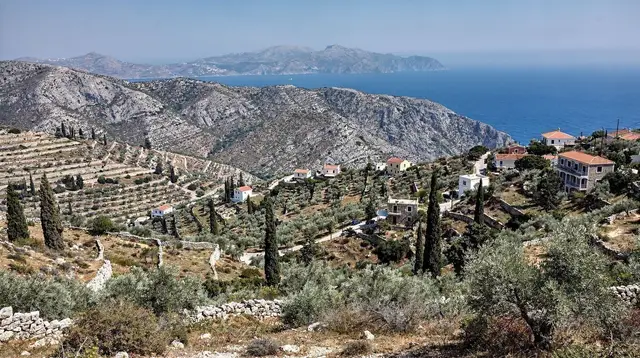
Crete’s four regional units do not move through the season in lockstep, and June highlights that. Around Chania and the west, the beach strip at Platanias and Agia Marina is filling in for the season while the Balos and Elafonissi day trips run on largely settled seas. In the mountainous south-west, the Samaria and Imbros gorges are in full swing, and boat-only villages like Loutro are pleasant without being crowded.
Around Rethymno, the old town and the Arkadi monastery sit comfortably in the mild end of the heat, while the Libyan-coast villages of Plakias and Preveli are warming their beaches ahead of the north coast. Heraklion and the centre get genuinely hot by June, which makes an early visit to Knossos — before the midday sun hits a site with almost no shade — worth planning for specifically.
Further east, Lasithi and the boats to Spinalonga run on the same settled early-summer pattern as the west, with Chrissi island off Ierapetra reliably reachable before the meltemi becomes a factor in July.
What to Do With a June Trip
June’s combination of open gorges, warming water and manageable crowds suits an itinerary that mixes hiking, coast and culture rather than settling for one. A day built around a coastal drive linking Rethymno, Chania and Lake Kournas makes sense while the light lasts long and temperatures have not yet peaked. Inland, June is a good month for a wine and olive oil tasting day around the Peza and Archanes wine villages, since the vines are green and the tasting rooms are not yet competing with peak-summer volume.
For beaches, a boat and beach day at Elafonissi avoids the mountain drive that a self-driven visit involves, and runs on the same settled June seas that keep the Balos and Gramvousa boats reliable. Evenings are where June starts to show its summer side: an off-road sunset tour into the hills behind the coast takes advantage of long June daylight without the peak-season heat haze that can dull a July or August sunset. None of these replace planning around this page’s honest limits — book with some flexibility, and check conditions close to the date rather than months out.
Getting the Timing Right
June is not a single, uniform month on Crete, and the useful mental model is a slope rather than a switch: early June leans toward the quiet, flower-fringed feel of May, and late June leans toward the busier, hotter start of summer. Anyone choosing between the shoulder months should weigh what matters most — flowers and solitude point toward May, a warmer sea and livelier towns point toward late June or into July, and either way the gorges stay open and the meltemi stays largely absent until July proper.
A broader guide to Crete’s best time to visit sets June against every other month for travellers still deciding when to go, and a look at common mistakes to avoid is worth a read regardless of season, since several of them — underestimating driving distances, assuming a boat trip is guaranteed, skipping water on a gorge walk — apply just as much in a calm June as in a windy August.
Frequently Asked Questions About Visiting Crete in June
Is the sea warm enough for swimming in June?
Yes, for most visitors, though it depends on the week. Crete’s sea typically reaches 21-25°C in June, up from the cooler 18-21°C of May and short of the 24-27°C of high summer. Early June can still feel brisk on the north coast; sheltered coves and the Libyan Sea in the south tend to warm first.
Does the meltemi affect June boat trips to Balos, Gramvousa or Chrissi?
Not usually. The meltemi, the strong north wind that regularly cancels boats to Balos, Imeri Gramvousa and Chrissi, is mainly a July-and-August phenomenon. June can still bring the odd windy day, so it is worth checking with the boat operator on the morning of departure, but cancellations are the exception rather than the rule.
Is the Samaria gorge open in June?
Yes. The gorge typically opens through the season from May to October, weather and fire risk allowing, and June sits comfortably inside that window. Expect the usual rules: an early start from Xyloskalo at Omalos, the 16 km one-way walk down to Agia Roumeli, and a boat out, since the village has no road.
Is there still snow on the mountains in June?
Often, yes, on the highest peaks. Psiloritis at 2,456 m and Pachnes at 2,453 m in the Lefka Ori can hold patches of snow into June after a heavy winter. It has no bearing on the coast, where June is reliably warm, but it explains why the high trails can still be cold, wet or blocked early in the month.
Are the wildflowers still out in June?
They are thinning rather than finished. Crete’s wildflower season runs mainly through April and May, and by June the hillsides that were carpeted in colour a few weeks earlier are drying out under the rising heat. Some flowering continues into early June, especially at altitude, but it is not the peak bloom photographers chase.
Is June crowded compared to July and August?
Noticeably less. June is busier than the quiet shoulder of April and May, but nowhere near the volume of July and August, when Cretan roads, beaches and the Samaria gorge car park are at their fullest. Expect a build-up as the month goes on, with the final week closer in feel to early July than to late May.
Do I need to book tours in advance in June?
It is sensible, though less urgent than in high summer. Popular fixed-departure activities such as a Samaria gorge hike or a boat to Balos and Gramvousa can fill on weekends, and booking a day or two ahead avoids disappointment without the weeks-out planning July and August sometimes demand.
What should I pack for Crete in June?
Light layers for daytime heat that can still cool sharply in the evening, sturdy shoes for gorge walking, a swimsuit, and sun protection, since June days are already long and strong. Anyone heading onto the high peaks should pack for cold and possible snow underfoot, not for a beach day.
Popular Crete Tours on GetYourGuide
Verified deep-linked GetYourGuide tours. Book through these links and we earn a small commission at no cost to you.
GetYourGuide does not provide a product photo for this activity — the image shows the meeting point, photographed by us.