The Lasithi Windmills That Are No Longer There
I’d seen the photograph before I’d seen Crete: a flat green basin ringed by mountains, dotted with white sails turning against the sky. It’s in half the old guidebooks and most of the tourist-board brochures for the island’s interior. So when I finally drove up onto the Lasithi plateau, I was, without quite admitting it to myself, looking for windmills. Working ones, sails and all.
I didn’t find them. What I found instead was more interesting, but it took me a while to stop being disappointed long enough to notice.
If you want the plateau’s own reference before you go — where to park, what else sits on the basin floor, how the villages connect to each other — the lasithi-plateau destination page and the A One-Day Loop Around the Lasithi Plateau guide both go further than a single explainer about missing windmills can.
What’s actually left on the plateau today
At its peak there were reportedly around ten thousand of these small canvas-sailed windmills scattered across the Lasithi basin, sitting at roughly 850 m above sea level. They weren’t decorative. Each one turned a simple pump that drew water up from the high water table beneath the plateau’s flat farmland, feeding the potatoes, apples and cereals grown here. It’s a genuinely clever piece of vernacular engineering for a place with no river and no easy access to the sea, and it ran on wind because wind was free and constant at that altitude.
It’s also, almost entirely, gone. Diesel pumps arrived in the mid-twentieth century, electric ones not long after, and a windmill with a canvas sail simply can’t compete with a switch. Farmers here are practical people working real fields, not curators of a folk landscape, so the sails came down and the metal frames were left standing, or fell, or were quietly recycled for scrap.
The villages themselves stay honest about this rather than dressing it up for visitors, which fits a wider pattern on Crete: real crafts and real calendars keep going elsewhere on the island rather than on this particular basin floor. The potters of Margarites, over in the Rethymno hills, are one example the Margarites Pottery and Cretan Crafts guide covers, and the plateau’s own saints’ days and harvest gatherings are the kind of thing the Cretan Villages and Festivals: What Traditional Life Looks Like guide is useful for if you’d rather time a visit around one than stumble into it.
What you actually see driving across the plateau today, mostly between Tzermiado, Agios Georgios and Psychro, is rusted skeletal frames without sails, some upright, some leaning, some barely there at all. A handful have been restored, repainted and re-canvassed near the main road, sails turning again for the cameras. Those are worth a photo. They are not evidence that the rest are working, and they’re not really representative of the plateau as a whole.
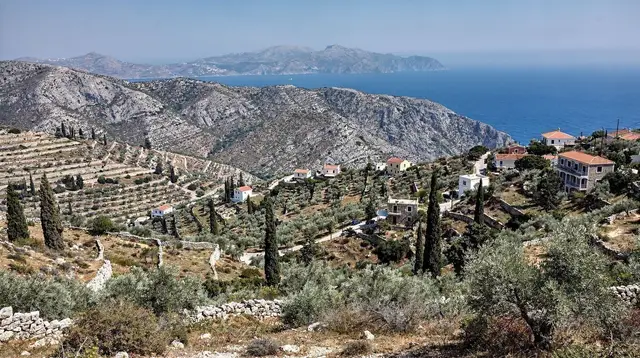
I mention this bluntly because I think the disappointment is avoidable. If you arrive expecting the brochure image, the actual Lasithi plateau reads as a letdown. If you arrive expecting a high farming basin with the remnants of an old irrigation system scattered through it, it reads as exactly what it is, and it’s genuinely worth the drive. The plateau itself, roughly circular and walled in by mountains on every side, is one of the few places on Crete where you get a real sense of interior, agricultural life rather than coastline. I’d rather send you there with the right expectation than let the postcard do the job for me.
The cave that’s actually the point
The reason most people are on this road in the first place, once the windmill disappointment settles, is the Dikteon cave above the village of Psychro. In Greek myth this is one of the places said to be the birthplace of Zeus, hidden here by his mother Rhea so his father Cronus couldn’t swallow him along with his siblings. Archaeological finds inside, including bronze votive offerings, show the cave was genuinely used as a cult site in antiquity, which is a rarer thing than a myth alone.
For the fuller practical rundown — parking, ticket prices, when the site gets busy with coach tours — the The Dikteon Cave and the Lasithi Plateau, Before You Descend guide covers ground this piece deliberately doesn’t. And if the idea of a cave with a story attached appeals beyond Psychro, Crete has two more worth comparing: Melidoni Cave: What to Know Before You Go Down near Rethymno carries its own grim wartime history rather than a mythological one, and Sfendoni Cave and Zoniana: Is It Worth the Detour? below Anogia is set up as an easier, better-lit show cave if Psychro’s slippery descent isn’t for you.
What I want to flag plainly, because it changes what shoes you should be wearing that morning, is that the descent into the cave is steep and the rock stays damp and worn smooth by generations of feet. It is not a casual, flat stroll. Sandals or anything without real grip are a bad idea here; I watched more than one visitor inch down sideways holding the rail with both hands in shoes that were fine everywhere else on the island and completely wrong for this. Give yourself 20 to 30 minutes down at an unhurried pace, more if it’s busy, and the same again coming back up. Inside, stalactites and stalagmites catch whatever light there is, and it’s cooler than the plateau above, which after a summer drive is no bad thing.
If you’re arranging your own days across the eastern side of the island, this pairs naturally with a wider loop through the plateau villages, and with a base further along the coast at Agios Nikolaos or Elounda. I’d treat the windmills as scenery you pass, not a destination in themselves, and the cave as the actual reason to make the detour.
Agios Nikolaos and Elounda both work as a base for this side of the island, and each earns more than a night’s sleep on its own account: the Agios Nikolaos and Lake Voulismeni: A Walking Base for Spinalonga guide covers the town itself, and from Elounda the boat out to Spinalonga: The Fortress That Was Never a Film Set is a far better use of a morning than a second attempt to find a working windmill.
For a structured route that ties the plateau, the cave and this stretch of coast together, the Lasithi and the East in 3 Days itinerary does the planning for you, and the longer 4 Days in East Crete: The Agios Nikolaos Loop itinerary stretches it to include Sitia if you have a spare day.
What I’d actually go up there for
Once I stopped hunting for turning sails, the plateau grew on me for reasons that had nothing to do with the photograph I’d been chasing. It’s farmed, properly and visibly, in a way most of coastal Crete isn’t. Fields of potatoes and orchards run right up to the mountain walls, stone-built villages sit at the edges rather than in the middle, and there’s a stillness to it that the resort strips further north don’t have. Local festivals and village life here still follow an agricultural calendar rather than a tourist one.
None of that was what I came for. It’s what I left remembering.
If your trip through this part of the island includes other interests beyond farmland and myth, it’s worth knowing Crete’s wartime history has its own strand of guided options on the north coast, such as a two-day Battle of Crete tour. The The Battle of Crete, 1941: Memory Near Maleme and Platanias guide covers the invasion itself in more depth than a tour description can, and it reads differently once you’ve read how villages still speak of it, which the Cretan Resistance and the War Cemeteries of Chania guide gets into properly.
Further west, a guided walk through the Samaria gorge makes a good companion day, and nearer Heraklion there’s a private day trip that takes in Knossos if the palace fits your route better than the plateau does.
If you’d rather read the details before deciding, the The Samaria Gorge: A Complete Guide sets out the one-way walk and its timing in full, and the Knossos and the Heraklion Archaeological Museum guide explains why the palace and the museum work best as a single visit rather than two separate stops. But for the plateau itself, keep the day simple: drive up, accept the windmills for what they are, and give the cave the good shoes it deserves.
Practical notes for visiting the plateau and the cave
| What | Detail |
|---|---|
| Altitude | Roughly 850 m |
| Nearest village to the cave | Psychro |
| Descent time | 20-30 minutes each way, unhurried |
| Footwear | Closed shoes with grip, not sandals |
| Best months | Late spring or autumn for the fields; avoid deep winter for snow closures |
| What’s working | A handful of restored windmills near the road only |
Two more things worth settling before you pick a date. Winter here is a genuine winter, and services thin out well past the cave itself, a pattern the Why Crete Empties in November piece covers for the island generally, while the Crete Weather Month by Month guide breaks down which months actually suit a plateau visit rather than a beach one. The climb up is manageable in an ordinary rental car, but if mountain roads on Crete are new to you, the Driving in Crete: Do You Really Need a Rental Car? guide is worth five minutes before you set off.
Before you go, it’s worth reading a proper loop route for the plateau villages, and checking what else in Crete gets misremembered from old photographs — the The Knossos Frescoes You See Are Copies piece is a fitting companion to this one — before you build your itinerary around an image rather than the place itself.
tours.Explainer
Verified deep-linked GetYourGuide tours. Book through these links and we earn a small commission at no cost to you.
GetYourGuide does not provide a product photo for this activity — the image shows the meeting point, photographed by us.