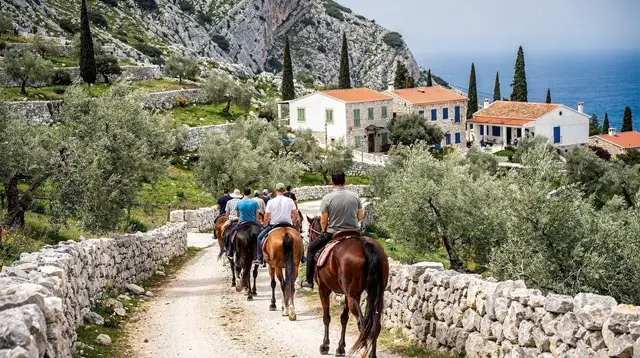
Horse Riding in Crete: Georgioupoli and Apokoronas
Where can you go horse riding near Georgioupoli in Crete?
Riding centres operate in the Apokoronas hills inland from Georgioupoli, between the coastal plain, Kalyves, Lake Kournas and the foothill villages that climb toward the White Mountains. Crete has only four snake species and none are dangerous, so trail wildlife is not a real concern on horseback. A rental car is the practical way to reach a stable, since these hills sit off the VOAK highway that the KTEL coaches serve.
Horse riding in Crete is not spread evenly across the island. It clusters in a handful of places where flat coastal ground gives way, within a short drive, to hills gentle enough to ride through and varied enough to be worth riding through — and the stretch of Apokoronas behind Georgioupoli is one of the clearest examples. This guide is about that geography: where the riding country actually sits, what the terrain and its wildlife are really like, and how to reach it, rather than a rundown of specific stables, prices or required riding levels, which change too often and too locally to state reliably here.
Where the riding country begins: Georgioupoli, Kalyves and the Apokoronas hills
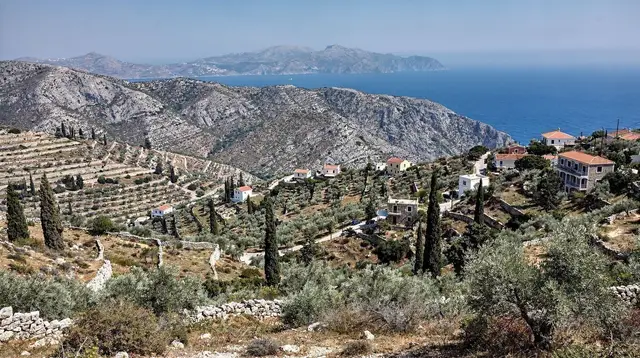
Georgioupoli is a beach resort at the mouth of the Almyros river, on the north coast roughly midway between Chania and Rethymno. It is flat, sandy and built for a beach holiday — not, in itself, riding country. What makes the wider area relevant to a horse riding trip is what sits a short drive inland: the Apokoronas district, a belt of olive terraces, low hills and scattered villages that rises gradually between the coast and the foothills of the Lefka Ori, the White Mountains.
Kalyves, a smaller coastal village a little further west toward Chania, marks the other edge of the same stretch of coast. Between Georgioupoli and Kalyves, and inland of both, the Apokoronas villages sit on ground that climbs steadily rather than dramatically — nothing like the high mountain passes further south, but enough relief to give a trail ride some variety of view and gradient that a purely coastal route would not offer.
South of Georgioupoli, Lake Kournas is the reference point most visitors already know, since it is the only natural freshwater lake on the island and a popular short excursion in its own right. It sits at the edge of the same hill country that hosts the area’s riding centres, which is one reason the lake and a ride are easy to combine into a single half-day out from the coast. Further inland again, toward Therisso and the approaches to the White Mountains, the land keeps rising into proper foothill country, though that is a longer detour than most riders staying at Georgioupoli would fit into a single outing.
The landscape: from the coastal plain to the foothills of the White Mountains
What defines this pocket of Crete, for a rider, is the speed of the transition. Within perhaps ten to fifteen minutes’ drive of the beach at Georgioupoli, the flat coastal plain — river delta, citrus groves, the last stretch of the VOAK highway before it bends toward Rethymno — gives way to olive terraces climbing a set of low hills. Keep going and the hills thicken into the kind of wooded, broken country that Crete’s interior is known for, eventually rising toward the Lefka Ori, the White Mountains that dominate the skyline of western Crete and hold snow well into late spring most years.
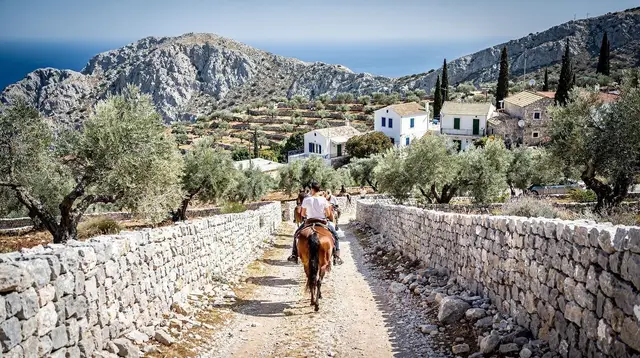
Riding centres in this area typically work the middle ground of that transition — the terraced hills and the wooded valleys above the coastal plain, rather than the high mountain itself, which belongs to hikers and the E4 long-distance trail rather than to horses.
The landscape at that level is a mix of open ground, olive groves, dry stone walls and stands of pine and cypress, with views back down over the coastal plain toward the sea on a clear day, and the White Mountains rising behind. It is quiet country — Apokoronas has none of the resort density of the strip further east around Hersonissos and Malia, and most of what you pass is agricultural land and small villages rather than any kind of tourist infrastructure.
Trail safety: what you actually meets on a Cretan path
Anyone weighing up an outdoor activity in an unfamiliar country tends to ask, sooner or later, what might actually be out there on the trail. Crete’s answer is reassuring. The island has four species of snake, and among them there is no dangerous viper — a fact that holds equally whether you are walking a gorge or riding a hill trail through Apokoronas. It is one of the more genuinely useful things to know before a trip here, since visitors from countries with a real snakebite risk sometimes carry that anxiety over without needing to.
The wildlife you are actually likely to notice on a ride through these hills is domestic rather than dangerous: free-ranging goats and sheep, their bells audible well before you see them, working dogs at the edges of villages, and birds of prey circling the thermals that rise off the warming hillsides through the morning.
Crete’s genuinely wild goat, the kri-kri, does not live in this part of the island — its last strongholds are the Samaria gorge further south and a few protected offshore islets — so it is not something to expect on an Apokoronas trail, whatever a tour description might imply. The island’s bearded vultures, similarly, hold on in the higher reaches of the White Mountains rather than the foothill country a riding centre works, though the mountains themselves are visible from up here on a clear day.
None of this amounts to a wilderness experience — Apokoronas is settled, farmed country, not backcountry — but it does mean that safety concerns specific to the terrain and its animals are minor by comparison with many other destinations that offer horse riding as a holiday activity.
a full-day horseback riding outing through the Cretan countryside, with lunch included is one way to see this landscape from the saddle rather than from a car window, and it pairs naturally with the kind of slow, inland exploring that Apokoronas rewards.
Getting there: why a rental car beats the coastal bus route
Crete’s KTEL coach network is one of the more usable rural bus systems in Greece along the north coast corridor — the VOAK, or E75, that links Chania, Rethymno, Heraklion and Agios Nikolaos. Georgioupoli and Kalyves both sit directly on that route, so reaching the coast itself by bus from any of the main towns is straightforward and frequent through the season.
The riding centres, though, are inland — up in the Apokoronas hills, off the highway and generally beyond a practical walk from the nearest bus stop. This is the point where the coastal bus network stops being useful for this particular activity: south of the main highway, KTEL service thins quickly to a handful of local runs that are not built around a tourist’s schedule.
In practice, that makes a rental car the sensible way to reach a stable from a base at Georgioupoli or Kalyves, the same as it is for reaching most of the villages, gorges and viewpoints tucked into Crete’s interior. Driving here on these secondary roads is generally easy going by comparison with the island’s mountain passes further south — Apokoronas is hill country, not high-mountain country — though the usual courtesies apply, including pulling onto the hard shoulder to let a faster local car pass on a narrow stretch.
A car also lets you build a half-day or full-day loop around a ride rather than treating it as an isolated booking: Lake Kournas, a handful of Apokoronas villages, and the coast at Kalyves or Georgioupoli are all close enough to combine in one outing.
For visitors who would rather not self-drive the inland roads at all, a private guided outing to Lake Kournas that includes transfer covers the same general area without needing a rental car of your own, and a guided 4x4 route into the White Mountains is a similar way to see the higher ground above Apokoronas without driving it yourself — see a private 4x4 safari up into the White Mountains for that option.
When to ride: choosing your months around the heat
Crete’s riding and outdoor season broadly follows the same calendar as its hiking and gorge season. Late April through June, and again in September into the first half of October, give the most workable conditions for time spent outdoors on a horse: daytime temperatures are warm rather than punishing, the countryside is still green or has cooled from the summer peak, and the hill trails are not baked hard by weeks of unbroken heat.
July and August are a harder proposition for any prolonged outdoor activity. Temperatures on the island regularly reach 30 to 35 degrees Celsius in these two months, sometimes more during a heatwave, and the inland hills of Apokoronas, while a little less exposed than the open beach strip, are not meaningfully cooler than the coast at midday. An early-morning or late-afternoon slot makes far more difference to comfort in high summer than the modest elevation gain of the foothills.
November through March is Crete’s genuine low season, when the coast stays mild but many south-coast and resort businesses close for the winter and outdoor operators scale right back. Spring wildflowers through April and May, and the settled warmth of September, are widely considered the most rewarding stretches for this kind of outdoor activity precisely because they avoid both the winter shutdown and the height of summer.
If wine is as much a draw as the ride itself, a horseback outing that combines riding with a Cretan wine tasting is worth weighing against a straightforward trail ride, and both are better suited to the cooler shoulder months than to the peak of summer.
Other ways to explore the same Apokoronas country
Horse riding is one way into this landscape, but not the only one, and it is worth knowing the alternatives if a ride does not suit everyone in your group or if you want to see more of the same hills on a different day. Cycling and e-bike routes cover some of the same terraced hill country at a different pace, and climbing and canyoning options exist further into the island’s gorge country for a more physical alternative.
A slower, less structured way to see the district is simply to drive it — the villages and festivals of inland Crete are as much a feature of Apokoronas as any single sight, and Lake Kournas and the springs around Argyroupoli make a natural stop either side of a ride.
For a broader look at the countryside beyond Apokoronas, a guided eco and nature tour from Rethymno — see an eco and nature tour that runs out of Rethymno — takes in more of the island’s rural interior for travellers who want a wider survey of the landscape rather than a single activity. Whichever combination you choose, the underlying appeal of this stretch of Crete is the same: a short drive turns a beach base at Georgioupoli or Kalyves into genuine hill country, with none of the crowding of the island’s package resorts and none of the real hazards — snakes included — that a first-time visitor might reasonably worry about.
Horse riding near Georgioupoli: your questions answered
Where exactly is the riding country around Georgioupoli?
It sits inland of the coastal resort strip, in the Apokoronas district between Georgioupoli and Kalyves on the coast, Lake Kournas just south of Georgioupoli, and a scatter of hill villages further inland toward the foothills of the White Mountains. The land shifts within a few kilometres from flat coastal plain to olive terraces and wooded hills, which is why the riding centres cluster here rather than on the beach strip itself.
Is it safe to ride here — what about snakes and other wildlife?
Crete has only four snake species and none of them are venomous vipers, so there is no dangerous snake to worry about on a trail ride here or anywhere else on the island. The animals you are more likely to notice are free-ranging goats and sheep with their bells, and birds of prey riding the thermals above the foothills. The genuinely wild Cretan goat, the kri-kri, is not found in this area — its surviving populations are restricted to the Samaria gorge and a few offshore islets.
Do I need a car to reach a riding centre from Georgioupoli?
In practice, yes. The KTEL coach network is genuinely useful along the north coast highway that runs through Georgioupoli, but the riding centres sit inland in the Apokoronas hills, off that route and beyond a reasonable walk from any bus stop. A rental car is the practical way to combine a ride with the villages, the lake and the wider Apokoronas countryside in the same day.
Can I get there by KTEL bus instead?
You can reach Georgioupoli and Kalyves by KTEL along the VOAK coastal highway between Chania and Rethymno without difficulty, since that route runs the length of the north coast. Getting from either town into the hill villages where the riding centres are based is a different matter — the inland network thins out fast, and a taxi or your own car becomes the realistic option.
When is the best time of year for horse riding in this area?
Late April to June and September into early October give the most comfortable conditions for a couple of hours outdoors, with the gorges open, the heat manageable and the countryside still green from spring or cooled after summer. July and August regularly push past 30 to 35 degrees Celsius, which makes any prolonged outdoor activity harder going, horse riding included, particularly in the exposed sections of a trail.
Is Apokoronas as hot as the coast in summer?
The inland hills sit at a modest elevation above the coastal plain, which softens the midday heat a little compared with the beach strip at Georgioupoli, but the difference is not dramatic — July and August remain the hottest, busiest months island-wide. Riding earlier in the day, in spring or in September, makes far more difference than the small change in altitude.
What else is there to do in the Apokoronas hills besides riding?
Lake Kournas, Crete’s only natural freshwater lake, sits close to Georgioupoli and makes an easy add-on before or after a ride. The hill villages around Therisso and the wider Apokoronas district also reward slower exploring by car — olive groves, small churches and the kind of countryside that the coastal resorts do not show you.
How does this area compare to riding elsewhere in Crete?
Apokoronas is one of a handful of pockets on the island where the terrain — rolling hills close to a coastal base — suits horse riding as an outdoor activity, rather than a niche pursuit you would have to travel far to find. This guide does not compare specific outfitters, prices or required experience levels between areas, since that detail changes by operator and season and is best confirmed directly once you have chosen a centre.
Horse Riding in Crete on GetYourGuide
Verified deep-linked GetYourGuide tours. Book through these links and we earn a small commission at no cost to you.
GetYourGuide does not provide a product photo for this activity — the image shows the meeting point, photographed by us.